An AI voice recorder does something an old dictaphone never could: it captures a meeting or a lecture and then hands you back a clean, searchable transcript and a tidy summary, without you replaying a single minute. But the recording is the easy part, and the cheap ones can lure you in with big storage numbers while quietly charging you for the AI that makes the gadget worth owning. We analyzed thousands of verified buyer reviews, recent sales data, and expert evaluations to find eight AI voice recorders that capture voices cleanly and turn them into text you will actually use.
Every product we compared, in ranked order. Tap through to Amazon to check today's price, or jump to the full review below.
1
Comu Action Pro
Best Overall30% OFF
Comu Action Pro AI Voice Recorder (6-Mic, 70-Hour Battery)
5.0
6-mic array · 70 hours battery · 113 languages
Our Best Overall pick: the most feature-packed Comu recorder, with a six-microphone array, a 70-hour battery and a dedicated AI button that turns a conversation into summaries, action items or even a slide deck. Basic transcription is free, but the deepest AI tools sit behind a subscription.
Comulytic Note Pro AI Voice Recorder in Black (64GB, w/ Case)
4.9
64 GB · 45 h recording · 113 languages
The black, case-included Comulytic Note Pro with unlimited free AI transcription and summaries for life, a 45-hour battery, 64 GB of storage and 113 languages, at $128.99.
Comulytic Note Pro AI Meeting Recorder (16GB, Triple-Mic)
4.8
16 GB + cloud backup · 45 h recording · 113 languages
Our Best Value pick: Comulytic's newest AI meeting recorder keeps the brand's unlimited free transcription for life and 45-hour battery, adds a triple-mic array with AI adaptive recording, and is the lowest-priced Comulytic here at $119.99.
Plaud Note AI Voice Recorder (64GB, Non-Pro Version)
4.7
64 GB · 30 h recording · 112 languages
The original credit-card AI recorder that built this category: Tom's Guide measured about 90% transcription accuracy in phone-interview testing, and it ships with a MagSafe-style case for $30 less than the Pro.
Plaud Note Pro AI Voice Recorder (64GB, 112 Languages)
4.7
64 GB · 30 h recording · 112 languages
The flagship from the category's best-known brand: a 2.99 mm aluminum card with a 4-mic AI-beamforming array, an InstantView display and transcription that expert testers measured at 95-98% accuracy.
Pocket AI Voice Recorder (64GB, Unlimited Free AI)
4.7
64 GB · 4-day battery · 120+ languages
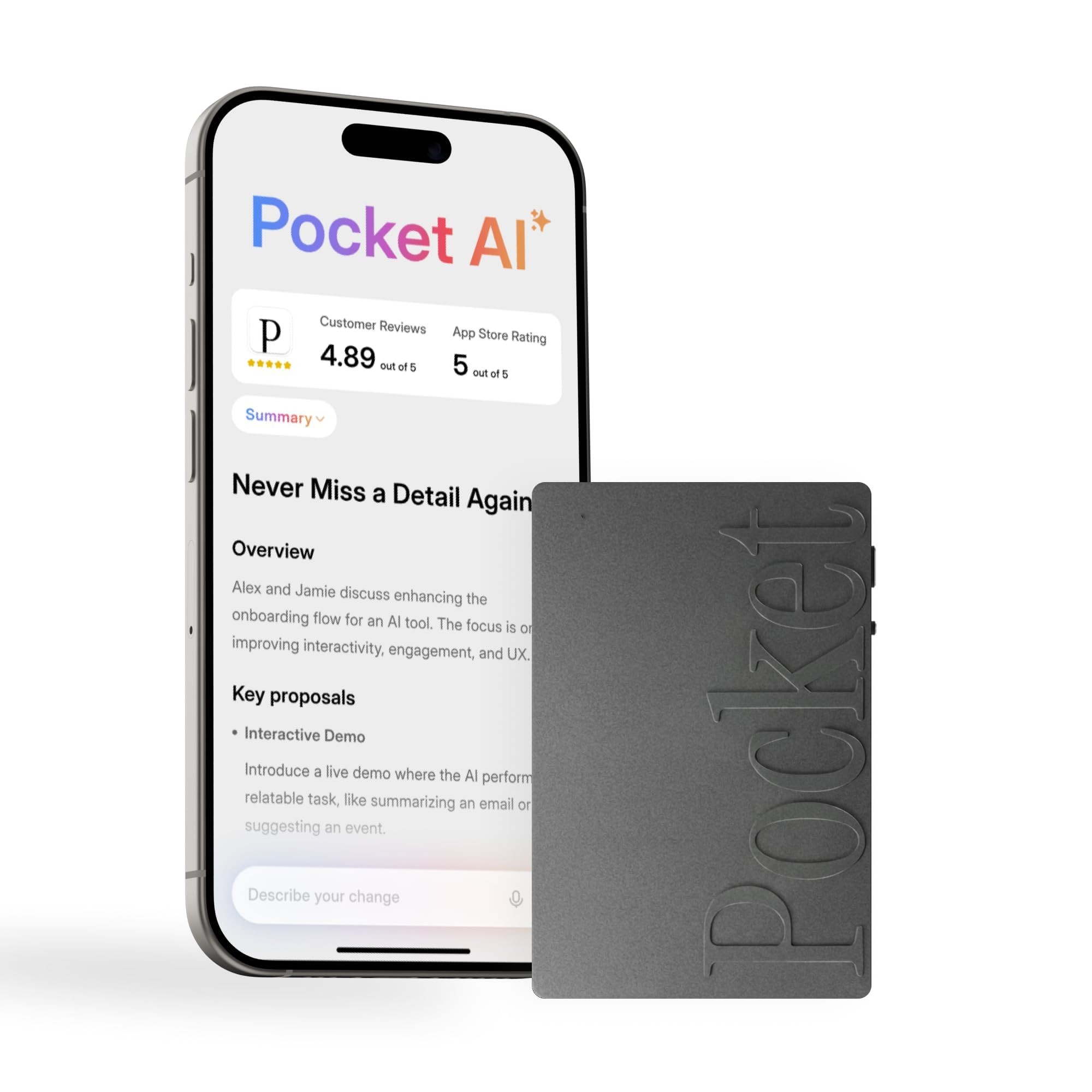
A screenless, MagSafe-compatible wearable from HeyPocket that clips to a collar and captures in-person conversations and phone calls from up to 15 meters away, with unlimited free transcription and summaries in over 120 languages.
Innioasis PR1 AI Voice Recorder (64GB, Offline AI)
4.6
64 GB · 17 h recording · 70+ languages offline
The only device in this lineup that transcribes entirely on-device: a 3.99-inch touchscreen recorder whose offline AI engine converts speech to text in 70-plus languages with no internet connection and no subscription, ever.
soundcore Work by Anker AI Voice Recorder (64GB, Find My)
4.6
64 GB · 8 h recording (32 h w/ case) · Find My support
Anker's coin-sized AI recorder in its fullest configuration: 64GB of onboard storage, support for 150+ transcription languages, and Apple's Find My network built in so the tiny disc is never truly lost.
Short on time? These three cover most buyers: our top-graded pick with the most microphones and longest battery, the best value pick with free-for-life AI at the lowest Comulytic price, and the hands-free wearable for people who talk on the move.
Best Overall
Comu Action Pro AI Recorder
Comu Action Pro AI Voice Recorder (6-Mic, 70-Hour Battery)
AI Voice Recorders 101: What They Do & How to Choose
Understand the category before you buy - what the science actually says, and which specs matter.
Every recorder here promises to transcribe and summarize, but the way they hear you and what they charge to process what they hear vary more than the marketing suggests. Here is how they work, the one cost most shoppers miss until after they buy, and the features actually worth comparing.
What does an AI voice recorder actually do?
At its simplest, one of these devices does three things in sequence:
Captures audio through a small microphone array, ideally isolating the speakers from room noise.
Uploads or processes that audio so an AI engine can convert speech to text in your language.
Returns a full transcript plus a short summary, often with action items, synced to a phone app so you can search it later.
The recording step is genuinely easy. Almost anything with a mic can store hours of sound, and these do: storage runs 64 GB on nearly every AI model here, up to 132 GB on the Elasound, which claims up to 9,800 hours of audio. Continuous battery ranges from 17 hours on the Innioasis PR1 to 100 hours on the Elasound. The hard, valuable part is everything that happens after you stop recording.
The real cost is the AI, not the recorder
Here is the thing most shoppers learn too late: a recorder's sticker price tells you almost nothing about what it costs to use. The transcription and summaries, the whole reason to buy an AI recorder, are frequently metered. Pay attention to two lines on the spec sheet.
First, is the AI free or gated? The Comulytic and Commulytic Note Pro models advertise an unlimited free transcription plan across 113 languages. The Plaud Note Pro and NotePin instead include 300 free AI minutes per month across 112 languages, and heavy users will bump into that ceiling and need a paid plan. A cheaper recorder with unlimited on-device or free-plan transcription can quietly beat a pricier one that rations your minutes, so do the math on how much you actually record before you compare prices.
Second, does it transcribe at all? The Elasound is the cautionary tale in this lineup. It offers 132 GB and 100 hours of runtime with on-device noise reduction, but no app and no transcription. It is a large, capable audio recorder, not an AI note taker, so if searchable text is the point, that storage number is a distraction.
Transcription quality itself rides on the microphone array. More and better-placed mics isolate the person talking from the hum of a room, and clean input is what lets the AI produce an accurate transcript. The Plaud Note Pro leans on this, pairing a 4-mic AI-beamforming array with transcription accuracy expert testers measured at 95-98 percent. Treat any accuracy claim as a best case in a quiet room, not a promise for a noisy cafe.
Which specs actually matter?
Once you understand that the AI is the product, a few features decide which recorder fits you:
AI plan and cost: This is the real lever. Unlimited free transcription, like the Comulytic models, versus a monthly allowance such as Plaud's 300 free AI minutes, changes the true cost far more than the hardware price does.
Language coverage: Support runs from 70-plus offline languages on the Innioasis PR1 up to 150-plus on the Anker soundcore Work, with the Plaud lineup at 112 and the Comulytic devices covering 113. If you work across languages, check that yours is on the list.
Microphone and noise handling: Cleaner capture means better transcripts. Look for a real mic array and active noise reduction rather than a single mic.
Battery and standby: Continuous recording spans 17 to 70 hours among the AI note-takers here, with the Comu Action Pro claiming 70 hours and the standard Comulytic Note Pro rated for 107 days of standby.
Form factor and weight: These range from a 16.6 g wearable capsule to a 30 g slim card to the 52 g Comu Action Pro card recorder. Pick what you will actually keep on you.
Connectivity and sync: Most sync over Bluetooth to an iOS and Android app. The Innioasis PR1 adds a 3.99-inch touchscreen for reviewing transcripts without a phone, and the Plaud Note Pro adds an InstantView display so you can confirm it is recording at a glance.
How we grade products
Graded Picks rankings are aggregated from several independent signals: verified buyer ratings and the size of the review base for credibility, recent monthly purchase volume for relevance, assessments from trusted productivity and consumer-tech publications, and how each product places in leading category lineups. For AI voice recorders we weigh:
Transcription and summary quality
AI plan value: free versus metered or subscription
Language coverage
Microphone capture and noise reduction
Battery life and storage
App reliability and sync
Form factor and overall value for the price
Consent and privacy note: Recording laws vary by place, and in many one-party and all-party consent regions you may need everyone's permission before you record a conversation or a call. Check the rules where you are, tell people when you are recording, and remember that cloud transcription sends your audio off the device to be processed. Review each app's privacy and data-retention settings, and avoid recording sensitive conversations you are not authorized to capture.
In-Depth Reviews
Everything we learned from buyer reviews and expert testing, product by product.
Comu Action Pro
Best Overall30% OFF
1. Comu Action Pro AI Voice Recorder (6-Mic, 70-Hour Battery)
5.0
Our Best Overall pick. The Action Pro is Comu's flagship recorder, and the hardware shows it: a six-microphone array (omnidirectional, directional and bone-conduction) with AI noise reduction, a claimed pickup range of up to seven meters, an OLED display, a magnetic back for MagSafe iPhones and a battery rated for 70 hours of recording, the longest of any card-style device in this comparison. Notebookcheck's real-world test with four English speakers found everyone recognized accurately with rare errors, and Cybernews and Digital Trends highlight the dedicated AI button that drafts action items, emails and presentations from a recording. Unlimited basic transcription is included at no cost, though 9to5Google concluded the device struggles to justify its full AI premium, and Cybernews and other testers point to a clumsy app, missing integrations, no way to capture web-based meetings and an advanced-AI subscription of roughly $10 to $15 a month. At $179.99 it costs more than the standard Comulytic Note Pro elsewhere in this lineup, which trades the extra mics and battery for free unlimited AI and more onboard storage, so the Action Pro suits buyers who specifically want the strongest hardware and don't mind paying for the deepest AI tools.
Storage16 GB + cloud sync
Battery (continuous recording)70 hours rated
AI transcription113+ languages, unlimited basic transcription
Six-microphone array with AI noise reduction and long pickup range
70-hour rated battery, the longest of any card-style recorder here
Dedicated AI button drafts action items, emails and slide decks
Notebookcheck's four-speaker test showed accurate speaker recognition
OLED display and magnetic back for MagSafe phone mounting
Cons
Advanced AI features need a paid plan of roughly $10 to $15 a month
Testers found the app clumsy, with missing integrations and no web-meeting capture
Costs more than the standard Comulytic Note Pro elsewhere in this lineup, with less onboard storage
Who is it for?
Our Best Overall pick for heavy meeting users who want the most microphones, the longest battery and AI document tools, and do not mind a subscription for the deepest extras.
Who is it not for?
Buyers who want fully subscription-free AI notes, who are better served by the Comulytic Note Pro.
2. Comulytic Note Pro AI Voice Recorder in Black (64GB, w/ Case)
4.9
The Comulytic Note Pro in black combines the broadest and most positive expert coverage in this lineup with a pricing model almost nobody else offers. Buy the hardware once and AI transcription and summaries are unlimited and free for life, no monthly caps and no per-minute fees, while most rivals meter you at about 300 minutes per month, a claim Forbes called genuinely rare. 9to5Mac's reviewer named it "my official sidekick for any meeting", and Cybernews, Notebookcheck, How-To Geek, Talk Android and TheReviewRewind all published broadly positive tests, with one reviewer measuring transcript accuracy at roughly 90% straight out of the box. Dual MEMS microphones plus a vibration sensor handle handset call capture, OpenAI Whisper transcription runs alongside GPT and Gemini summarization across 113 languages, and testers confirmed the 45-hour continuous recording and roughly 107-day standby claims, a class-leading battery here. This edition bundles the magnetic case and app control and keeps a full 64 GB on board, where the brand's newer triple-mic model trades down to 16 GB in exchange for unlimited cloud backup. Cybernews did flag that the device fell short of fully covering its advertised 113 languages in spot checks, and testers across the board noted that busy, multi-speaker meetings can still trip up speaker attribution. The tradeoffs: a proprietary magnetic charging cable, and garbled audio if you record phone calls through the earpiece instead of speakerphone.
Storage64 GB
Battery (continuous recording)45 hours (107 days standby)
AI transcription113 languages, unlimited free plan
ConnectivityBluetooth app sync (iOS & Android)
Weight27.6 g (0.12" thin)
In the boxRecorder, magnetic case, charging cable, OTG adapter
Warranty12-month limited
Pros
Unlimited free AI transcription and summaries for life - no subscription, ever
Broad, largely positive expert coverage across eight independent outlets
45-hour continuous recording with roughly 107 days of standby, confirmed by testers
Dual MEMS microphones plus a vibration sensor for clear handset call capture
Case and app control bundled standard in a professional black finish
Cons
Some testers found language coverage did not fully match the advertised 113-language claim
Multi-speaker meetings can still produce imperfect speaker attribution
Proprietary magnetic charging cable - lose it and you cannot charge
Who is it for?
Buyers who want a reliable mix of subscription-free AI notes, battery life and storage in this comparison, in a professional-looking black package with a case included.
Who is it not for?
Multi-speaker meeting regulars who need airtight speaker separation, and anyone who takes calls exclusively through the phone earpiece rather than speakerphone.
3. Comulytic Note Pro AI Meeting Recorder (16GB, Triple-Mic)
4.8
The newest Comulytic Note Pro is our Best Value pick: it pairs the acclaimed engine behind this brand's other two entries in this comparison - unlimited free AI transcription and summaries for life, a claim Forbes highlighted as genuinely rare in this category - with a triple-mic array and AI adaptive recording that automatically captures in-person meetings, phone calls and video conferences without switching modes by hand. Reviewers who tested the brand's Note Pro hardware measured real-world transcription accuracy around 92% in clean conditions, dropping into the high 70s in noisy rooms, findings that track closely with this model sharing the same OpenAI Whisper and GPT-based engine. It trims onboard storage to 16 GB from the 64 GB of its siblings, offsetting that with unlimited cloud backup and Wi-Fi sync that transfers files roughly 10 times faster than Bluetooth, and it keeps the same 45-hour continuous recording, 107-day standby and 90-minute fast charge that reviewers confirmed on the other Comulytic devices in this lineup. An aluminum body with a 0.78-inch display keeps status visible at a glance, AES encryption protects anything stored on the device, and a 25% discount brought it to $119.99 at our last scan - the lowest price of any Comulytic model here, and the reason it takes our value ribbon, though buyers who want 64 GB on board and a bundled case should step up to the standard Comulytic Note Pro in this lineup. The catches carried over from the rest of the family: a proprietary magnetic charging cable, and call audio that testers found can garble through a phone's earpiece rather than speakerphone.
Storage16 GB + unlimited cloud backup
Battery (continuous recording)45 hours (107 days standby)
AI transcription113 languages, unlimited free Starter plan
In the boxRecorder, magnetic case, OTG adapter, charging cable
Warranty12-month limited
Pros
Unlimited free AI transcription and summaries for life, matching its acclaimed siblings
Triple-mic array with AI adaptive recording auto-captures meetings, calls and video without switching modes
Wi-Fi sync transfers files about 10x faster than Bluetooth, backed by unlimited cloud backup
45-hour battery and 107-day standby, shared with the brand's most tested hardware
Lowest price of any Comulytic model in this comparison at $119.99
Cons
16 GB onboard storage is far behind the 64 GB of its Comulytic siblings
Proprietary magnetic charging cable, same as the rest of the lineup
Independent testing of the brand's shared engine found accuracy drops into the high 70s in noisy rooms
Who is it for?
Value-minded buyers who want the newest Comulytic hardware, hands-free adaptive capture and the same subscription-free AI as its siblings for the lowest price in the family.
Who is it not for?
Anyone who wants maximum onboard storage before relying on the cloud - the 64GB Comulytic editions elsewhere in this comparison hold more locally.
4. Plaud Note AI Voice Recorder (64GB, Non-Pro Version)
4.7
The Plaud Note is the device that made AI voice recorders mainstream, and it remains the sensible Plaud for most people. Tom's Guide tested it at roughly 90% transcription accuracy on phone interviews using GPT-4o - "extremely competent" with minimal cleanup - and TechRadar praised the build and the app's custom summary templates, which let you tailor outputs to lectures, interviews or sales calls. You get the same 112-language support and 300 free AI minutes per month as the Pro, the same 30-hour battery and 64 GB storage, and a magnetic case in the box for phone-call capture via its vibration sensor. What the Pro adds for $30 more is the 4-mic beamforming array, a status display and sharper multi-speaker separation; what the standard Note keeps is a lower price on proven hardware. Known quirks from testing: a proprietary charging cable, full dependence on the smartphone app, and AI voice enhancement that Tom's Guide found could degrade already-clear speech.
Storage64 GB
Battery (continuous recording)30 hours (60 days standby)
AI transcription112 languages, 300 free AI min/month
ConnectivityBluetooth, MagSafe-compatible case
Weight30 g (0.12" thin)
In the boxRecorder, magnetic case, magnetic ring, charging cable
Warranty1 year
Pros
About 90% transcription accuracy in Tom's Guide phone-interview testing
Custom AI summary templates adapt output to lectures, meetings or interviews
Magnetic case included for handset call recording
Years of proven real-world use - the category's original benchmark
$30 cheaper than the Note Pro with the same battery and storage
Cons
Dual mics cannot match the Pro's 4-mic speaker separation in group settings
300 free AI minutes per month before a subscription is needed
Proprietary charging cable and full reliance on the companion app
Who is it for?
Students and lecture-goers who want a proven, pocket-invisible recorder with excellent summaries at the lowest price of entry into the Plaud ecosystem.
Who is it not for?
Multi-speaker meeting regulars who will benefit from the Note Pro's beamforming array, and anyone unwilling to ever pay for AI minutes.
5. Plaud Note Pro AI Voice Recorder (64GB, 112 Languages)
4.7
The Plaud Note Pro remains one of the most thoroughly tested recorders in this comparison, backed by the broadest and most positive expert coverage in this lineup. PCWorld called the tiny recorder "brilliant", How-To Geek's tester measured transcription accuracy between 95 and 98% across varied accents, and Notebookcheck's five-speaker test produced almost no speaker misattributions - a direct payoff of the 4-mic array that builds a spatial map of the room and locks onto whoever is talking. The 2.99 mm, 30 g aluminum body attaches magnetically to a phone for call capture, the small InstantView display confirms recording status at a glance, and reviewers verified the 30-hour recording / 60-day standby battery claims. It supports 112 transcription languages with GPT and Claude-class summarization behind them. The honest catches: the free plan caps AI processing at 300 minutes per month before a subscription kicks in, charging uses a proprietary magnetic cable, and the MagSafe call-recording workflow is smoothest on iPhone.
Storage64 GB
Battery (continuous recording)30 hours (60 days standby)
AI transcription112 languages, 300 free AI min/month
ConnectivityBluetooth 5, MagSafe-compatible mount
Weight30 g (2.99 mm thin)
In the boxRecorder, magnetic case, magnetic ring, charging cable
Warranty1 year
Pros
95-98% transcription accuracy in expert testing (How-To Geek, Notebookcheck)
4-mic AI beamforming with near-flawless speaker labeling in a 5-speaker test
Premium 2.99 mm aluminum build with InstantView status display
30-hour battery and 60-day standby verified by reviewers
112 languages with strong accent handling
Cons
300 free AI minutes per month - heavy users will need the subscription
Proprietary magnetic charging cable instead of plain USB-C
Professionals whose work revolves around conversations - consultants, journalists, sales teams and founders who need the most accurate, best-built recorder available.
Who is it not for?
Occasional voice-memo takers whose phone is already enough, and subscription-averse heavy transcribers who should look at the Comulytic Note Pro's unlimited free plan.
6. Pocket AI Voice Recorder (64GB, Unlimited Free AI)
4.7
The Pocket is a newer wearable entrant built around a genuinely different pitch. Dual studio microphones plus a dedicated contact microphone for phone calls sit inside a screenless 52 g body that clips to a collar or mounts magnetically to a phone via MagSafe, so it captures a conversation the moment you clip it on with no holding or mounting required. Independent comparisons found its 15-meter (49-foot) pickup range comfortably outdistances card-style rivals, and reviewers at mrktcorrect.com and GoodDaySaver both judged it a genuine alternative to the market-leading Plaud lineup after extended daily use. The core transcription, summary and mind-map features run free and uncapped in over 120 languages, with an optional $19.99/month Pro tier unlocking AI speaker separation, more summary styles and the ability to choose the underlying AI model (including Claude Opus-class engines) behind every summary. Battery life is rated at up to 4 days per charge - well ahead of most card-shaped recorders in this comparison - and a 1.5-hour recharge over USB-C brings it back to full. As a newer, screenless design it lacks the polish and track record of the category's more established players, and reviewers note its fully cloud-dependent workflow means nothing processes on-device.
Storage64 GB
Battery (continuous recording)Up to 4 days per charge (1.5-hr recharge)
AI transcription120+ languages, unlimited free plan
7. Innioasis PR1 AI Voice Recorder (64GB, Offline AI)
4.6
The Innioasis PR1 takes a different approach from nearly every other recorder in this comparison: instead of sending audio to the cloud for processing, its built-in speech-to-text engine runs transcription on the device itself, in 70-plus languages with a claimed accuracy up to 98% in good conditions, and none of your audio needs to leave the recorder to get a transcript. A 4-plus-1 beamforming microphone array feeds that engine, a 3.99-inch touchscreen runs a full interface for reviewing and editing notes without a phone in hand, and a dedicated travel-translation mode works in both online and fully offline settings for bilingual conversations on the road. The 2,800 mAh battery is rated for 17 hours of continuous AI recording and about 30 days of standby, and 64 GB of onboard storage holds everything locally. The honest caveat: the device's AI-Do summarization layer integrates ChatGPT and Gemini for richer summaries and mind maps, so the deepest features still lean on a connection when you want them, and as a newer product line it does not yet carry the years of independent testing that the established Plaud and Comulytic hardware in this lineup have built up.
Storage64 GB
Battery (continuous recording)17 hours (about 30 days standby)
AI transcription70+ languages, fully offline on-device engine
ConnectivityBluetooth 5, USB-C, 3.5 mm audio
Weight4.72 in x 2.17 in x 0.47 in (smartphone-style touchscreen body)
In the boxRecorder, USB-C cable, 3.5 mm AUX cable
Warranty1 year manufacturer
Pros
Offline, on-device transcription in 70-plus languages - no cloud upload, no subscription required
4+1 beamforming microphone array for clearer capture in meetings and lectures
3.99-inch touchscreen runs a full interface for reviewing notes without a phone
Dedicated travel-translation mode works fully offline for bilingual conversations
64 GB of local storage keeps everything on the device
Cons
Richer AI-Do summaries and mind maps still lean on ChatGPT/Gemini connectivity for the deepest features
17-hour recording battery trails several longer-running devices in this lineup
A newer product line without the years of independent testing behind Plaud or Comulytic
Who is it for?
Privacy-conscious professionals - lawyers, journalists, researchers - who want transcription that never has to leave the device, plus offline translation for travel.
Who is it not for?
Buyers who want the most battle-tested AI engine with a long independent-review track record - the Plaud and Comulytic devices in this lineup have more history behind them.
8. soundcore Work by Anker AI Voice Recorder (64GB, Find My)
4.6
This soundcore Work configuration pairs GPT-4.1-powered transcription with a 10 g disc that clips to a collar, hangs as a necklace or snaps magnetically to a phone, and the 64GB, Find-My-equipped build is the fullest expression of Anker's coin-sized hardware. How-To Geek's tester found transcription accuracy 'a little better than expected' for structured conversations like meetings and appointments, with the dual microphones picking up clear speech within roughly a five-meter radius, while Cult of Mac and Basic Tutorials both came away positive on build quality and everyday usability. Storage jumps well beyond the entry-level soundcore configuration, language coverage reaches 150+, and Apple's Find My integration - a feature none of its rivals in this lineup offer - means a misplaced recorder can still be located from an iPhone. AES-256 encryption and SOC2 Type I certification protect anything stored on the device, and it remains a well-rounded way into this lineup's flagship AI feature set. The tradeoffs mirror the rest of the soundcore Work family: the 300 free AI minutes a month cover barely over an hour a week of transcription before a paid plan is needed, and How-To Geek found summaries of casual, unstructured conversation noticeably less useful than for structured meetings.
Storage64 GB
Battery (continuous recording)8 hours (32 hours with charging case)
AI transcription150+ languages, GPT-4.1, up to 97% claimed accuracy
ConnectivityUSB-C, MFi certified, Find My support
Weight10 g clip-on (48 g with case)
In the boxRecorder, magnetic ring, necklace chain, USB-C cable
Warranty18 months
Pros
64GB of onboard storage - well beyond the entry soundcore model's capacity
Apple Find My integration helps locate a misplaced recorder, unique in this lineup
150+ transcription languages with AES-256 encryption and SOC2 Type I certification
Coin-sized, 10 g wearable design that clips, hangs or mounts magnetically to a phone
A well-rounded entry into this lineup's flagship AI feature set, even at full price
Cons
300 free AI minutes a month is barely over an hour a week before a paid plan is needed
Casual, unstructured conversations produce noticeably weaker summaries than structured meetings
The magnetic mount can slip on thick fabric, and the experience clearly favors Apple/iPhone users
Who is it for?
Apple-ecosystem professionals who want the fullest-capacity soundcore Work - more storage, more languages and Find My peace of mind.
Who is it not for?
Android-first users, whose iPhone-tuned Find My and app experience add little value, and anyone who wants a longer battery life without a charging case, who should look at the Comulytic Note Pro's 45-hour runtime instead.
The stars you see are the Graded Picks cumulative score, not a single retailer's average. It blends verified buyer reviews aggregated across major retailers, assessments from professional reviewers and expert testers, and how prominently the product features in leading category lineups.
Advertising Disclosure
Our rankings are compiled by aggregating several independent signals, including verified buyer feedback, how popular a product currently is with shoppers, and evaluations published by professional reviewers. Editorial opinions are our own.
Please note that we participate in affiliate marketing programs. When you purchase through links on our site, we may earn a commission. As an Amazon Associate we earn from qualifying purchases. This comes at no additional cost to you and helps support the resources required to provide valuable content.