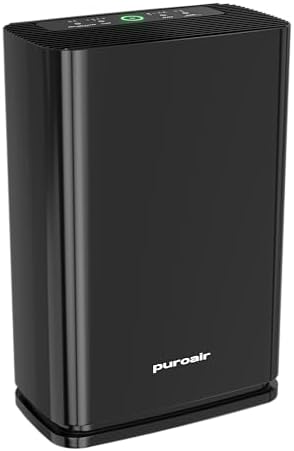
A good air purifier quietly pulls pollen, smoke, dust, and pet dander out of the air all day, and you stop noticing it until allergy season reminds you why it is there. But the coverage number on the box is the most misleading spec in the category, and buying by it alone is how people end up with a unit too small for the room. We analyzed thousands of verified buyer reviews, recent sales data, and expert evaluations to find six air purifiers that clean real rooms at a real rate, not just on paper.
Every product we compared, in ranked order. Tap through to Amazon to check today's price, or jump to the full review below.
1
PuroAir 240 2-Pack
Best Overall12% OFF
PuroAir 240 HEPA 14 Air Purifier, 2-Pack (1,000 Sq. Ft. Each)
5.0
1,000 sq ft x2 · HEPA 14 · 22 dB sleep
Our Best Overall pick: a two-pack of PuroAir's flagship HEPA 14 purifier, enough to treat two rooms at once. Each unit covers 1,000 sq ft, pairs HEPA 14 with CarbonTech activated carbon for odors, idles at 22 dB on sleep mode, and adds an air quality sensor with auto mode. CARB, ETL and UL certified, with a 2-year warranty.
The large-room flagship of the PuroAir range: HEPA 14 filtration rated for 2,000 sq ft, a sensor-driven auto mode, and a $15 coupon stacked on a 20% discount at our last scan.
Blueair Blue Pure 311i Max Smart Air Purifier (465 Sq. Ft.)
4.8
465 sq ft · HEPASilent · 23-50 dB
An expert-validated, near-silent purifier recommended by Wirecutter and CNET, both AHAM Verifide and Energy Star certified. Its HEPASilent filtration cleans a 465 sq ft room roughly five times an hour from just 23 dB.
Blueair Blue Pure 511i Max Smart Air Purifier (237 Sq Ft)
4.8
237 sq ft · HEPASilent · 19-42 dB
Blueair's compact small-room sibling to the 311i Max above, with the same electrostatic HEPASilent filtration and Wi-Fi app control in a smaller tower rated for real coverage around 237 sq ft. RTINGS and Consumer Reports both cover it, backed by a whisper-quiet 19 dB low setting.
Levoit's AHAM Verifide mid-size smart purifier, with 254 CFM dust CADR confirmed by independent testing and a 3-stage filter that pairs particle capture with activated carbon. An air quality sensor and VeSync app add auto, sleep and pet modes for bedrooms and pet-owning households.
An Auto-Clean pre-filter clears itself of fur on its own, and dual sensors are tuned specifically to detect heavy pet-hair events rather than just general dust. AHAM Verifide certification backs up its published CADR figures.
Understand the category before you buy - what the science actually says, and which specs matter.
Every purifier advertises a big coverage figure, a HEPA filter, and a quiet sleep mode, but those claims hide how the machines are rated and where the real running cost lives. Here is how they work, the coverage trick almost everyone falls for, and the specs that decide whether a unit fits your room.
What does an air purifier actually do?
An air purifier uses a fan to pull room air through one or more filters, then pushes the cleaned air back out. Do that enough times an hour and airborne particles and odors drop steadily. Most units here use the same core stages:
A pre-filter that catches large debris like hair and lint, often washable, as on the MOOKA and BLUEAIR.
A HEPA or HEPA-grade filter that traps fine particles: pollen, dust, smoke, and dander.
A layer of activated carbon that adsorbs gases and smells, which particle filters cannot touch.
A sensor-equipped model reads the air continuously and, in auto mode, speeds up when it gets dirty and idles when it is clean.
The coverage number hides how often the air actually gets cleaned
That headline figure, whether it is the BLUEAIR at 2,107 sq ft or the PuroAir 400 at 2,000 sq ft, is almost always quoted at just one air change per hour. One change an hour barely keeps a room fresh, and is nowhere near enough for allergies, smoke, or heavy dust, where you want four to five changes an hour so the whole room cycles through the filter every twelve to fifteen minutes.
Cleaning the same room that much more often means the same unit covers only about a fifth of the advertised space, which is why the honest brands print both numbers. The BLUEAIR is the clearest example: it lists 2,107 sq ft at one change per hour, but only 465 sq ft at roughly five changes. The Blueair 511i Max does the same, advertising 1,138 sq ft while independent testing puts its dependable coverage closer to 237-465 sq ft. Read the smaller number. If a listing gives you only the big figure, assume real allergy-grade coverage is closer to a fifth of it, as with the MOOKA KJ190H's 2,200 sq ft claim, better read as roughly 440 sq ft of honest coverage.
The clean way to compare across brands is CADR, the clean air delivery rate, or a coverage figure stated at four to five changes per hour. Match that honest number to your actual room, confirm the filtration pairs true HEPA with activated carbon since HEPA alone does nothing for odor, then weigh the replacement filter cost as the real long-term expense.
Which specs actually matter?
Once you read the honest coverage number, a few features decide the rest:
Real coverage at four to five air changes: Size to this, not the headline. A few hundred square feet at that rate suits a bedroom or office; for a larger open space, look to a unit with a higher rated coverage like the PuroAir 400.
True HEPA grade: Look for an explicit true-HEPA rating, such as HEPA 14 on the PuroAir 240 and 400. A vaguer "HEPA-grade" label is fine but less strictly defined than a numbered HEPA class.
Activated carbon: This is the odor and gas stage. Every unit here includes some, from the BLUEAIR's carbon layer to PuroAir's CarbonTech. If smoke or cooking smells are your problem, do not skip it.
Sensor and auto mode: A built-in air quality sensor plus auto mode, found on the MOOKA KJ190H and both PuroAir 240 and 400, lets the unit match its speed to the air.
Sleep noise: For a bedroom, quiet matters. This lineup runs from about 22 dB on the PuroAir units up to 50 to 58 dB at full speed.
Replacement filter cost: HEPA and carbon filters are consumable and typically need replacing every several months, so factor the ongoing price, not just the sticker price.
Power draw: A purifier often runs around the clock, so low wattage adds up. These range from 7.8 watts on the Blueair to 80 watts on the PuroAir 400, with a couple Energy Star certified.
How we grade products
Graded Picks rankings are aggregated from several independent signals: verified buyer ratings and the size of the review base for credibility, recent monthly purchase volume for relevance, assessments from trusted home and air-quality publications, and how each product places in leading category lineups. For air purifiers we weigh:
Real coverage at four to five air changes per hour
Filtration quality: true HEPA grade plus activated carbon
Sensor accuracy and auto-mode behavior
Noise on sleep and low settings
Replacement filter cost and energy use for around-the-clock running
Overall value for the price
Maintenance note: A purifier only works if its filter is clean, so keep the air intake clear, rinse or vacuum any washable pre-filter on schedule, and replace the HEPA and carbon filters when the indicator says so. A clogged filter chokes airflow and quietly cuts the air changes you are actually getting.
In-Depth Reviews
Everything we learned from buyer reviews and expert testing, product by product.
PuroAir 240 2-Pack
Best Overall12% OFF
1. PuroAir 240 HEPA 14 Air Purifier, 2-Pack (1,000 Sq. Ft. Each)
5.0
Our Best Overall pick. The PuroAir 240 two-pack pairs a HEPA 14 filter with PuroAir's CarbonTech activated carbon layer, removing up to 99.99% of airborne pollutants as verified by an ISO 17025-accredited lab. An air quality sensor drives the auto mode, and a mindbodygreen editor's test measured sleep mode at about 37 dB - below the 40 dB threshold sleep experts flag as disruptive. Buying two units solves the most common purifier mistake, expecting one machine to treat a whole floor: run one in the bedroom and one in the living area. The honest caveats: genuine replacement filters run about $75 per two-pack, and value-focused testers like HouseFresh argue that cheaper units deliver similar raw airflow per dollar. It was 12% off at our last scan, and PuroAir backs each unit with a 2-year warranty.
Coverage (advertised)1,000 sq ft per unit (sold as a 2-pack)
FiltrationHEPA 14 + CarbonTech activated carbon
Noise level22 dB on sleep mode
Power draw22 watts
Dimensions (D x W x H)8.5" x 8.5" x 14.25" (7.3 lbs each)
Controls & featuresAir quality sensor, auto mode, child lock, timer
Warranty2 years
Pros
CARB, ETL and UL certified
HEPA 14 + activated carbon, ISO 17025 lab tested
Near-silent 22 dB sleep mode (~37 dB editor-measured)
Air quality sensor with auto mode and child lock
Two units cover two rooms at once; 2-year warranty
Cons
Genuine replacement filters cost about $75 per two-pack
Value-focused testers argue cheaper rivals match its raw airflow
1,000 sq ft per-unit claim assumes a light one-air-change clean
Who is it for?
Households that want to treat two rooms at once - bedroom plus living area - with the category's proven crowd favorite and its strongest certification stack.
Who is it not for?
Single-room buyers (the Shark Compact Pro below costs far less) and spec-per-dollar maximizers who want an AHAM-verified CADR before spending this much.
2. PuroAir 400 HEPA 14 Air Purifier (2,000 Sq. Ft.)
4.9
The PuroAir 400 is our Best for Large Rooms pick: the single-unit answer for open floor plans, basements and shared family spaces, with one tower rated for 2,000+ sq ft instead of two smaller machines. It uses the same lab-tested HEPA 14 plus CarbonTech combination as the 240 - capturing up to 99.99% of pollutants down to 0.3 microns - scaled up with more airflow, and reviewers found it noticeably reduced airborne particles in a 400 sq ft test room within a few hours. The air quality sensor drives auto mode, and child lock, timer and filter indicator round out the controls. Where it differs from the 240: a deeper 80-watt maximum draw without an Energy Star badge, a 35 dB sleep mode that is audible where the smaller units are not, and a 14.7 lb body you will park rather than carry. At our last scan it had the best deal in the lineup - 20% off plus a $15 coupon.
Coverage (advertised)2,000 sq ft
FiltrationHEPA 14 + CarbonTech activated carbon
Noise level35 dB on sleep mode
Power draw80 watts (maximum)
Dimensions (D x W x H)8.1" x 14.4" x 21.5" (14.73 lbs)
Controls & featuresAir quality sensor, auto mode, child lock, timer
3. Blueair Blue Pure 311i Max Smart Air Purifier (465 Sq. Ft.)
4.8
The Blue Pure 311i Max brings the deepest expert résumé in this comparison: recommendations from Wirecutter and CNET, an AHAM Verifide CADR, Energy Star certification, and hands-on tests from Consumer Reports, TechGearLab, TechHive and HouseFresh - whose lab measured a PM1 CADR around 220 CFM and clocked it clearing particles faster than Dyson's far pricier Big+Quiet. Blueair's HEPASilent design pairs electrostatic charging with mechanical filtration, so it moves serious air from a whisper-quiet 23 dB low speed while sipping under 10 watts. A particle sensor drives auto mode, the app adds Alexa and Google control, the pre-filter is washable, and registration extends the warranty to 3 years. Two honest caveats: HouseFresh measured a loud 57.7 dBA at top speed, and the 2,107 sq ft number in the listing is a one-air-change figure - Blueair itself sizes it at about 465 sq ft for real cleaning.
Coverage (advertised)465 sq ft (~5 air changes/hr); 2,107 sq ft (1x)
Whisper-quiet 23 dB low speed drawing under 10 watts
Particle sensor auto mode plus app, Alexa and Google control
Warranty extends to 3 years with registration
Cons
Loud at top speed - 57.7 dBA in HouseFresh's testing
2,107 sq ft headline is a one-air-change figure; it is a 465 sq ft unit
Costs well over the Shark Compact Pro, the budget pick in this lineup
Who is it for?
Allergy sufferers and bedroom users who want one of the most expert-validated purifiers in this lineup, near-silent night operation and verified performance numbers.
Who is it not for?
Whole-floor and basement buyers who need more than ~465 sq ft of real coverage, and budget shoppers - the Shark Compact Pro below costs far less.
4. Blueair Blue Pure 511i Max Smart Air Purifier (237 Sq Ft)
4.8
The Blue Pure 511i Max is Blueair's small-room take on the HEPASilent formula already proven by its 311i Max sibling above, scaled down to a slim tower for bedrooms, home offices and dorms. RTINGS and Consumer Reports both include it in their testing lineups, and independent CADR figures cluster in the 125-175 CFM range for smoke, dust and pollen, translating to reliable coverage of about 237 sq ft in 12.5 minutes even though the box tops out at a 1,138 sq ft one-hour figure. Reviewers consistently single out the low-speed noise: 19 dB, quieter than a library, climbing to a still-modest 42 dB on high. The Blueair app adds scheduling and Welcome Home geofencing that starts cleaning before you walk in the door, and a washable pre-filter keeps upkeep simple. The honest trade-off flagged by testers is a thinner activated-carbon layer than dedicated odor-control units, so it handles dust, pollen and pet dander well but is a weaker choice against heavy cooking or smoke odors. It was 15% off at our last scan, and Blueair's standard warranty runs 1 year, extendable to as much as 5 years with product registration.
Coverage (advertised)1,138 sq ft (one air change/hr); ~237 sq ft at 5 changes/hr
5. Levoit Vital 200S-P Smart Air Purifier (1,875 Sq. Ft.)
4.7
The Vital 200S-P is back in this lineup as one of its strongest all-around performers: Levoit's AHAM Verifide mid-size smart purifier, and independent lab testing confirms the numbers on the box: 254 CFM for dust, 250 CFM for smoke and 289 CFM for pollen, figures Consumer Reports and RTINGS both verified rather than took on faith. In RTINGS-style testing it drove PM1 to zero in just 23 minutes at top speed, and still hit zero in 46 minutes on a much quieter second-speed setting - real-world proof the numbers translate into performance. HouseFresh rates it excellent value at its price point next to purifiers costing twice as much, crediting a genuinely capable air quality sensor, washable pre-filter and the VeSync app's auto, sleep and pet modes. The catch some testers flag: the particle and carbon media are bonded into one cartridge, so once the carbon layer exhausts around the 12-month mark you replace the whole filter even if the HEPA-grade media still has life left, and the optical air quality sensor needs periodic wiping to stay accurate. It carried a limited-time deal discount at our last scan, and Levoit covers it with a 1-year warranty that extends to 2 years on free registration.
Coverage (advertised)1,875 sq ft (AHAM CADR real coverage ~380-465 sq ft)
RTINGS-style testing drove PM1 to zero in under 25 minutes at top speed
Air quality sensor plus VeSync app auto, sleep and pet modes
Washable pre-filter extends the life of the particle and carbon media
HouseFresh rates it exceptional value against pricier smart purifiers
Cons
Bonded filter cartridge - the whole thing needs replacing once the carbon layer is spent
Optical air quality sensor needs regular wiping to stay accurate
1,875 sq ft headline is a one-air-change figure; real coverage is closer to a mid-size room
Who is it for?
Buyers who want independently verified CADR numbers, smart-home automation and a strong expert track record in a mid-size room.
Who is it not for?
Buyers who want a filter system that never needs full replacement, and anyone treating a genuinely large open floor plan beyond a single mid-size room.
The Vital Pet Pro is the pet-focused pick in this lineup, with engineering that goes beyond a simple washable filter: Auto-Clean technology periodically clears the pre-filter of fur on its own, and a wide U-shaped air inlet is rated to capture 99% of floating pet hair within 1.4 feet of the intake. Dual sensors distinguish heavy pet-hair events from routine dust and ramp fan speed accordingly, while a high-carbon filter layer targets litter box and pet odor specifically rather than general household smells. AHAM Verifide certification independently backs its CADR figures - 148 CFM smoke, 152 CFM dust and 163 CFM pollen - putting real third-party numbers behind the marketing claims, and it runs at just 21dB on its lowest setting for overnight use. Levoit backs it with a 2-year limited warranty. It's rated for fast, 4.8-air-changes-per-hour cleaning in a 229 sq ft room, extending to 1,100 sq ft at a slower single air change per hour. As Levoit's newest pet-specific model, its auto-clean maintenance and dual-sensor design are genuine advances for heavy-shedding households, even with a shorter independent review history than some established rivals.
Coverage area (advertised)229 sq ft (fast clean); 1,100 sq ft (single air change)
The stars you see are the Graded Picks cumulative score, not a single retailer's average. It blends verified buyer reviews aggregated across major retailers, assessments from professional reviewers and expert testers, and how prominently the product features in leading category lineups.
Advertising Disclosure
Our rankings are compiled by aggregating several independent signals, including verified buyer feedback, how popular a product currently is with shoppers, and evaluations published by professional reviewers. Editorial opinions are our own.
Please note that we participate in affiliate marketing programs. When you purchase through links on our site, we may earn a commission. As an Amazon Associate we earn from qualifying purchases. This comes at no additional cost to you and helps support the resources required to provide valuable content.