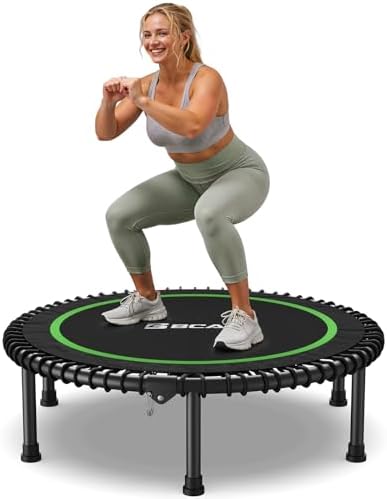
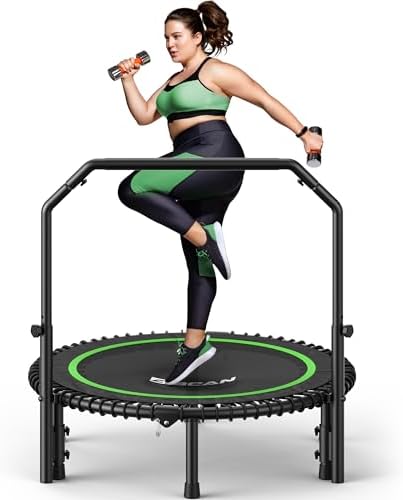
A rebounder turns a few square feet of floor into low-impact cardio you can do while a show plays in the background. But not every mini trampoline bounces the same way, and the wrong one can be jarring on your knees or loud enough to annoy the room below you. We analyzed thousands of verified buyer reviews, recent sales data, and expert evaluations to find eight BCAN rebounders that give you a soft, quiet bounce and stay stable underfoot.
Every product we compared, in ranked order. Tap through to Amazon to check today's price, or jump to the full review below.
1
BCAN BT2 Handle-Free
Best Overall Black Friday Deal27% OFF
BCAN BT2 40-Inch Rebounder (Handle-Free)
5.0
40-inch frame · 450 lb capacity · Handle-free
This version strips the handlebar from the 40-inch BT2 entirely, leaving the same reinforced frame and bungee system for users who do not need a rail to balance. Removing the handle also shaves a little off the price and the footprint when folded.
The SP2 is BCAN's entry point into rebounding, using traditional galvanized springs instead of bungee cords to hit a lower price without giving up an adjustable handle. It folds to about a quarter of its working size, which makes it easy to tuck away in a closet between workouts.
BCAN BT2 40-Inch Rebounder with Adjustable Handle Bar
4.8
40-inch frame · 450 lb capacity · Bungee cords
The 40-inch BT2 shrinks the brand's flagship design into a footprint that fits in a bedroom corner or apartment living room without losing the adjustable handlebar. Thirty-two bungee cords and a thickened alloy frame carry the same low-impact bounce as the larger BT2 at a lower price.
The BT2 48-inch pairs a thickened alloy frame with a three-point reinforced handlebar that adjusts across three heights, so it stays steady whether a user is 5 feet tall or well over 6. Bungee cords replace springs for a quieter, lower-impact bounce that suits daily cardio in a living room or bedroom.
The BT3 trades a round frame for a 51-inch octagonal platform, giving it the largest jumping area in BCAN's lineup and making it a natural fit for a dedicated home gym corner. A four-level handlebar and a stainless steel frame round out a build meant to stay put through repeated daily sessions.
The SP3 is nearly identical to the SP2 but swaps the foam T-handle for a U-shaped grip that some users find more comfortable to hold with both hands. It shares the same spring-based bounce and folding frame, aimed at buyers who prioritize storage and price over the bungee system.
The BT4 Soft Land Pro is BCAN's premium rebounder, built around a one-piece 16-gauge steel chassis and two swappable sets of latex bungee cords that let users dial in six tension levels. It is the most expensive model in the lineup, aimed at buyers who want the softest possible landing and room to progress as fitness improves.
The BT8 pairs a 51-inch hexagonal frame with a 40-inch diagonal jump mat, advertised to open up roughly a third more landing room than a standard round mat. Natural latex bungee cords replace springs for a quiet, joint-friendly bounce, and the whole unit folds flat in one step for storage under a bed or in a closet.
Short on time? These three cover most buyers - our top-graded pick, the higher-capacity 48-inch bungee build for home gyms and multi-person households, and the best value pick for tight budgets.
Understand the category before you buy - what the science actually says, and which specs matter.
Every rebounder promises a fun, joint-friendly workout, but the feel of the bounce and how much noise it makes come down to what is holding the mat up. Here is how a rebounder works, why the suspension type matters more than almost any other spec, and the features actually worth comparing.
What does a rebounder actually do?
A rebounder is a small trampoline built for exercise rather than tricks. You step onto a taut mat suspended inside a round or octagonal frame, and the mat flexes and rebounds with each step, jog, or jump. That gives you a cardio workout while the surface absorbs most of the shock a hard floor would send straight into your joints.
It gives you low-impact cardio in a small footprint, so it fits in a living room or spare corner.
Many models fold down for storage and travel, and the lightest here weighs about 17 pounds.
An adjustable handle bar adds a point of balance for warming up, steady-state bouncing, or older users.
Why the suspension type decides your whole workout
This is the one thing most shoppers overlook. A rebounder is only as good as what suspends the mat, and there are two approaches: elastic bungee cords or steel coil springs. BCAN builds most of its lineup around bungee cords, and that choice changes how the whole thing feels.
Bungee cords give a soft, deep, near-silent bounce that is gentler on the knees and ankles, which is exactly what you want for sustained low-impact cardio. The bungee BT2 and BT4 models are engineered specifically for quiet indoor use, cutting jump noise well below spring-based designs. Steel springs, by contrast, are firmer and louder. The spring-based SP2, SP3, and T-handle models here use 32 steel coil springs and deliver a snappier, more traditional trampoline feel.
Either way, the suspended mat is doing the real work: it absorbs the landing your joints would otherwise take. So the smart move is to pick your suspension for the feel you want, then match the diameter and weight capacity to your body and your space. If balance is a concern, an adjustable stability bar helps beginners and older users stay steady while they build confidence.
Which specs actually matter?
Once you know how the bounce is generated, a few features decide which rebounder fits you:
Suspension system: This is the feel lever. Choose bungee cords, like the BT2, BT4, and BT3, for a soft and quiet bounce; choose the 32-spring SP models for a firmer, springier feel.
Diameter: Mat size runs from 40 inches up to 48 inches on BCAN's larger BT2 frames. A larger mat gives you more room to move and land with confidence.
Weight capacity: Static ratings range from 330 lbs on the spring SP models to 550 lbs on the 48-inch BT2. Pick a capacity with comfortable headroom over your body weight so the bounce stays consistent.
Handle bar: Options run from no handle at all on the frame-only BT2, to fixed-choice foam and T-shape and U-shape bars with 3 to 4 adjustable height levels, some reaching from about 2 feet 6 inches up to 3 feet 5 inches. A handle helps with balance and lets you push harder without worrying about your footing.
Foldable design and weight: Several models fold for storage, and item weight ranges from about 17 lbs to 34 lbs, which matters if you plan to move or stow it often.
Bungee configuration: On the BT4, the dual-tension bungees (32 at 8mm plus 22 at 9mm) are mixable, so you can tune the bounce firmer or softer to taste.
How we grade products
Graded Picks rankings are aggregated from several independent signals: verified buyer ratings and the size of the review base for credibility, recent monthly purchase volume for relevance, assessments from trusted fitness publications, and how each product places in leading category lineups. For BCAN rebounders we weigh:
Suspension type and bounce quality
Noise level during use
Mat diameter and jumping area
Weight capacity and stability
Handle bar design and adjustability
Foldability and storage footprint
Overall value for the price
Safety and setup note: A rebounder is only as safe as its setup, so make sure the frame is fully assembled and the mat tension is even before your first bounce, and give yourself clear space overhead and on all sides. If you are new to rebounding, recovering from injury, or on the older side, start with a model that has an adjustable handle bar and hold it until your balance is steady, and check with a healthcare provider before starting any new exercise routine.
In-Depth Reviews
Everything we learned from buyer reviews and expert testing, product by product.
BCAN BT2 Handle-Free
Best Overall Black Friday Deal27% OFF
1. BCAN BT2 40-Inch Rebounder (Handle-Free)
5.0
The handle-free BT2 shares its 32mm thickened alloy frame, 450-pound static capacity, and 32-cord bungee system with the standard handlebar version, just without the handlebar and its mounting hardware. BCAN markets this configuration toward users who already have rebounding experience or plan to use the trampoline for free-form cardio and light strength work where a handrail would get in the way. The bungee cords are the same 1.2mm thickened type used across the BT2 range, tested to more than 30,000 jumps, and the frame keeps the same 10-turn thread reinforced legs for stability. Without a handlebar to fold or detach, setup is slightly faster than the handled version, and the finished unit has one less part that can loosen over time. It is best suited to buyers who have already used a rebounder and know they will not want the extra balance support.
Frame diameter40 inches
Weight capacity450 lb static
Suspension32 premium bungee cords
HandlebarNone
Frame material32mm thickened alloy steel
Rebounder weight17.3 lb
AssemblyAbout 60% pre-assembled, 10 minutes
Pros
Same reinforced frame and 450-pound capacity as the handled BT2 40-inch
No handlebar hardware means one less part to loosen or adjust over time
Slightly lower price than the equivalent handled version
Open layout suits free-form cardio and strength moves
Bungee cords tested to more than 30,000 jumps
Cons
No handrail for balance, which is a step back for beginners
Harder to add balance support later without buying a separate handlebar
Smaller 40-inch surface than the BT3 octagonal or 48-inch BT2
Who is it for?
Experienced rebounder users who do not need a handrail and want to save a little on price.
Who is it not for?
First-time users or anyone recovering from injury who benefits from a handlebar for balance.
2. BCAN SP2 40-Inch Rebounder with Adjustable Foam Handle
4.9
The SP2 uses 40 galvanized steel springs rather than BCAN's bungee system, a design choice that keeps manufacturing cost down and brings the price below every bungee-based model in the lineup. The foam-grip handlebar adjusts across four heights from about 2 feet 6 inches to 3 feet 5 inches, and the frame is ASTM approved with a one-year warranty on parts and labor. At 330 pounds of rated capacity and 26 pounds of unit weight, the SP2 is built for lighter, more occasional use than BCAN's bungee rebounders, but the non-slip PP mat and alloy steel frame still hold up to regular cardio sessions. It folds to under a quarter of its unfolded footprint, which suits anyone who needs to store it under a bed or in a closet rather than leave it set up permanently. For shoppers mainly comparing spring noise and price rather than chasing the softest possible landing, it is the simplest way into the BCAN catalog.
Frame diameter40 inches
Weight capacity330 lb
Suspension40 galvanized steel springs
Handlebar4-level adjustable foam, 2'6" to 3'5"
Frame materialAlloy steel
Unit weight26 lb
Warranty1 year, parts and labor
Pros
Lowest price point in the BCAN rebounder lineup
Adjustable foam handle spans four heights, from 2'6" to 3'5"
Folds to under a quarter of its unfolded size for easy storage
ASTM approved with a one-year parts-and-labor warranty
Non-slip PP mat holds up to regular indoor use
Cons
Spring-based bounce is noisier than BCAN's bungee-cord models
330-pound capacity is the lowest of any product in this lineup
Lighter 26-pound build feels less planted underfoot than the BT-series rebounders
Who is it for?
Budget-focused buyers who want a basic adjustable-handle rebounder without paying for bungee cords.
Who is it not for?
Heavier users or anyone who wants the quietest possible bounce, both better served by a bungee-based BT model.
3. BCAN BT2 40-Inch Rebounder with Adjustable Handle Bar
4.8
The 40-inch BT2 uses the same 32mm thickened alloy frame and 10-turn thread reinforced legs as its 48-inch sibling, scaled down to a 450-pound static capacity and a jumping surface just under 30 inches wide. Thirty-two premium bungee cords, tested by BCAN to withstand more than 30,000 jumps, replace springs for a softer landing that the brand says absorbs much of the shock before it reaches the joints. The handlebar carries over the M-shaped reinforcement plates and locking screws from the 48-inch model and adjusts across three heights from about 2 feet 7 inches to 3 feet 2 inches. BCAN ships the unit roughly 60 percent pre-assembled, so most owners are jumping within 10 minutes of opening the box. The smaller 40-inch diameter trades some jumping room for a footprint that fits more easily into a bedroom, apartment, or shared living space than the 48-inch version.
Frame diameter40 inches
Weight capacity450 lb static
Suspension32 premium bungee cords
Handlebar3-level adjustable, 2'7" to 3'2"
Frame material32mm thickened alloy steel
Rebounder weight17.3 lb
AssemblyAbout 60% pre-assembled, 10 minutes
Pros
Compact 40-inch footprint fits bedrooms and apartments better than the 48-inch BT2
Same reinforced handlebar design as the larger BT2, rated for three height levels
Bungee cords are tested to more than 30,000 jumps for long-term durability
Thickened alloy frame keeps the 450-pound capacity despite the smaller size
Mostly pre-assembled out of the box, with setup in about 10 minutes
Cons
Smaller jumping surface than the 48-inch BT2 or the BT3 octagonal
450-pound capacity is lower than the 48-inch BT2's 550-pound rating
No octagonal or extra-large frame option at this size
Who is it for?
Shoppers who want the BT2's handlebar and build quality but need a smaller footprint.
Who is it not for?
Taller or heavier users who should size up to the 48-inch BT2 for the higher weight capacity.
4. BCAN BT2 48-Inch Rebounder with Adjustable Handle Bar
4.7
The BT2 48-inch builds on BCAN's original rebounder with a 32mm thickened alloy frame and support legs reinforced with ten-turn threads, giving it a 550-pound static weight capacity. In place of metal springs, 11 to 13 premium bungee cords with a 350-strand latex core absorb the bulk of each landing, which keeps the bounce quiet enough for apartment use and easier on knees and ankles than a hard floor. The handlebar locks into three heights from about 2 feet 7 inches to 3 feet 2 inches and is braced with M-shaped reinforcement plates, so it does not wobble under load the way lighter handrails do. A 16-strand nylon-stitched PP mat covers the jumping surface, and the unit arrives roughly 60 percent pre-assembled, so most owners finish setup in about 10 minutes. The frame folds down to a fraction of its working footprint for storage against a wall or in a closet.
Frame diameter48 inches
Weight capacity550 lb static
Suspension11-13 latex bungee cords
Handlebar3-level adjustable, 2'7" to 3'2"
Frame material32mm thickened alloy steel
Jump mat16-strand nylon-stitched PP
AssemblyAbout 60% pre-assembled, 10 minutes
Pros
Thickened alloy frame and reinforced legs support up to 550 pounds
Bungee cords give a quieter, lower-impact bounce than spring-based rebounders
Handlebar locks into three heights and stays rigid thanks to M-shaped bracing
Arrives mostly pre-assembled, with setup taking about 10 minutes
Folds down for storage in a closet or against a wall
Cons
48-inch footprint needs more floor space than the 40-inch BT2
Handlebar adds bulk that some users remove once they build confidence
Bungee cords are rated for high-volume use but are not user-replaceable with standard springs
Who is it for?
Shoppers who want the largest, most stable BT2 platform with a handlebar for balance during longer cardio sessions.
Who is it not for?
Anyone with limited floor space, who should look at the 40-inch BT2 instead.
The BT3 is built around a 51-inch octagonal, stainless steel frame, a shape BCAN chose specifically to maximize usable jumping area over a standard round mini trampoline. Forty quiet bungee cords, upgraded to 8mm thickened latex, replace springs entirely, and BCAN ships about half of them pre-installed to cut setup time to roughly 10 minutes with the included tools. The handlebar adjusts across four levels, from about 2 feet 6 inches to 3 feet 5 inches, through an upgraded stability armrest structure, so it suits a wider range of user heights than BCAN's 3-level handles. At 450 pounds of static capacity and 12.5 kilograms of frame weight, it is built sturdier than the brand's standard 40-inch models despite folding down for storage between sessions. The larger surface and dedicated-home-gym framing make it the pick for anyone setting aside permanent floor space for cardio equipment rather than tucking a rebounder away after each use.
Frame shape51-inch octagonal
Weight capacity450 lb static
Suspension40 quiet 8mm bungee cords
Handlebar4-level adjustable, 2'6" to 3'5"
Frame materialStainless steel
Frame weight12.5 kg
AssemblyAbout 50% pre-installed, 10 minutes
Pros
Largest jumping surface in the BCAN lineup thanks to the 51-inch octagonal frame
Stainless steel construction resists corrosion better than painted alloy frames
Four-level handlebar fits a wider range of heights than BCAN's standard 3-level design
Quiet 8mm bungee cords keep bounce noise low for shared living spaces
Ships about half pre-installed, so full setup takes roughly 10 minutes
Cons
Octagonal footprint takes up more floor space than a round 40-inch rebounder
Priced above most of BCAN's 40-inch models
Handlebar height tops out lower than the BT4's premium bracket
Who is it for?
Anyone dedicating a permanent corner of a home gym to a rebounder and wanting the largest jumping surface BCAN makes.
Who is it not for?
Renters or small-space users who need a compact rebounder that tucks away easily.
The SP3 carries over the SP2's 40-inch round frame, 32 high-strength springs, and alloy steel construction, with the main difference being a U-shaped handle instead of a straight T-bar. BCAN says the U-handle's wider grip gives a steadier two-handed hold for users working on balance, and it still adjusts across three levels from about 32 to 42 inches. At roughly 12.27 kilograms, the frame is light enough to fold down to a quarter of its working size and move between rooms, and BCAN ships it about 80 percent pre-assembled with a step-by-step video to keep setup near 10 minutes. The 330-pound capacity matches the SP2, so it targets the same lighter-use buyer rather than competing with the BT-series bungee rebounders on durability. The U-handle's main appeal is ergonomics rather than a higher weight rating or a quieter bounce.
Frame diameter40 inches
Weight capacity330 lb
Suspension32 high-strength springs
Handlebar3-level adjustable U-handle, 32" to 42"
Frame materialAlloy steel
Frame weight12.27 kg
AssemblyAbout 80% pre-assembled, 10 minutes
Pros
U-shaped handle offers a wider, two-handed grip than a straight T-bar
Folds to a quarter of its working size for easy storage
Ships about 80 percent pre-assembled with a step-by-step setup video
Lightweight alloy steel frame is easy to move between rooms
Priced close to BCAN's most affordable model
Cons
Spring-based bounce is noisier than BCAN's bungee-cord rebounders
330-pound capacity trails every BT-series model in the lineup
Handle design is the main upgrade over the SP2, with no other spec changes
Who is it for?
Buyers who prefer a two-handed U-grip over a straight handlebar and do not need bungee-level capacity.
Who is it not for?
Heavier users or anyone prioritizing a quiet bounce, who should look at a BT-series bungee model instead.
The BT4 Soft Land Pro centers on a one-piece 16-gauge steel frame rated for 500 pounds of static capacity and 400 pounds dynamic, ahead of every other model in BCAN's lineup. Instead of a single bungee set, it ships with two: 38 lighter 8mm cords for cardio endurance and 22 heavier 9mm cords for stronger resistance, combining into six adjustable tension levels so the bounce can scale from gentle recovery work to high-energy intervals. BCAN rates the latex filaments to 100,000 jumps and says the system delivers up to 60 percent less impact than a hard-floor landing, with reviewers describing the bounce as quiet and noticeably softer on joints than BCAN's spring-based models. The foam-grip handlebar uses a quick-adjust knob rather than locking pins, and most components arrive pre-installed for a fast setup. At nearly double the price of BCAN's standard BT2, the Soft Land Pro is positioned as the brand's flagship for buyers who have outgrown an entry-level rebounder and want adjustable resistance built in rather than relying on the frame and springs alone.
Frame diameter40 inches
Weight capacity500 lb static, 400 lb dynamic
SuspensionDual bungee sets, 8mm and 9mm
Tension levels6 adjustable
HandlebarFoam grip, quick-adjust knob
Frame materialOne-piece 16-gauge steel
Bungee durabilityRated to 100,000 jumps
Pros
Highest weight capacity in the lineup at 500 pounds static
Two bungee sets give six adjustable tension levels instead of one fixed bounce
One-piece 16-gauge steel chassis feels sturdier than BCAN's standard frames
Latex bungees rated to 100,000 jumps for long-term durability
Quick-adjust handlebar knob is faster to reset than locking-pin designs
Cons
Most expensive model in the BCAN lineup by a wide margin
Swapping between the two bungee sets takes more effort than a single fixed system
40-inch frame is smaller than the BT3's 51-inch octagonal platform despite the higher price
Who is it for?
Buyers who want adjustable resistance and the highest weight capacity in the lineup, and are willing to pay more for it.
Who is it not for?
Budget shoppers or anyone who just wants a simple, fixed-tension bounce.
The BT8 is BCAN's largest rebounder, built around a reinforced all-steel double-support frame rated for up to 500 pounds of static weight. Its 40-inch diagonal jump mat is advertised to give roughly 33% more movement room than a standard round mat, which suits full-body cardio and light plyometric work rather than a stationary bounce in place. Premium natural latex bungee cords replace steel springs, and BCAN rates them to withstand more than 100,000 stretch cycles while keeping operating noise under 25 decibels, advertised figures that line up with the quiet, low-impact feel reviewers describe. The included T-bar handle adjusts for balance support, and the frame folds flat in a single step without removing the mat or legs first, so it tucks under a bed or into a closet between sessions. Setup out of the box is advertised at about 3 minutes. At this size and price it competes with sturdier rebounders aimed at daily, higher-volume use, and testers note it suits lighter or occasional sessions better than an everyday hour-long routine.
Frame diameter51 inches, hexagonal
Jump mat40-inch diagonal, advertised 33% more movement room
Fold and setupOne-step full fold, about 3-minute setup
Pros
51-inch hexagonal frame and 40-inch diagonal mat give more landing room than BCAN's smaller rebounders
Natural latex bungee cords are rated for over 100,000 stretch cycles while keeping noise under 25 decibels, advertised figures
Reinforced all-steel double-support frame carries up to 500 pounds of static weight
Folds flat in one step without removing the mat or legs, for easy under-bed storage
Adjustable T-bar handle adds balance support for beginners
Cons
Largest and heaviest BCAN rebounder, so it needs more floor space to unfold than the 40-inch models
List price runs well above BCAN's other SP and BT2 rebounders
Sized for lighter or occasional use rather than daily high-volume training
Who is it for?
Users who want BCAN's biggest jump mat and extra landing room, plus a handle for balance, and who have space to store a larger folded unit.
Who is it not for?
Buyers doing daily high-intensity rebounding sessions, or anyone short on floor space, who would do better with a smaller BCAN model or a sturdier daily-use rebounder.
The stars you see are the Graded Picks cumulative score, not a single retailer's average. It blends verified buyer reviews aggregated across major retailers, assessments from professional reviewers and expert testers, and how prominently the product features in leading category lineups.
Advertising Disclosure
Our rankings are compiled by aggregating several independent signals, including verified buyer feedback, how popular a product currently is with shoppers, and evaluations published by professional reviewers. Editorial opinions are our own.
Please note that we participate in affiliate marketing programs. When you purchase through links on our site, we may earn a commission. As an Amazon Associate we earn from qualifying purchases. This comes at no additional cost to you and helps support the resources required to provide valuable content.