A good dehumidifier quietly fixes the problems damp air causes, the musty basement smell, the clammy bedroom, the towels that never fully dry. But the cheap ones tend to overpromise on the box, printing a big pint number that you will almost never see in your own home. We analyzed thousands of verified buyer reviews, recent sales data, and expert evaluations to find eight dehumidifiers that pull real moisture and keep running without babysitting.
Every product we compared, in ranked order. Tap through to Amazon to check today's price, or jump to the full review below.
1
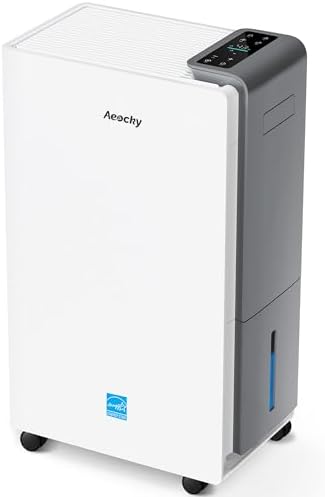
AEOCKY 80-Pint
Best Overall10% OFF
AEOCKY 80-Pint Energy Star Dehumidifier (4,500 Sq. Ft.)
5.0
80 pints/day · 4,500 sq ft rating · 1.45 gal tank
Our Best Overall pick: AEOCKY's 80-pint flagship, an Energy Star Most Efficient 2025 certified unit with a 44 dB low setting that testers compare to white noise and a 3-year warranty with 5 years on the compressor.
AEOCKY's 50-pint compressor dehumidifier, the smaller sibling of our Best Overall AEOCKY 80-Pint: a precise 40 to 80% humidistat, child lock and fan-speed control with quiet running, a drain hose in the box and a 3-year warranty, at a price well below the 80-pint models.
KNKA 34-Pint Dehumidifier with Drain Hose (2,500 Sq. Ft.)
4.9
34 pints/day max · 2,500 sq ft rating · 0.79 gal tank
Our Best Affordable pick: the lowest-priced dehumidifier in this comparison, a compact 34-pint unit with a drain hose, three modes and quiet 37 dB running for bedrooms, baths and small basements up to 2,500 sq ft.
AEOCKY 80-Pint Dehumidifier with Pump (4,500 Sq. Ft.)
4.7
80 pints/day · 4,500 sq ft rating · built-in pump
AEOCKY's pump-equipped model: 80 pints/day and a 4,500 sq ft rating, plus a built-in pump that pushes water up to a sink or window - the answer when there's no floor drain.
Gasbye 115-Pint Energy Star Dehumidifier (4,500 Sq. Ft.)
4.7
115 pints/day max · 4,500 sq ft rating · 1.72 gal tank
A genuine extraction heavyweight: a 115-pint max rating, a 12,600 cubic-feet-per-hour airflow figure, four modes including Turbo, and the largest tank in this lineup (1.72 gallons).
KNKA Energy Star 80-Pint Dehumidifier (5,500 Sq. Ft.)
4.7
80 pints/day max · 5,500 sq ft listing · 1.06 gal tank
An Energy Star certified 80-pint compressor dehumidifier with a drain hose, a digital display and a dry-clothes mode, priced about $58 below the AEOCKY 80-Pint.
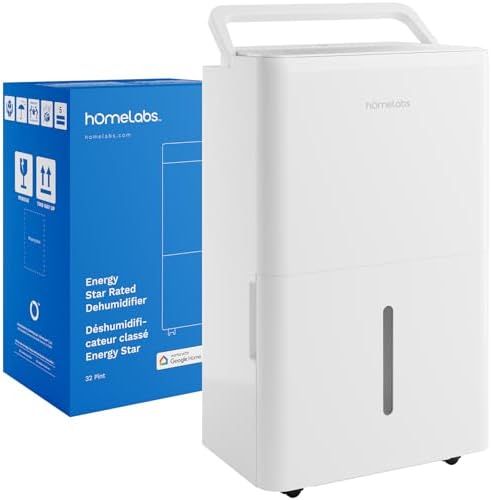
The budget-minded member of hOmeLabs' Wi-Fi lineup: 32 pints of daily removal (80-pint max at 95°F/90% RH) for spaces up to 4,500 sq ft, with app, Alexa and Google Assistant control built in.
DECIUU 100-Pint Energy Star Dehumidifier (5,000 Sq. Ft.)
4.6
100 pints/day max · 5,000 sq ft rating · 1.45 gal tank
Our Best for Large Basements pick: an Energy Star Most Efficient 2024 unit with the largest coverage claim in this comparison at 5,000 sq ft, a 100-pint max rating, three fan speeds and 360° swivel casters.
Short on time? These three cover most buyers: our top-graded 80-pint AEOCKY, the most affordable pick for small to mid-size damp spaces, and the specialist for big, damp basements.
Best Overall
AEOCKY 80-Pint Dehumidifier
AEOCKY 80-Pint Energy Star Dehumidifier (4,500 Sq. Ft.)
Understand the category before you buy - what the science actually says, and which specs matter.
Every dehumidifier lists a pints-per-day rating, a coverage area, and a tank size, but those three numbers hide most of the story. Here is how these machines actually work, why the advertised pint figure reads higher than what you will get, and the features worth comparing before you buy.
What does a dehumidifier actually do?
A dehumidifier pulls damp room air across a cold coil, where the moisture condenses into water, then reheats that air slightly and sends it back out drier. The water it collects goes into a tank or straight down a drain hose. Nearly every unit in this lineup is a compressor model, which is the refrigerant-based type that works best in warm, moderately humid spaces like basements and living areas.
It lowers humidity, which protects against mold, mildew, and that damp smell.
It collects the removed water in a tank or routes it out through a hose.
It holds a target humidity when it has a humidistat, cycling on and off as needed.
Desiccant models, which use a moisture-absorbing wheel instead of a compressor, exist for cold rooms and garages, but this lineup is built around compressor units for typical home conditions.
Read the pint number honestly, then size up
This is the one thing most shoppers miss. That headline pint rating, the 80 pints on the AEOCKY, the 100 to 115 pints on the Gasbye, is measured in hot, near-saturated lab conditions. The real pull in a cooler basement is meaningfully lower, because a compressor removes less water as the air gets colder and less humid. You can see the honesty gap right in the specs: the Gasbye lists 100 pints in normal use against a 115-pint max. Those two numbers describe the same machine under different air.
So match the pint rating and coverage to your room, but size up rather than exactly for a damp space. If a room falls near the top of a unit's coverage claim, the next model up will hold your target humidity with less strain and less noise. The lineup spans roughly 28 pints and 2,000 square feet on the smallest unit up to 115 pints and 4,500 square feet on the largest, so there is room to give yourself margin.
After capacity, drainage decides how hands-off the machine is. A built-in pump like the one on the AEOCKY 80-pint pump model can push water upward into a sink or out a window, and a continuous gravity drain, offered on units like the Gasbye with its triple-drain setup, lets water run out on its own as long as the drain sits below the machine. Either way you skip emptying a tank. Pair that with a humidistat that holds a set humidity, and the unit stops running dry or running nonstop, cycling only when the room actually needs it.
Which specs actually matter?
Once you understand the pint honesty gap, a few features decide which unit fits:
Pints per day, read realistically: Treat the advertised max as a ceiling, not your everyday number. Ratings here run from 28 pints up to 100-plus pints, so pick for your dampest season, not your driest.
Coverage area: Sizes span 2,000 to 4,500 square feet. Choose a unit whose coverage comfortably exceeds your room rather than one you will run at its limit.
Drainage type: Tank-only means emptying by hand. A gravity drain hose runs continuously downhill, and a built-in pump, as on the AEOCKY pump model, moves water upward or over a distance for true set-and-forget operation.
Humidistat and auto control: A humidistat lets you set a target, for example the AEOCKY 50-pint's 40 to 80 percent range, and the unit cycles to hold it instead of running constantly.
Tank volume: Bigger tanks mean fewer trips if you are not using a hose. Capacities here run from about 0.44 gallons up to 1.72 gallons on the Gasbye.
Noise: In a bedroom or office this matters. Quieter compressor units here are rated around 38 to 45 decibels, including the Gasbye and the VEAGASO models, down to 38 dB in the smaller VEAGASO's sleep mode.
Convenience features: Auto defrost protects the coil in cooler rooms, and timers, child locks, and auto restart after a power cut are common across this lineup.
How we grade products
Graded Picks rankings are aggregated from several independent signals: verified buyer ratings and the size of the review base for credibility, recent monthly purchase volume for relevance, assessments from trusted home and appliance publications, and how each product places in leading category lineups. For dehumidifiers we weigh:
Real moisture removal relative to the advertised rating
Coverage area matched to typical room sizes
Drainage options, including pump and continuous drain
Humidistat accuracy and auto cycling
Noise level for living spaces
Tank size and ease of emptying
Build quality, warranty, and overall value
Maintenance note: A dehumidifier only stays healthy if you keep it clean. Empty and rinse the tank regularly to stop mold from growing in standing water, wash or vacuum the air filter every few weeks so airflow stays strong, and give the unit a few feet of clearance on all sides so it can breathe. If you run a continuous drain, check now and then that the hose still slopes downhill and has not clogged or kinked.
In-Depth Reviews
Everything we learned from buyer reviews and expert testing, product by product.
AEOCKY 80-Pint
Best Overall10% OFF
1. AEOCKY 80-Pint Energy Star Dehumidifier (4,500 Sq. Ft.)
5.0
The AEOCKY 80-pint is our Best Overall pick on the strength of an Energy Star Most Efficient 2025 certification, consistently positive expert testing and enduring buyer enthusiasm. Reviewers highlight two things: it removes what it promises (the 80-pint max rating handled damp basements "with ease" in testing), and it does so remarkably quietly, with the lowest fan speed measuring around 44 dB, closer to white noise than to an appliance. Five operation modes (auto, constant humidity, continuous, smart drying, sleep) plus a child lock and timer cover practically every scenario, and a drain hose ships in the box for set-and-forget gravity drainage. Its smaller 50-pint sibling below trades some capacity and tank size for a lower price, so step down to that model only if your space is modest - this 80-pint version is the one to get for a genuinely damp basement or large room. AEOCKY backs it with a 3-year warranty and 5 years on the compressor, well beyond the category's 1-year norm.
Energy Star Most Efficient 2025 for meaningfully lower running costs
Very quiet: about 44 dB on low, white-noise territory
Powerful real-world moisture removal validated by testers
Drain hose and garden-hose adapter included
3-year warranty with 5 years on the compressor
Cons
4,500 sq ft claim is optimistic: treat it as a very damp 2,000 sq ft unit
1.45-gallon tank fills fast without hose drainage
No built-in pump, gravity drainage only
Who is it for?
Most buyers: anyone with a damp basement, large room or whole small home who wants the proven crowd favorite with top-tier efficiency, quiet operation and an unusually long warranty.
Who is it not for?
Anyone who needs to pump water upward to a sink or window (see the AEOCKY LEO with pump below) and small-space users who would be better served by the cheaper 50-pint AEOCKY or a compact 34-pint unit.
The BOREAS-001 is AEOCKY's mid-size model and the sensible pick when our Best Overall 80-pint flagship is more machine than your space needs. It combines an efficient compressor, adjustable humidity control from 40 to 80%, child lock, fan speed control and a timer, sized for bedrooms, bathrooms and medium basements up to a rated 3,500 sq ft. Reviewers, including HouseFresh, single out its quiet running and low price, though they also note the 50-pint label is a best-case rating and that real-world removal at normal indoor conditions is lower. A drain hose and garden-hose adapter ship in the box for continuous drainage, which matters because the 0.8-gallon tank is the smallest among the full-size units in this comparison. A 3-year machine warranty comfortably beats the 1-year norm for dehumidifiers in this price range.
Coverage area (advertised)3,500 sq ft
Daily removal capacity50 pints
Tank volume0.8 gallons
Dimensions (D x W x H)13.19" x 17.99" x 8.66"
Modes & controlsHumidistat 40-80%, child lock, fan speeds, timer
DrainageTank or gravity drain hose (included)
Warranty3 years (brand standard)
Pros
Strong AEOCKY compressor performance at one of the lower prices among full-size units here
Quiet running praised by reviewers
Precise 40 to 80% humidistat with child lock
Drain hose and garden-hose adapter included
3-year warranty comfortably beats the category's 1-year norm
Cons
Small 0.8-gallon tank: plan on hose drainage in damp spaces
No pump; gravity drainage only
50-pint and 3,500 sq ft figures are best-case, so expect less in consistently damp spaces
Who is it for?
Buyers with medium spaces - bedrooms, bathrooms, modest basements - who want AEOCKY's efficiency and controls without paying for our Best Overall 80-pint model's bigger tank and capacity.
Who is it not for?
Big, very damp basements that need more capacity (see the Best Overall AEOCKY 80-Pint above or the DECIUU 100-Pint below) and anyone who needs upward pump drainage instead of a gravity hose.
3. KNKA 34-Pint Dehumidifier with Drain Hose (2,500 Sq. Ft.)
4.9
Our Best Affordable pick. At $129.99 the KNKA PD22SC-12 is the lowest-priced dehumidifier in this comparison, and it covers the essentials for a bedroom, bathroom, laundry room or small basement up to a rated 2,500 sq ft. It offers dehumidify, dry and continuous modes, a built-in humidity indicator, auto defrost and a 3.28-foot drain hose for hands-off drainage, and buyers describe it as quiet, easy to roll around and quick to pull moisture from the air. KNKA rates it at about 37 dB. The trade-offs are the ones you expect at this price: a 3-liter tank that needs frequent emptying without the hose, no pump, no smart controls or remote, and a 1-year warranty. Its 34-pint rating is a best-case figure, so it is the right pick for modest spaces, not for a large, consistently damp basement.
4. AEOCKY 80-Pint Dehumidifier with Pump (4,500 Sq. Ft.)
4.7
The LEO is AEOCKY's answer to the most common dehumidifier dealbreaker: no floor drain. It delivers 80 pints of daily capacity and a 4,500 sq ft rating, then adds a built-in pump that actively pushes condensate upward through the included hose to a sink, window or utility tub - no gravity required, no bucket emptying. It's also app-connected for remote control. Worth knowing before you buy: early reviews praise the pump convenience but a minority report pump noise and app quirks, and at $270 it carries a real premium over AEOCKY's simpler gravity-drain models in this comparison. If you have a floor drain, the AEOCKY 50-Pint above is cheaper and mechanically simpler; if you don't, this is the AEOCKY to get.
Coverage area (advertised)4,500 sq ft
Daily removal capacity80 pints (max)
Tank volume1.45 gallons
Dimensions (D x W x H)14.4" x 8.6" x 23.3"
Modes & controlsAutomatic mode, app-connected smart control
DrainageBuilt-in pump (upward) or tank; hose included
Warranty3 years (brand standard)
Pros
Built-in pump drains upward - no floor drain needed
80-pint daily capacity, among the highest in this comparison
Smart/app control included
Drain hose in the box
Cons
Newer release without as long a track record as AEOCKY's other models here
Highest price here at our last scan
Some early reports of pump noise and app quirks
Who is it for?
Basements and laundry rooms with no floor-level drain - the pump pays for itself the first week you don't have to carry a full tank upstairs.
Who is it not for?
Anyone with a floor drain who wants a simpler, cheaper gravity-drain unit - the AEOCKY 50-Pint above covers that - and buyers who want the longest-established track record in this comparison.
5. Gasbye 115-Pint Energy Star Dehumidifier (4,500 Sq. Ft.)
4.7
The Gasbye is the extraction heavyweight of this comparison: a 115-pint maximum daily rating (100 pints at its standard condition), the strongest airflow figure here at 12,600 cubic feet per hour, and an Energy Star 2026 certification to keep all that work affordable. Four modes - Normal, Turbo, Comfort and Continuous - let you blast a flooded laundry room dry or hold a steady target humidity, and its 1.72-gallon tank is the largest in the lineup, backed by triple drainage flexibility (tank, gravity hose, or continuous). The trade-off is brand pedigree: Gasbye has little professional-review coverage, so you're relying on buyer feedback and the spec sheet, and its 4,500 sq ft coverage claim tops out short of the DECIUU's 5,000 sq ft rating for genuinely oversized basements.
6. KNKA Energy Star 80-Pint Dehumidifier (5,500 Sq. Ft.)
4.7
The KNKA PD30MA-20 is an Energy Star certified 80-pint unit that undercuts the AEOCKY 80-Pint by about $58. KNKA rates it to remove up to 80 pints a day at 95°F and 95% RH and about 56 pints at the more typical basement condition of 86°F and 80% RH, and its Energy Star certification works out to roughly 230 kWh a year. A removable washable filter, a digital display, an LED humidity indicator, auto, dry and setting modes, a child lock and a 12-hour timer are included, and a drain hose ships in the box. Buyers describe it as efficient, quiet and easy to live with, and the continuous-drain option is a favorite. The caveats: KNKA is a newer name with little professional-review coverage, the warranty is 1 year against AEOCKY's 3, the 1.06-gallon tank is modest for this capacity, and the coverage claim appears as 5,500 sq ft on this listing but 4,500 sq ft on the maker's own page.
Coverage area (advertised)5,500 sq ft (4,500 sq ft on maker's page)
Daily removal capacity80 pints max (56 at 86°F, 80% RH)
This hOmeLabs Wi-Fi model shares its 4,500 sq ft coverage claim with several other units in this comparison but is rated for a more modest 32 pints of daily removal at typical conditions (80 pints at 95°F/90% RH). Wi-Fi app control lets you check and adjust the target humidity from a phone, and it pairs with Alexa and Google Assistant for voice control - a step up from the older, non-Wi-Fi hOmeLabs 50-pint classic unit also in this lineup. Owners consistently describe quiet running for a compressor unit of this size, and hOmeLabs backs it with a 2-year limited warranty, extendable to 2.5 years with online registration. The 1.6-gallon tank and auto shutoff handle occasional use well, though a drain hose is not included, so continuous operation in a genuinely damp space means adding one separately. Treat the 4,500 sq ft claim the same way as every other unit here: a best-case number, not a guarantee for a consistently wet room.
Coverage area (advertised)4,500 sq ft
Daily removal capacity32 pints (80-pint max at 95°F/90% RH)
Tank volume1.6 gallons
Dimensions (D x W x H)11" x 15.4" x 24.3" (40 lbs)
Modes & controlsWi-Fi app, Alexa/Google Assistant, auto shutoff
DrainageTank or continuous drain (hose not included)
Warranty2 years (2.5 with registration)
Pros
Wi-Fi app control plus Alexa and Google Assistant compatibility
Quiet compressor operation for its size
2-year limited warranty, extendable to 2.5 years with registration
Auto shutoff protects against tank overflow
Shares hOmeLabs' proven core platform with the brand's non-Wi-Fi classic model in this lineup
Cons
32-pint real-world rating is modest next to this lineup's 80-115 pint units
Drain hose not included for continuous drainage
1.6-gallon tank needs regular emptying without a hose hooked up
Who is it for?
Smart-home households with a moderate damp space - a bedroom, office or small basement - who want app and voice control without paying for flagship-size extraction.
Who is it not for?
Owners of large, consistently damp basements who need more than 32 pints of everyday removal - the DECIUU 100-Pint or AEOCKY 80-Pint with Pump in this comparison are better matched.
8. DECIUU 100-Pint Energy Star Dehumidifier (5,000 Sq. Ft.)
4.6
Our Best for Large Basements pick. The DECIUU pairs the largest coverage claim in this lineup (5,000 sq ft) with an Energy Star Most Efficient 2024 certification for lower running costs. Its 100-pint max rating, three fan speeds, auto defrost with automatic restart, child lock and continuous-drain support make it a legitimate big-basement machine on paper, and 360-degree swivel casters make its 32.8 lbs easy to roll between rooms. It is a newer arrival with less professional coverage than the established AEOCKY models here, but the spec sheet backs up the claim for buyers with genuinely oversized spaces. DECIUU covers it with up to 2 years of product protection.
Coverage area (advertised)5,000 sq ft
Daily removal capacity100 pints (max)
Tank volume1.45 gallons
Dimensions (D x W x H)11.39" x 17.29" x 26.33" (32.8 lbs)
Modes & controls3 fan speeds, humidistat, child lock, timer
DrainageTank or continuous drain hose
WarrantyUp to 2 years
Pros
Energy Star Most Efficient 2024 certification
Big 100-pint max rating with 3 fan speeds
Auto defrost with automatic restart and a child lock
Swivel casters and reasonable 32.8 lbs weight
95°F upper operating rating suits hot garages
Cons
Little expert coverage yet from a newer brand
Second warranty year requires registering the product within 30 days
1.45-gallon tank is average for this capacity class
Who is it for?
Owners of large or severely damp basements who want the biggest coverage claim in this comparison and don't mind betting on a newer brand with strong early reviews.
Who is it not for?
Anyone who wants a long track record or expert validation behind a $250 purchase - the AEOCKY models here are the safer picks at this price.
The stars you see are the Graded Picks cumulative score, not a single retailer's average. It blends verified buyer reviews aggregated across major retailers, assessments from professional reviewers and expert testers, and how prominently the product features in leading category lineups.
Advertising Disclosure
Our rankings are compiled by aggregating several independent signals, including verified buyer feedback, how popular a product currently is with shoppers, and evaluations published by professional reviewers. Editorial opinions are our own.
Please note that we participate in affiliate marketing programs. When you purchase through links on our site, we may earn a commission. As an Amazon Associate we earn from qualifying purchases. This comes at no additional cost to you and helps support the resources required to provide valuable content.