A wireless dog fence gives your dog room to roam without you digging a trench or fencing the whole yard. It teaches an invisible boundary using a warning cue on a collar, so your dog learns where the safe zone ends. But the cheap ones can wobble a few feet on a bad day, and where that line lands matters when it is the only thing between your dog and the road. We analyzed thousands of verified buyer reviews, recent sales data, and expert evaluations to find seven wireless dog fences that hold a reliable boundary and treat your dog fairly while they learn it.
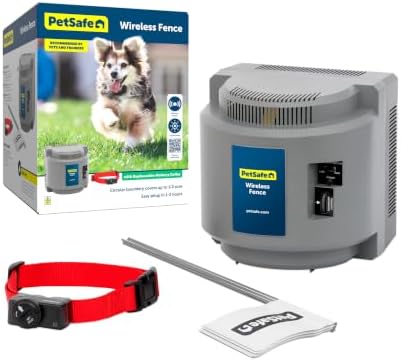
Our Best Overall pick: a portable, plug-in wireless fence that draws up to a 3/4-acre circle around an indoor transmitter, works with unlimited additional collars for growing households, and skips both the digging of a buried wire and the drift of GPS.
A GPS-based virtual fence that lets you draw a custom boundary shape in the PetSafe app instead of committing to a fixed circle or buried wire, with no monthly fee, a redesigned collar, and up to 5 days of battery per charge.
GPS virtual fence · Medium dogs (12-18in neck) · No subscription required
The priciest fence in this comparison, sized specifically for medium dogs with a 12 to 18 inch neck: unlimited custom GPS boundaries, no required subscription, and an extended battery mode that outlasts every other GPS collar here.
Radio wireless fence · 1/2 acre circular · No subscription
The long-running, entry-level PetSafe wireless fence: a plug-in transmitter, a half-acre circular boundary, and a track record longer than almost anything else in this category.
VUMXPE GPS Wireless Dog Fence (6,561 ft Radius, No App)
4.7
GPS virtual fence · 6,561 ft radius · No app or subscription
Our Best Affordable pick: a budget GPS fence that skips the smartphone app entirely, drawing a radius or custom multi-point boundary straight from the collar's own receiver and a magnetic charging base, at the lowest price in this comparison.
Our pick for multiple dogs: a buried-wire in-ground fence that trades quick setup for a reliable, drift-free boundary, with a fully submersible rechargeable collar and room to expand to unlimited dogs on one system.
An app-controlled GPS fence collar that lets you draw circular or polygon boundaries and no-go zones from your phone, with built-in location tracking and a free first year of the optional subscription.
Short on time? These three cover most yards: our top-graded overall pick, the best affordable GPS option, and the best choice for multi-dog households.
Wireless Dog Fences 101: What They Do & How to Choose
Understand the category before you buy - what the science actually says, and which specs matter.
Every system promises a safe boundary, but the way that boundary is drawn, and how gently the collar corrects, varies a lot from one model to the next. Here is how these fences work, the one choice that decides how precise your boundary really is, and the features actually worth comparing.
What does a wireless dog fence actually do?
A wireless dog fence creates a boundary your dog cannot see, then uses a collar to remind them where it is. As your dog approaches the edge, the collar gives a warning, and if they keep going it delivers a stronger cue until they turn back. Over a few weeks of training, most dogs simply learn to stay inside.
The systems here fall into three families:
A buried in-ground wire, like the SportDOG system with its 1,000 ft of included wire, which you lay out in any shape you want.
A radio wireless fence, like the PetSafe Stay & Play and PetSafe Original, which broadcasts a round boundary from an indoor transmitter with no digging.
A GPS virtual fence, like the PetSafe Guardian and Meowant, which draws a custom boundary by satellite through a phone app.
The boundary technology is the real decision
This is the part most shoppers skip, and it matters more than any other spec. How the fence draws its line decides how precise, how flexible, and how much setup work you are signing up for.
A radio wireless fence is the fastest to set up. You plug in a transmitter and it makes a circle around it, adjustable from a small ring to a wide one, for example the roughly 22 to 105 ft radius on the PetSafe Stay & Play or the 5 to 90 ft on the PetSafe Original. The trade-off is shape and steadiness: you only get a circle, the signal wants open flat ground, and metal, slopes, and walls can make the boundary breathe in and out by a few feet.
A GPS fence, like the PetSafe Guardian or Meowant, fixes the shape problem. You walk or draw a custom outline in an app, save several yard profiles, and cover a large area that follows your actual property. The trade-off is that satellites need a clear view of the sky, and the position can drift, so the line is best kept well inside real hazards rather than right on the curb.
A buried in-ground wire like the SportDOG asks the most work up front, but because the boundary is a physical wire you can trench it along any path and it does not wobble or drift. If you want the tightest, most predictable line, wired is still the most precise of the three, and neither wireless approach fully matches it. Pick the technology that fits your yard first, then compare everything else.
Which specs actually matter?
Containment type: Radio for a quick round boundary on open ground, GPS for a large custom shape, buried wire for the most precise and stable line. Decide this before anything else.
Coverage area and range: Match the range to your yard. Radio systems here span a small ring up to a 3/4 acre circle, while GPS models like the PetSafe Guardian handle 3/4 acre or larger in a shape you define.
Correction modes and levels: Look for tone and vibration before any static, and enough steps to fit your dog. The range runs from 5 static levels on the PetSafe radio systems up to 10 on the GPS collars and adjustable beep, vibration, and static banks on the Meowant.
Rechargeable versus replaceable collar: Rechargeable Li-ion collars like the SportDOG and the GPS models save you buying batteries, though GPS units run shorter, roughly 24 to 36 hours on the VUMXPE and up to 5 days on the Guardian, so they need regular charging.
Waterproofing: A waterproof collar handles rain and puddles. Ratings here go from IPX7 on the 4-in-1 and VUMXPE GPS systems, with the SportDOG collar rated fully submersible.
Number of dogs: The SportDOG is expandable to contain more dogs, while the 4-in-1 system is built for 2 dogs on one setup.
Collar fit and neck size: Fit is safety. Confirm your dog's weight and neck fall in range, from 5 lbs and up on some models up to systems rated 25 lbs and up, with neck sizes spanning about 5 to 28 inches across the lineup.
How we grade products
Graded Picks rankings are aggregated from several independent signals: verified buyer ratings and the size of the review base for credibility, recent monthly purchase volume for relevance, assessments from trusted pet and dog-training publications, and how each product places in leading category lineups. For wireless dog fences we weigh:
Boundary technology and how stable the line holds
Coverage range against typical yards
Correction options, gentleness, and adjustability
Collar battery type and time between charges
Waterproofing and durability
Fit range and support for multiple dogs
Setup effort and overall value
Safety and training note: A wireless fence is a training aid, not a physical barrier, and it does not stop other animals or people from entering your yard. Introduce it slowly with proper boundary training, supervise your dog while they learn, and never treat it as a substitute for a solid fence around a real hazard. Check the collar fit against your dog's neck size, keep it snug but not tight, and remove it for long stretches to protect the skin. These systems are not suited to aggressive dogs or very small dogs below a model's rated weight. When in doubt about your dog's temperament, talk to a professional trainer or your veterinarian.
In-Depth Reviews
Everything we learned from buyer reviews and expert testing, product by product.
PetSafe Stay & Play
Best Overall32% OFF
1. PetSafe Stay & Play Wireless Fence
5.0
The Stay & Play plugs into any indoor outlet and radiates a circular boundary sized anywhere from 22 to 105 feet in every direction, one of the largest coverage areas among radio wireless fences in this comparison, and because the boundary itself is broadcast rather than tied to a single collar, any number of additional PetSafe collars can be added to cover more dogs on the same fence with no second transmitter needed. Buyer feedback is strong and long-running - this is one of the more established names from the parent company behind Invisible Fence - and reviewers consistently note that most dogs learn the boundary within a couple of training sessions. A veterinary product review from Dr. Patrick Mahaney highlights the tone-only mode as a genuinely useful stepping stone before static correction is ever introduced, an approach worth repeating with each new dog added to a multi-dog household. That combination - fast setup, no per-dog hardware cost, and a boundary technology that avoids both GPS drift and buried-wire labor - makes it a strong fit for most multi-dog and renter households. Because the whole system is portable, owners take it on trips and to vacation rentals where a permanent fence isn't an option. The tradeoffs some owners report are patchy coverage in homes with a lot of metal or on sloped yards, and a collar beep that a handful of reviewers find too quiet to hear outdoors.
2. PetSafe Guardian GPS Dog Fence (No Subscription)
4.9
PetSafe's Guardian GPS Fence trades wires and radio transmitters for a boundary you sketch by hand in the My PetSafe app, aimed at yards of 3/4 acre or larger where a circular wireless fence would leave awkward dead zones. Reviewers at outlets like PawTech Review and DogTechHQ describe setup as genuinely fast, about two hours from unboxing to a trained dog, and testers who tried it near coyote activity reported both dogs respecting the boundary reliably. The rechargeable collar runs up to 5 days per charge and switches between tone-and-vibration or 10 levels of static correction, and PetSafe backs it with a standard warranty and no ongoing subscription cost. That combination - a custom boundary shape most competitors can't match, no recurring fees, and consistently strong buyer response - makes it a strong GPS option for owners with large or irregular yards. Vetstreet's comparison work on PetSafe's GPS lineup notes it isn't as tracking-rich as premium GPS collars like Halo, and a minority of owners report the collar continuing to correct after a hardware fault rather than failing safe. Even with those caveats, it remains a well-rounded GPS option: a boundary shape that fits an irregular lot, no monthly fee, and a track record of reliable containment.
SpotOn's Omni collar is the premium GPS option in this comparison, built in the USA and sized specifically for medium dogs with a 12-18 inch neck rather than a one-size-fits-all band. Independent coverage from Canine Journal and DogTechHQ gives the broader SpotOn Omni lineup consistently positive marks, citing simple app-based fence drawing (walk the boundary once and watch it draw in real time), free training consultations, and a 90-day money-back guarantee. Unlike every other GPS fence in this lineup, SpotOn supports an unlimited number of saved custom fences covering anywhere from a half acre up to 100,000-plus acres, and its extended battery mode pushes runtime to roughly 35-40 hours per charge without a tracking subscription, well ahead of the 20-36 hour figures on the Dogtra and VUMXPE GPS collars here. That accuracy has real limits testers are upfront about: independent testing at World Animal Foundation found GPS drift of roughly 6 to 10 feet in open yards and 15 to 20 feet under dense tree cover, so testers recommend keeping the boundary well inside any real hazard and widening the buffer in wooded areas. The core containment features work with no required monthly fee; an optional cellular plan adds live tracking and escape alerts for owners who want that extra layer.
Unlimited custom GPS fences with no subscription required for core containment
Extended battery mode reaches up to roughly 40 hours per charge, longer than any other GPS collar here
IP67 waterproof, built in USA
Free training consultation and a 90-day money-back guarantee
Sized specifically for medium-neck dogs (12-18 in) for a more secure, accurate fit
Cons
Priciest fence in this comparison by a wide margin
GPS drift of roughly 6-10 feet in open areas, worse (15-20 ft) under dense tree cover
Optional cellular tracking and escape alerts require an added monthly subscription
Who is it for?
Owners of medium-sized dogs who want the most accurate, no-subscription-required GPS containment and are willing to pay a premium price.
Who is it not for?
Budget-conscious buyers, owners of small or extra-large dogs who need a different neck-size model, or anyone training in dense tree cover without room for a wide buffer zone.
The PetSafe Original has been the default starter wireless fence for over a decade, and that longevity shows up in the sheer volume and consistency of buyer feedback it has accumulated. Coverage is adjustable from a 5 to 90-foot radius (up to 180 feet across) from the indoor transmitter, and outlets like iHeartDogs and PureDogTraining still recommend it as a reliable, no-frills entry point for first-time wireless-fence buyers. Setup reviewers describe as genuinely fast - often under two hours including a training period - and the small 2.5-ounce collar runs on a widely available RFA-67 battery rather than requiring a proprietary recharge cable. PetSafe's own support material attributes the signal fluctuation some owners report to environmental interference like metal siding or sloped terrain rather than a fundamental design flaw, and the fix is usually adjusting the transmitter's placement or boundary radius. It remains one of the easiest ways into wireless containment without committing to GPS hardware or buried wire, backed by that long, consistent track record.
5. VUMXPE GPS Wireless Dog Fence (6,561 ft Radius, No App)
4.7
Our Best Affordable pick, the VUMXPE GPS fence takes a different approach than the other satellite-based systems in this lineup: instead of drawing your boundary in a phone app, setup happens through the collar's own receiver and a magnetic charging dock, with a dedicated static test light to confirm the correction level before you put the collar on your dog. It also undercuts every other fence in this comparison on price. The system supports either a simple radius fence or a multi-point custom shape walked out in person, and scales from a tight circle up to a rated 6,561-foot radius, one of the largest advertised ranges here. A pre-alert warning zone sounds before the correction zone activates, and the beep, vibration and static modes give a layered introduction similar to the pricier GPS collars in this comparison. The 1000 mAh battery is rated for 24 to 36 hours of continuous use between charges, and the IPX7-rated collar is built for dogs 15 lbs and up with a 9 to 26-inch neck. VUMXPE also sells the 4-in-1 wireless-and-remote-trainer system elsewhere in this comparison, and this GPS-only model is a separate, single-purpose design in the same brand's lineup. As with the brand's other entry, no independent test lab or pet-training publication has reviewed this specific model yet, so what's known comes from the product listing and manufacturer specs rather than third-party testing.
Containment technologyGPS virtual fence (radius or multi-point custom shape, no app or subscription)
Coverage area (advertised)Adjustable radius up to 6,561 ft (about 1.24 miles)
Correction modesBeep, vibration, static with a pre-alert warning zone
Collar battery life1000 mAh battery, 24-36 hours per charge
SportDOG is our pick for multiple dogs. Unlike the GPS and radio-wireless systems in this lineup, the SDF-100C runs on a physical buried wire, and that simplicity is exactly why testers and long-term owners rate its containment reliability so highly: there's no satellite drift, no tree-cover dead zones and no circular-boundary compromise, just a boundary you define with 1,000 feet of included wire and 100 flags. The rechargeable, lithium-ion collar is rated fully submersible rather than merely splash-resistant, a real advantage over collars that are only waterproof for dogs that swim, and it holds a charge for one to two months between roughly two-hour top-ups. Seven levels of static correction sit above a tone-and-vibration-only mode, and the system is explicitly built to expand: PureDogTraining and Technobark both highlight that additional collars let it contain effectively unlimited dogs on the same boundary, with total coverage scalable up to 100 acres - the most straightforward path to a multi-dog setup in this comparison. The one real caveat from experienced installers: the wire that ships in the box is the thinnest gauge that will work, so anyone burying it under a driveway or through heavily wooded runs is advised to upgrade the wire and bury it a little deeper than the minimum.
Containment technologyBuried in-ground wire (1,000 ft included)
Coverage area (advertised)Expandable; boundary width 16-24 ft adjustable
Correction modesTone/vibration plus 7 static levels
Collar battery lifeLi-ion, 1-2 months per charge (2-hr charge)
Collar waterproof ratingWaterproof and fully submersible collar
The Thereye collar is a GPS-based fence that you set up from a smartphone app: draw a circular or polygon boundary, add no-go zones around a pool or road, and the collar warns your dog as it nears the edge. Its dual-frequency GPS falls back on Bluetooth, Wi-Fi or cellular signal when satellites are weak, and the maker quotes accuracy of about 6 feet in open areas, the same open-sky caveat that applies to every GPS fence here. Unlike the app-free VUMXPE or the no-subscription SpotOn, it leans on a subscription model: the core fence works without one and a free first year is included, but live tracking, cellular data and family sharing sit behind a paid plan afterwards. The IP67-rated collar fits dogs from about 8 lbs with an 8 to 25 inch neck, and it logs location history and offers sound and light locate features within Bluetooth range. It is the newest and least-tested name in this lineup, with no dedicated independent review found yet, so most of what is known comes from the manufacturer's specifications and early buyer feedback. At its price it is a feature-rich but unproven option.
Coverage area (advertised)Custom fences from under 1/10 acre to 3/4 acre and beyond
Correction modesWarning alert on approach to the boundary, with app-managed settings
Collar battery lifeRechargeable lithium battery, charged by USB cable
Collar waterproof ratingIP67 waterproof and dustproof
Dog size / weight8 lbs+, neck 8-25 in
Subscription & warrantyFree 1-year subscription, then optional paid plan for live tracking; 12-month warranty
Pros
Draw circular or polygon fences and no-go zones from the phone app
Free first year of the subscription includes live tracking
Fits small dogs from about 8 lbs, lighter than most GPS collars here
IP67 waterproof and dustproof build
Location history and sound-and-light locate features within Bluetooth range
Cons
No dedicated independent review coverage found yet
Live tracking and cellular data need a paid plan after the first year
Open-sky accuracy of about 6 feet means a wide buffer is needed near roads
Who is it for?
Owners of small to medium dogs who want an app-drawn GPS fence with tracking features and are comfortable with a subscription after the first year.
Who is it not for?
Buyers who want a fully no-subscription system or a model with independent test results, since the SpotOn and PetSafe GPS options here have more track record.
The stars you see are the Graded Picks cumulative score, not a single retailer's average. It blends verified buyer reviews aggregated across major retailers, assessments from professional reviewers and expert testers, and how prominently the product features in leading category lineups.
Advertising Disclosure
Our rankings are compiled by aggregating several independent signals, including verified buyer feedback, how popular a product currently is with shoppers, and evaluations published by professional reviewers. Editorial opinions are our own.
Please note that we participate in affiliate marketing programs. When you purchase through links on our site, we may earn a commission. As an Amazon Associate we earn from qualifying purchases. This comes at no additional cost to you and helps support the resources required to provide valuable content.