A good ergonomic chair disappears under you: you stop noticing it and just get through the workday without the low-back ache, the numb legs, or the shoulder tension that a cheap seat leaves behind. But "ergonomic" is one of the most oversold words in furniture, and plenty of chairs wear the label while offering almost nothing you can actually adjust. We analyzed thousands of verified buyer reviews, recent sales data, and expert evaluations to find six ergonomic chairs that are built to be shaped around your body, not the other way around.
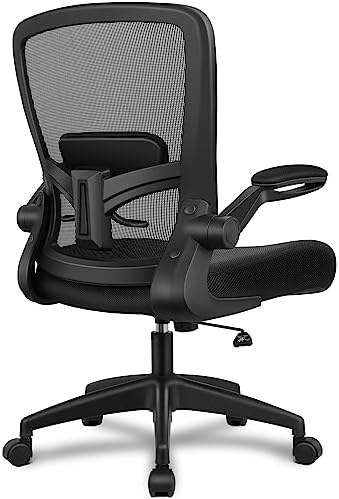
A budget mesh chair priced under $130, still backed by broad buyer approval and independent hands-on validation. Flip-up arms and a tilt-and-lock recline cover the fundamentals cleanly.
One of the best-tested chairs in this comparison, with independent hands-on coverage from six separate publications and 4-way adjustable lumbar support in a breathable mesh build with a 330-lb rating, made for long sitting sessions.
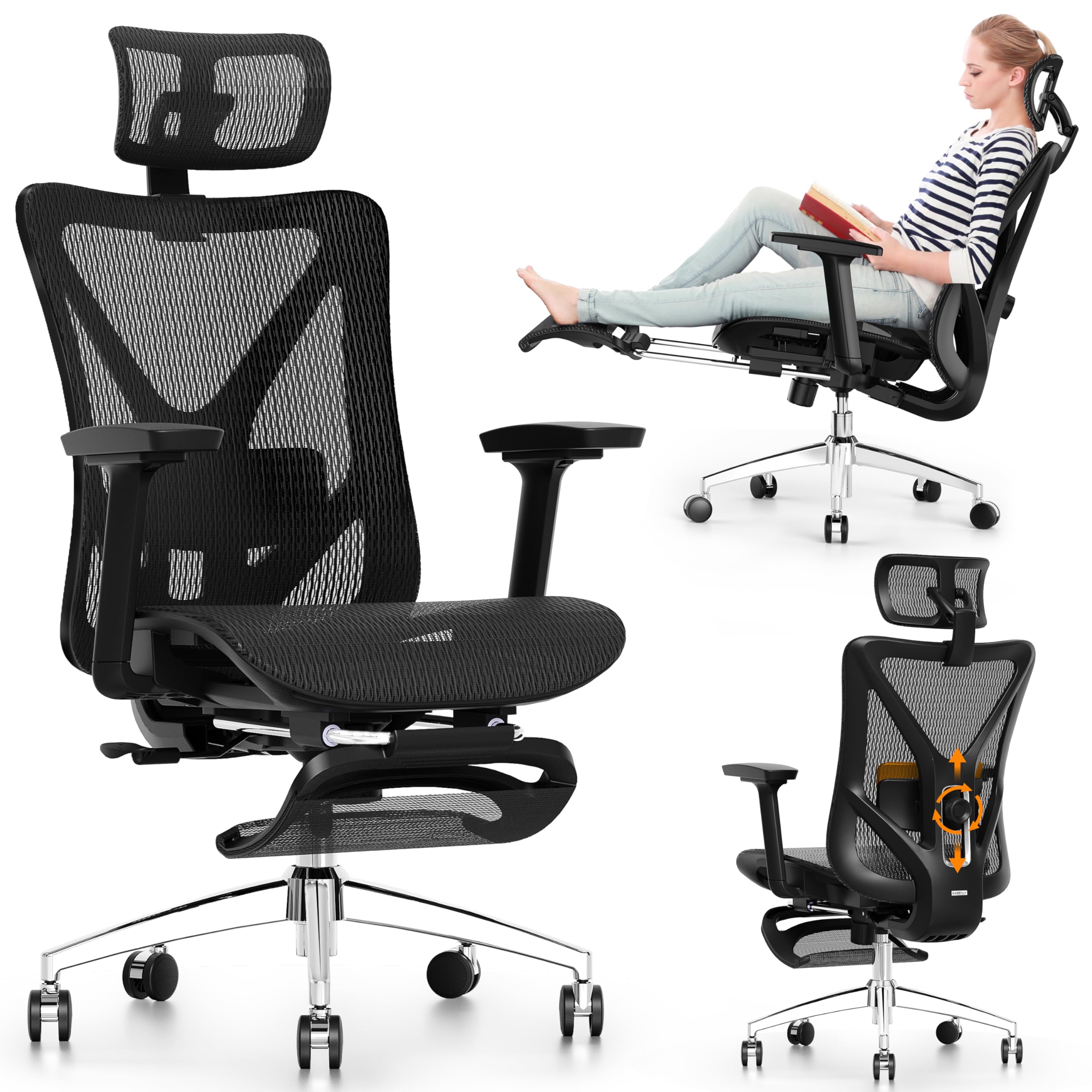
A mesh task chair built around a 135° recline and a retractable steel footrest, positioned for buyers who want to lean back and rest between tasks. Reviewers like the comfort and mesh airflow but flag the tilt mechanism as the part most likely to need attention over time.
Our Best for Big & Tall pick: a big-and-tall mesh chair with a built-in footrest, a seat that rises to 22.8 inches and the densest multi-point adjustment system in this comparison. Reviewers credit it with real relief for back pain sufferers.
HUANUO MSOC10B Ergonomic Mesh Office Chair with 3D Armrests
4.7
300-lb capacity · 3D armrests · 3-year warranty
Our Best Value pick: the lowest price in this comparison on a high-back mesh chair that still packs adjustable lumbar support, a 2D headrest, 3D armrests and a thick foam seat.
A high-back mesh chair sized specifically for bigger and taller users, with a sliding headrest and flip-up arms built around a wide, supportive frame. Independent testers have put it through hands-on evaluation and rate it as a solid all-rounder for the price.
Short on time? These three cover most buyers: our top-graded SIHOO B100 with adaptive lumbar support that moves with you, the best value for money, and the pick for taller users with a high seat range and a built-in footrest.
Ergonomic Chairs 101: What They Do & How to Choose
Understand the category before you buy - what the science actually says, and which specs matter.
Every chair in this lineup claims support for your back, but the ones worth buying earn it through adjustments you can dial in, not padding alone. Here is how these chairs actually support you, the single thing that separates a truly ergonomic chair from a marketing label, and the specs worth comparing before you commit.
What does an ergonomic chair actually do?
An ergonomic chair is designed to hold your spine in a neutral position and take pressure off the parts of your body that tire first during a long sitting day. It does that through a few coordinated parts:
A backrest, usually with lumbar support, that fills the natural curve of your lower back so you are not slouching to reach it.
A seat you can raise or lower so your feet rest flat and your knees sit near a right angle.
Armrests that carry the weight of your arms so your shoulders and neck can relax.
A recline or tilt mechanism that lets you shift your posture through the day instead of freezing in one position.
Most of these chairs pair a breathable mesh back with a foam-padded seat, and several add an adjustable headrest for when you lean back.
Why "ergonomic" means nothing until the chair is set to you
Here is the part most shoppers miss: "ergonomic" is a marketing word until a chair can be adjusted to your specific body. A well-shaped seat that is stuck at the wrong height or has armrests that only go up and down is not ergonomic for you, it is just ergonomic for the average person the factory had in mind. So the spec that actually matters most is the number of independent adjustments a chair gives you: adjustable lumbar support, multi-dimensional armrests, seat height, and recline tension. The more of those you can tune, the closer the chair gets to fitting you.
You can see the spread across this lineup. The ELABEST X100 leads on adjustability with 5D flip-up armrests, a 3D adjustable lumbar system, a seat height range of 19 to 22.8 inches, and a 90 to 135 degree recline with a 3-position lock. The GABRYLLY sits a step behind with a 3D flip-up armrest, adjustable lumbar, and a locking recline at 90, 110, and 135 degrees. At the simpler end, the FelixKing uses fixed-height flip-up arms and a tension knob rather than fine armrest control, which is fine for a light user but gives you fewer levers to pull. When you compare chairs, count the adjustments, because a chair is only ergonomic once it is set to you.
One thing no chair fixes on its own: material. Mesh breathes and suits a warm room, while a cushioned foam seat adds comfort over a long sitting session, but neither one corrects bad posture. The adjustments do that.
Which specs actually matter?
Number of independent adjustments: This is the real ergonomic score. Look for adjustable lumbar, multi-way armrests, seat height, and recline tension all on one chair, as on the ELABEST X100.
Armrest dimensions: More directions means better shoulder support. These range from fixed-height flip-up arms on the FelixKing, to 2D height-and-width arms on the SIHOO M18, up to 3D and 5D arms on the GABRYLLY and ELABEST.
Seat height range: Match this to your desk and leg length. The ranges here run from about 16.5 to 20.8 inches on the Duramont up to 19 to 22.8 inches on the ELABEST, so taller and shorter users have real options.
Recline and tilt lock: A wider recline plus a lock lets you find and hold a comfortable angle. These span roughly 120 degrees on the FelixKing and Marsail up to 135 degrees on the ELABEST and GABRYLLY.
Lumbar support type: Adjustable lumbar, like the 3D system on the ELABEST, lets you position the support where your back needs it instead of hoping a fixed curve lines up.
Weight capacity and seat size: Match this to your body. Most chairs here hold 300 lbs, while the SIHOO M18 and HUANUO FlowLift are rated to 330 lbs, and a wider foam-padded seat gives more room than a compact one.
Material: Choose mesh for airflow in a warm space, or a thicker foam seat like the Marsail's 3.15 inch cushion for long-sit comfort.
How we grade products
Graded Picks rankings are aggregated from several independent signals: verified buyer ratings and the size of the review base for credibility, recent monthly purchase volume for relevance, assessments from trusted furniture and workspace publications, and how each product places in leading category lineups. For ergonomic chairs we weigh:
Number and range of independent adjustments
Lumbar support quality and adjustability
Armrest flexibility
Seat comfort, size, and material
Recline range and lock reliability
Build quality, frame, and casters
Overall value for the price
Fit and setup note: A great chair only helps if you take ten minutes to set it up for your body: raise or lower the seat until your feet are flat and your knees sit near a right angle, position the lumbar support into the curve of your lower back, and set the armrests so your shoulders stay relaxed. Even the best chair will not undo hours of stillness, so stand, stretch, and move for a few minutes each hour.
In-Depth Reviews
Everything we learned from buyer reviews and expert testing, product by product.
FelixKing
Best Overall
1. FelixKing Ergonomic Mesh Office Chair
5.0
FelixKing is a low-priced chair that still nails the ergonomic fundamentals, backed by broad buyer approval and echoed by independent hands-on coverage from YouTube testers and a dedicated BestViewsReviews writeup. A breathable mesh back, a high-density foam seat, flip-up arms that tuck away to save desk space, and a 90 to 120 degree tilt-back with a tension knob to control recline resistance cover exactly what most desk workers need day to day. Reviewers consistently praise the mesh back and lumbar support for staying comfortable through full workdays, and assembly is reported to take about 15 minutes with no surprises. It gives up a few things pricier chairs in this comparison offer: some owners report the frame developing creaks over time, the hard plastic armrests can get uncomfortable during extended mouse use, and the warranty is shorter than most other chairs here. Only our Best Value HUANUO costs less, and it adds more adjustable parts, but FelixKing remains a solid, proven mesh chair for buyers on a budget.
Weight capacity300 lbs
Recline range90-120° with tension knob
Seat height range17.7-21.2 in
ArmrestFixed-height flip-up arms (hard plastic)
Back & seat materialBreathable mesh back, high-density foam seat
Frame & castersSteel-framed base with rolling casters
Warranty1-year
Pros
A proven mesh chair at a budget price
Broad buyer approval, backed by independent YouTube and BestViewsReviews coverage
Comfortable mesh back and lumbar support for full workdays
Flip-up arms tuck away to save desk space
Quick assembly, typically around 15 minutes
Cons
Some units develop creaking noises over time
Hard plastic armrests can be uncomfortable during extended mouse use
Shorter warranty than most other chairs in this comparison
Who is it for?
Budget-focused buyers who still want comfort, buyer trust and a proven mesh chair at a low price.
Who is it not for?
Anyone who wants premium build quality or padded, highly adjustable armrests: the ELABEST X100 and GABRYLLY Reclining elsewhere in this comparison cover that at a higher price.
The M18 combines the deepest independent testing record in this comparison, six separate publications putting it through hands-on review, with a 4-way adjustable lumbar system and a headrest that slides up and down and rotates to support the neck, addressing two of the biggest pain points reviewers cite in cheaper chairs. Testers have singled it out as an unusually complete package, praising the breathable mesh back for staying cool during long sessions and the high weight rating for accommodating more body types than most chairs in its class. The tradeoff is that dialing in every adjustment takes a bit more fiddling than on pricier chairs, and the caster wheels roll a little less smoothly than testers would like. Once it is set up, though, reviewers describe the seat and lumbar support as comfortable enough for full workdays, and the frame is backed by an unusually long warranty with free replacement parts. It costs more than our Best Value HUANUO, but it brings the strongest expert validation and the highest weight rating in this lineup.
This GABRYLLY model centers on three lockable recline positions - 90°, 110° and 135° - plus a retractable steel footrest that extends to 18.1 inches, aimed at buyers who want an occasional lounge break built into their desk chair. It also includes 2-way adjustable lumbar support, a 3D headrest and flip-up armrests, and it has passed third-party SGS and BIFMA testing for its weight rating. Reviewers are generally pleased with day-to-day comfort and mesh breathability, and the recline versatility and footrest set it apart from chairs without a lounge-style option. The one durability risk worth weighing: independent longevity tracking has found the tilt mechanism developing clicking, grinding or lock-up in a meaningful share of units after roughly a year and a half of daily use. Assembly takes 15-25 minutes with the included Allen wrench and screw kit.
Weight capacity300 lbs
Recline range90°/110°/135° with lock
Overall dimensions20.6 in W x 19.1 in D x 42.7-48.8 in H
Armrest3D flip-up armrest
Back & seat materialAll-mesh back and seat
Frame & castersLarge steel base with rolling casters
Warranty3-year parts warranty
Pros
135° recline with a retractable steel footrest for lounge-style breaks
2-way adjustable lumbar support and a 3D headrest
Passed third-party SGS and BIFMA testing for its weight rating
Mesh back and seat stay comfortable through long sessions
Cons
Independent longevity tracking flags the tilt mechanism as prone to clicking or grinding over time
Best fit is for users between about 5'3" and 6' tall
Footrest adds bulk that some buyers may not want if they rarely recline
Who is it for?
Buyers who specifically want a desk chair that doubles as a recline-and-rest spot during breaks.
Who is it not for?
Anyone who wants the simplest possible mechanism with the fewest moving parts to maintain.
The X100 is our Best for Big & Tall pick: it is the chair here built and marketed for taller, larger users, with a seat that rises to 22.8 inches and a seat-depth range that suits longer legs. Reviewers count 17 distinct points of adjustment, including 3D lumbar support and 5D flip-up armrests, the most of any chair in this comparison, aimed at the fit that off-the-shelf chairs usually miss. A dual-layer mesh design is reported to move noticeably more air than a single-layer back, which matters over multi-hour sessions, and the pop-out footrest lets you recline and prop your legs up between tasks. Reviewers who bought it for back pain describe real relief once the lumbar and footrest are dialed in, and most report tool-free assembly taking around 15 minutes. Note that most sources list the weight rating at 300 lbs, so this pick is about fit and height rather than the highest rated load. The weak points flagged are a footrest that could be more comfortable for extended use and mesh that some expect to show wear faster. It carries a 5-year warranty and is the highest-priced chair here.
Weight capacity300 lbs
Recline range90-135° with 3-position lock
Seat height range19-22.8 in
Armrest5D flip-up armrests
Back & seat materialDual-layer AirMesh back and seat
Frame & castersBIFMA-tested steel frame and gas lift
Warranty5-year
Pros
Seat rises to 22.8 inches for taller users, with a wide seat-depth range
17-point adjustment system, including 3D lumbar and 5D armrests
Built-in pop-out footrest for reclined breaks
Dual-layer mesh is reported to move noticeably more air than single-layer designs
Long 5-year warranty and tool-free assembly in around 15 minutes
Cons
Footrest isn't as comfortable for extended use as a dedicated ottoman
Mesh fabric is expected to show wear faster under heavy daily use
Highest price in this comparison, even before considering ongoing discounts
Who is it for?
Taller or larger users who want a high seat range, a dense adjustment system and a built-in footrest for long days.
Who is it not for?
Budget shoppers, anyone who needs a weight rating above 300 lbs, or buyers who do not need the footrest.
5. HUANUO MSOC10B Ergonomic Mesh Office Chair with 3D Armrests
4.7
The HUANUO MSOC10B is our Best Value pick because it offers the most adjustability per dollar in this lineup, at the lowest price of any chair here. Its lumbar support moves 1.18 inches forward and back and 2.16 inches up and down, the 2D headrest tilts and slides, and the 3D armrests shift 1.96 inches in depth, swivel 15 degrees and flip up 90 degrees, so you can tune it to your body and your desk. A 3.14-inch high-density foam seat balances softness and support, the mesh back keeps air moving through long sessions, and the back reclines from 90 to 120 degrees. Reviewers describe it as a smart pick for home-office users, students and casual gamers who want customizable support without premium pricing, and one long-term tester found it kept its responsiveness without sagging much. Its components are SGS certified and HUANUO backs it with a 3-year warranty. The caveats: recline stops at 120 degrees, the weight rating is 300 lbs, and independent long-term durability data is still limited.
Weight capacity300 lbs
Recline range90-120° with tilt lock
Lumbar & headrestAdjustable lumbar (1.18 in x 2.16 in), 2D headrest
Armrest3D adjustable: depth, 15° swivel, flip-up
Back & seat materialBreathable mesh back, 3.14-in high-density foam seat
Frame & castersSGS-certified components, rolling casters
Warranty3-year
Pros
Adjustable lumbar, 2D headrest and 3D armrests at a price under $110
Thick 3.14-inch foam seat with a breathable mesh back
Armrests flip up out of the way and have no side rails to restrict movement
SGS-certified components
3-year warranty
Cons
Recline stops at 120 degrees, less than lounge-style chairs
300-lb weight rating rules out heavier users
Limited independent long-term durability data so far
Who is it for?
Most buyers, from home-office workers to students and casual gamers, who want a fully adjustable mesh chair without paying premium prices.
Who is it not for?
Heavier or very tall users who need a higher weight rating, and anyone who wants a deep lounge recline.
This GABRYLLY chair makes its case for bigger users with a wider nylon-and-steel frame, designed for larger users roughly 5'5" to 6'2" tall, with a sliding, adjustable headrest and flip-up arms that free up desk space when needed. Independent testers describe it as performing reasonably well across the board for the price rather than excelling in any single area, which lines up with buyer feedback praising the mesh back's airflow on hot days. The main long-term concern raised by durability tracking is the tilt mechanism, which a meaningful share of units develop clicking, grinding or occasional lock-up in after around a year and a half of regular use - worth knowing given how many buyers rely on this chair for daily work. A 5-year warranty helps offset that risk, and the 90-120° tilt lock covers the basics most buyers need for everyday sitting and light recline.
Weight capacity300 lbs
Recline range90-120° with tilt lock
Seat height range18.5-22.05 in
ArmrestFlip-up arms with adjustable headrest
Back & seat materialBreathable mesh, nylon and alloy-steel frame
Frame & castersAlloy-steel base with rolling casters
Warranty5-year
Pros
Sized specifically for bigger and taller users with a wide, supportive frame
Sliding, adjustable headrest and space-saving flip-up arms
Mesh back is praised for airflow on hot days
Rated by independent testers as a solid all-rounder for the price
The stars you see are the Graded Picks cumulative score, not a single retailer's average. It blends verified buyer reviews aggregated across major retailers, assessments from professional reviewers and expert testers, and how prominently the product features in leading category lineups.
Advertising Disclosure
Our rankings are compiled by aggregating several independent signals, including verified buyer feedback, how popular a product currently is with shoppers, and evaluations published by professional reviewers. Editorial opinions are our own.
Please note that we participate in affiliate marketing programs. When you purchase through links on our site, we may earn a commission. As an Amazon Associate we earn from qualifying purchases. This comes at no additional cost to you and helps support the resources required to provide valuable content.