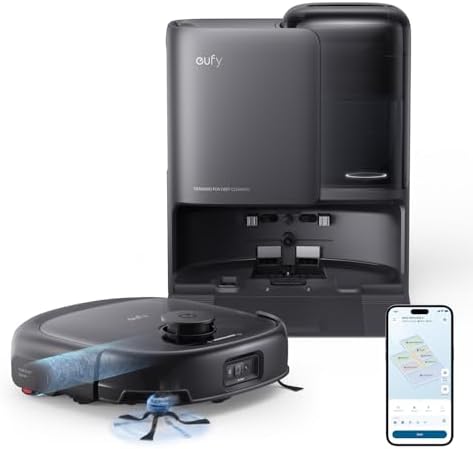
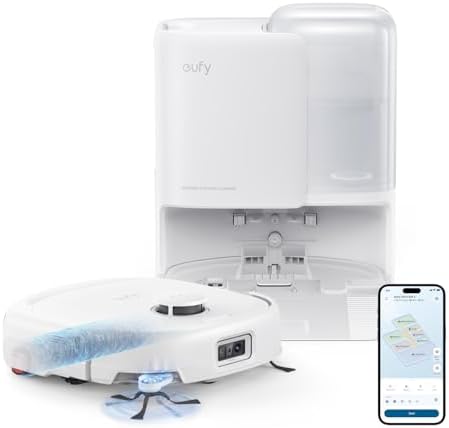
A good robot vacuum turns floor cleaning into something you stop thinking about, gliding room to room while you get on with your day. But the cheap ones bump around at random, miss whole patches, and leave you emptying a tiny bin every few days. We analyzed thousands of verified buyer reviews, recent sales data, and expert evaluations to find eight Eufy robot vacuums that map your home properly and actually clean it.
Every product we compared, in ranked order. Tap through to Amazon to check today's price, or jump to the full review below.
1
eufy C28
Best Overall38% OFF
eufy C28 Robot Vacuum & Mop (15,000 Pa)
5.0
15,000 Pa suction · iPath 2.0 LiDAR · 140 min runtime
Our Best Overall pick: Expert Reviews called it the best value robot vacuum and mop they've tested, with 15,000 Pa suction, a HydroJet self-cleaning roller mop and a fully automated station that empties, washes and hot-air dries itself.
20,000 Pa suction · 5,200 mAh battery · 3L base dust bag
Our Best for Large Homes pick: Vacuum Wars called it eufy's most impressive robot yet, pairing 20,000 Pa turbo suction with a roller mop that nails pet hair without ever tangling, plus a station rated to store roughly 75 days of dust.
eufy E28 Robot Vacuum & Mop with FlexiOne Deep Cleaner
4.8
20,000 Pa suction · FlexiOne portable cleaner · 3L base dust bag
The most versatile eufy here: 20,000 Pa suction and a HydroJet roller mop, plus a detachable FlexiOne portable deep cleaner built into the dock for carpets and upholstery.
iRobot Roomba 115X Combo Robot Vacuum & Mop with AutoEmpty Dock (15,000 Pa)
4.7
15,000 Pa suction · ClearView LiDAR · 90-day AutoEmpty dock
Not a eufy model - this iRobot brings 15,000 Pa suction and edge-sweeping brush pickup to the lineup, backed by an AutoEmpty dock that stores roughly 90 days of dust. SmartHomeCompared highlighted its compact, under-furniture-friendly design and multi-floor LiDAR mapping, though mopping stays manual with no auto-wash or lift.
Consumer Reports and Reviewed both tested this budget classic and found it picks up more on hardwood than robots costing several times as much, in a super-thin 2.85-inch body.
20,000 Pa suction · 5,200 mAh battery · 3L base dust bag
Vacuum Wars called this E25 eufy's most impressive robot yet, pairing 20,000 Pa turbo suction with a roller mop that nails pet hair without ever tangling, plus a station rated to store roughly 75 days of dust.
30,000 Pa suction · 3D MatrixEye 2.0 · 150 min runtime
The newest addition to eufy's Omni lineup: Vacuum Wars measured a flawless 24-of-24 score in its obstacle-avoidance torture test and found the 30,000 Pa AeroTurbo system lifted 87% of embedded carpet sand versus 61% for its own predecessor. A camera-based navigation system replaces the usual LiDAR turret, keeping the robot's profile low enough to clean under furniture other Omni models can't reach.
Not a eufy model - this Shark is a vacuum-only robot built around 360-degree LiDAR Matrix Clean mapping and a bagless self-empty base rated for about 30 days of dust. Just a Dad Approved found genuine HEPA filtration and long battery life, but flagged suction and obstacle avoidance as clear weak points next to the eufy models in this lineup.
Understand the category before you buy - what the science actually says, and which specs matter.
Every robot vacuum promises hands-off floors, but how it finds its way, how hard it pulls, and how much it cleans up after itself vary enormously across a lineup like this. Here is how these machines work, why the navigation system matters more than the headline suction number, and the features actually worth comparing.
What does a robot vacuum actually do?
A robot vacuum drives itself around your floors, pulling dirt, dust, and hair into an onboard bin, then returns to its charging dock when the battery runs low or the job is done. The better models add a few layers on top of that basic loop:
Build a map of your home so they clean in orderly rows instead of wandering
Mop hard floors, either by dragging a damp pad or spinning one
Empty their own bin into a larger bag in the base station
Steer around shoes, cables, and pet messes using cameras and sensors
Take commands from a phone app or your voice, with no monthly fee to use them
You control most of this from a free app, setting no-go zones, scheduling cleans, and picking suction levels room by room.
Navigation is the feature that decides everything else
If you check one thing before you buy, make it navigation, because it is what separates a robot that cleans your whole floor in tidy, overlapping rows from one that bumps around randomly and leaves gaps. Every model in this lineup uses laser-based LiDAR mapping, like the iPath LiDAR on the C28 and E25, the ClearView LiDAR on the iRobot Roomba here, and the 360-degree Matrix Clean LiDAR on the Shark model. LiDAR builds an accurate floor plan, remembers it across multiple levels, and lets the robot plan an efficient path instead of bumping around at random.
Once navigation is sorted, suction in pascals is the next thing to check, and it is where this lineup spreads out most: from 5,000 Pa on the L60 up to 30,000 Pa on the Omni S2 (not every brand publishes a pascal figure, so compare lab-tested pickup results too). Higher pascals matter most on carpet and for pet hair, where the vacuum has to lift debris out of fibers rather than sweep it off tile.
After that, a self-empty dock is the upgrade that turns a robot from a gadget you tend into genuinely hands-off cleaning. Instead of emptying a small onboard bin every few days, the robot drops its dust into a sealed bag in the base, so the C28, E25 and Omni S2 go about 60-75 days between bag changes, the Roomba's AutoEmpty dock stretches to about 90 days, and the Shark's bagless base holds roughly 30 days. If your model mops, look for a design that lifts or rinses the pad so it does not just push dirty water around. The HydroJet roller models auto-wash the mop and hot-air dry it, while the Roomba's pad drags manually and the Shark skips mopping entirely. Match the suction, mopping, and dock features to your actual floors.
Which specs actually matter?
Navigation: LiDAR mapping (iPath on the eufy models, ClearView on the Roomba, 360-degree Matrix Clean on the Shark) cleans in planned rows and remembers multi-floor layouts, so every model in this lineup covers a room systematically instead of bumping around.
Suction power: Ranges from 5,000 Pa to 30,000 Pa in this lineup, though the Shark here doesn't publish a pascal figure. Aim high if you have carpet or pets; hard floors need far less.
Self-empty dock: A base holds weeks of dust, from about 30 days on the Shark's bagless base up to 90 days on the Roomba's AutoEmpty dock, so you are not touching the bin constantly.
Mopping system: Roller and spinning mops that auto-wash and hot-air dry stay cleaner than a passive drag pad. Pad or mop lift keeps carpet dry; the Roomba's pad drags manually and the Shark doesn't mop at all.
Obstacle avoidance: AI and camera avoidance, as on the E25, steers around cords and pet messes that a basic robot would drag through; the Roomba and Shark here instead rely on laser-only navigation without a front camera.
Battery runtime: Rated times run up to 216 minutes vacuum-only, though mixed vacuum-and-mop runs shorter, closer to 110 to 125 minutes. Bigger homes need the longer figures.
Anti-tangle brushes: Zero-tangle rollers and DuoSpiral detangle brushes keep long hair from wrapping the roller, which matters most in pet households.
How we grade products
Graded Picks rankings are aggregated from several independent signals: verified buyer ratings and the size of the review base for credibility, recent monthly purchase volume for relevance, assessments from trusted home and cleaning publications, and how each product places in leading category lineups. For robot vacuums we weigh:
Navigation accuracy and mapping
Suction power on carpet and hard floors
Self-empty and dock automation
Mopping quality and pad handling
Obstacle avoidance in real homes
Battery runtime and coverage
Anti-tangle performance and overall value
Setup and maintenance note: A robot vacuum works best after you let it map your home once and set no-go zones around cords, pet bowls, and clutter. Even self-emptying models still need occasional care: clear the brushes of tangled hair, rinse or replace mop pads, and change the base bag when it fills. A quick tidy of the floor before a run keeps the robot from choking on socks and charging cables.
In-Depth Reviews
Everything we learned from buyer reviews and expert testing, product by product.
eufy C28
Best Overall38% OFF
1. eufy C28 Robot Vacuum & Mop (15,000 Pa)
5.0
The eufy C28 is our Best Overall pick on the strength of remarkably broad, positive expert coverage at a mid-range price. Expert Reviews called it the best value robot vacuum/mop combo they'd tested, and lab measurements back that up: a top-10 mopping score with 9.8 N of downward pressure and 270 RPM roller spin, an 89% carpet deep-clean result, and a flawless anti-tangle result against 7-inch hair. The Omni station handles the unglamorous parts on its own - self-emptying into a 3-liter bag rated for roughly 75 days, washing the mop roller, and drying it with 122°F hot air - while iPath 2.0 LiDAR maps multiple floors for the companion app. Testers' honest caveats: its 15,000 Pa suction figure is modest next to newer 20,000+ Pa flagships (though real-world pickup is strong), corner cleaning and navigation around scattered cables or socks isn't its strongest suit, and stubborn dried stains still benefit from a manual pass.
Suction power15,000 Pa
NavigationiPath 2.0 LiDAR mapping
Battery runtimeUp to 140 minutes
Mopping systemHydroJet roller mop, auto wash & hot-air dry
Dust capacity (bin / base)300 ml onboard bin; 3L base bag (~75 days)
iPath 2.0 LiDAR multi-floor mapping at a mid-range price
Cons
15,000 Pa suction trails newer 20,000+ Pa flagships on paper
Corner cleaning and navigation around clutter isn't its strongest suit
Stubborn dried stains still need a manual pre-treatment
Who is it for?
Most buyers: anyone who wants genuinely strong vacuuming and mopping with full station automation without paying flagship prices.
Who is it not for?
Buyers fixated on suction specs alone (our Best for Large Homes E25 below rates 20,000 Pa) and cluttered homes that need best-in-class obstacle navigation.
The E25 Black is our Best for Large Homes pick: Vacuum Wars called it eufy's most impressive robot to date, and its dust-handling capacity backs up multi-room use - a 3-liter base bag rated for around 75 days between changes, plus a 5,200 mAh battery officially rated for 216 minutes in vacuum-only mode (roughly 110-125 minutes mixed vacuum-and-mop, still enough for 1,000+ sq ft on one charge). Independent testing found it the rare mid-range robot that nails pet hair pickup almost perfectly without ever tangling the roller, and while its 20,000 Pa rating is a motor-capacity figure rather than measured floor suction, real carpet pickup still came in around 88% in lab tests. The HydroJet mopping system uses dual water reservoirs to keep the roller mop fresh through long runs. The honest caveats: measured suction at the brush trailed some rivals in bench tests, and toughest stains still need a second pass.
Suction power20,000 Pa (turbo)
NavigationiPath LiDAR, multi-floor mapping
Battery runtimeUp to 216 min vacuum-only; ~110-125 min mixed
Dust capacity (bin / base)300 ml onboard bin; 3L base bag (~75 days)
Anti-tangle & obstaclesZero-tangle roller, extendable side brush, AI avoidance
Robot dimensions~13.8" diameter x 4.4" H
Pros
Vacuum Wars called it eufy's most impressive robot yet
Nails pet hair pickup with essentially no tangling in testing
3-liter base bag rated for about 75 days between changes
5,200 mAh battery covers 1,000+ sq ft on one charge
Dual water reservoirs keep the roller mop fresh on long runs
Cons
Measured suction at the brush trailed some rivals despite the 20,000 Pa rating
Toughest, driest stains still need a manual second pass
Full mixed vacuum-and-mop runtime is closer to 110-125 minutes than the 216-minute headline figure
Who is it for?
Larger homes and multi-room layouts that want long dust-bag intervals and dependable pet-hair pickup.
Who is it not for?
Buyers who specifically want a dedicated furniture and upholstery attachment, which this model doesn't include, or the more affordable C28 above if 15,000 Pa suction is enough.
3. eufy E28 Robot Vacuum & Mop with FlexiOne Deep Cleaner
4.8
The E28 does everything the E25 does and adds a genuinely unique feature: a detachable FlexiOne portable deep cleaner lives inside the dock, ready with a hose, brush and spray nozzle for spot-cleaning fabric furniture and stairs the robot can't reach. In lab testing it removed 85% of deeply embedded carpet dirt - a top-eight result among more than 150 robots evaluated - and posted a stain-removal score well above the category average. The HydroJet system's dual water reservoirs and dual-scraper structure keep the roller mop refreshed continuously, while DuoSpiral detangle brushes keep maintenance low for pet owners. The all-in-one station handles self-emptying, mop washing, hot-air drying, detergent dispensing and wastewater collection on its own. The trade-offs: it's the most expensive eufy in this lineup, the FlexiOne attachment adds a learning curve, and like its siblings, real-world mixed-mode runtime lands well under the quiet-mode headline figure.
Suction power20,000 Pa (turbo)
NavigationLiDAR + camera mapping
Battery runtimeUp to 216 min hard floor; ~110 min mixed
Mopping systemHydroJet roller + FlexiOne portable deep cleaner
Dust capacity (bin / base)300 ml onboard bin; 3L base bag (~75 days)
Anti-tangle & obstaclesDuoSpiral detangle brushes, LiDAR + camera avoidance
Robot dimensions~13.8" diameter x 3.8" H
Pros
Top-eight carpet deep-clean score among 150+ robots tested
Unique FlexiOne portable deep cleaner for furniture and stairs
Above-average stain-removal score in independent testing
4. iRobot Roomba 115X Combo Robot Vacuum & Mop with AutoEmpty Dock (15,000 Pa)
4.7
The Roomba 115X Combo is not a eufy model, but its AutoEmpty dock and 15,000 Pa Power-Lifting suction put it in direct competition with eufy's mid-range Omni-series robots in this lineup. ClearView LiDAR maps up to three floors and lets the app set Keep Out Zones and a dedicated No Mop Zone so the trailing mop pad skips carpet automatically, a detail SmartHomeCompared called out as useful for mixed hard-floor-and-rug homes. The dock empties the bin into a sealed 2.5-liter AllergenLock bag rated for about 90 days, closing the gap with eufy's own self-empty stations. iRobot rates the battery for about 100 minutes and roughly 900 square feet per charge, enough for an apartment or small house in a single run, and three selectable modes (vacuum, mop, or both) let buyers match the cleaning method to the floor. The honest tradeoffs: the microfiber mop pad is a passive drag design with no auto-washing, drying or lifting, so it needs hand-rinsing between runs, and the robot connects only over 2.4 GHz Wi-Fi with no Matter, Apple HomeKit or Samsung SmartThings support.
Suction power15,000 Pa (Power-Lifting)
NavigationClearView LiDAR, up to 3 floor maps
Battery runtimeUp to 100 minutes (~900 sq ft/charge)
The 11S MAX is the no-frills, budget end of eufy's lineup, and independent testing consistently finds it punches above its price on hardwood floors, outperforming some robots that cost four times as much. There's no mopping, no LiDAR and no app here - just BoostIQ auto-boosting suction, dual side brushes for edges, and a 2.85-inch profile thin enough to slide under furniture that stops taller robots. It runs at a measured 55 dB, about the level of normal conversation, and a 2,600 mAh battery covers up to 100 minutes before self-charging. The honest limits are real: there's no WiFi or voice control, no mopping function, and no LiDAR mapping - it navigates by bumping around rooms rather than building a map, so coverage is less systematic than eufy's Omni-series robots above.
Suction power2,000 Pa (BoostIQ)
NavigationBump navigation, no app/LiDAR
Battery runtimeUp to 100 minutes
Mopping systemNone (vacuum-only)
Dust capacity (bin / base)600 ml onboard bin, no base
Anti-tangle & obstaclesDual side brushes, low 2.85" profile
Robot dimensions12.79" x 12.79" x 2.85"
Pros
Consumer Reports and Reviewed testing found strong hardwood pickup for the price
2.85-inch super-thin body slides under low furniture
Quiet 55 dB operation, comparable to normal conversation
Dual side brushes handle edges and corners well
By far the lowest price in this eufy lineup
Cons
No mopping function, LiDAR mapping or app/WiFi control
Bump navigation is less systematic than the mapped robots above
600 ml dustbin and 100-minute runtime suit smaller spaces
Who is it for?
Budget buyers and smaller homes that just need reliable hardwood and light-carpet vacuuming without app fuss or mopping.
Who is it not for?
Anyone who wants mopping, app control or multi-floor mapping - every other eufy model above offers those.
The E25 White is eufy's large-home-capable E25 variant: Vacuum Wars called it eufy's most impressive robot to date, and its dust-handling capacity backs up multi-room use - a 3-liter base bag rated for around 75 days between changes, plus a 5,200 mAh battery officially rated for 216 minutes in vacuum-only mode (roughly 110-125 minutes mixed vacuum-and-mop, still enough for 1,000+ sq ft on one charge). Independent testing found it the rare mid-range robot that nails pet hair pickup almost perfectly without ever tangling the roller, and while its 20,000 Pa rating is a motor-capacity figure rather than measured floor suction, real carpet pickup still came in around 88% in lab tests. The HydroJet mopping system uses dual water reservoirs to keep the roller mop fresh through long runs. The honest caveats: measured suction at the brush trailed some rivals in bench tests, and toughest stains still need a second pass.
Suction power20,000 Pa (turbo)
NavigationiPath LiDAR, multi-floor mapping
Battery runtimeUp to 216 min vacuum-only; ~110-125 min mixed
The Omni S2 is eufy's newest flagship, and independent testing backs up the higher price tag: Vacuum Wars was the only outlet in its test group to record a perfect 24-of-24 result in obstacle avoidance, crediting an AI-powered front camera that recognizes more than 200 household objects in place of the LiDAR turret found on older Omni models. That camera-based 3D MatrixEye 2.0 system keeps the robot just 98mm tall, low enough to clear furniture that trips up taller siblings. On carpet, testers measured 87% embedded-sand removal, a sizeable jump over the prior-generation S1, alongside strong flattened pet-hair pickup. The HydroJet 2.0 roller mop self-cleans in the dock, and the base station empties a 330 ml onboard bin into a 2.5-liter bag rated for about 60 days between changes. Reviewers flag two honest tradeoffs: the battery is rated for 150 minutes but testing found real-world coverage closer to 120 minutes per charge, and at 57 dB it runs a touch louder than some flagship rivals. Combined with a $1,599.99 list price, this is a premium pick for buyers who specifically want best-in-class obstacle handling.
Suction power30,000 Pa
Navigation3D MatrixEye 2.0 (ToF sensors + AI camera, no LiDAR)
Battery runtimeUp to 150 min rated; ~120 min real-world
Mopping systemHydroJet 2.0 roller mop, auto wash & dry
Dust capacity (bin / base)330 ml onboard bin; 2.5L base bag (~60 days)
Anti-tangle & obstaclesDuoSpiral anti-tangle brush, AI camera avoidance (200+ objects)
Robot dimensions14.1" x 12.8" x 3.9"
Pros
Vacuum Wars recorded a perfect 24-of-24 score in obstacle-avoidance testing, the best in its test group
87% embedded-sand removal on carpet in independent testing, well ahead of the prior-generation S1
Camera-based 3D MatrixEye 2.0 navigation keeps the robot just 98mm tall for low-clearance furniture
HydroJet 2.0 roller mop self-cleans and dries in the dock automatically
330 ml onboard bin empties into a 2.5-liter base bag rated for about 60 days
Cons
Real-world battery coverage runs closer to 120 minutes despite a 150-minute rating
57 dB operating volume is a touch louder than some flagship rivals
Fixed, non-removable battery limits long-term serviceability, and the $1,599.99 price is the highest in this lineup
Who is it for?
Buyers who want eufy's most capable current obstacle avoidance and carpet cleaning and don't mind paying flagship prices for it.
Who is it not for?
Budget-conscious buyers and anyone satisfied with the C28 or E-series above, which cover similar core cleaning for far less.
8. Shark AV2501S AI Ultra Robot Vacuum (Self-Empty Base)
4.4
The AV2501S AI Ultra is not a eufy model, and unlike every eufy robot in this lineup it skips mopping entirely to focus on vacuuming alone. Its 360-degree LiDAR builds a home map and drives Shark's Matrix Clean pattern, which makes repeated grid passes over a room rather than a single sweep, and testers measured 17.7 CFM of airflow, in the same range as some pricier flagship robots. A true HEPA system captures 99.97% of dust down to 0.3 microns, and the bagless self-empty base holds roughly 30 days of debris, trading the recurring cost of dock bags for a canister you empty by hand. Battery runs up to 120 minutes with a Recharge and Resume feature that lets the robot finish a job across multiple charges. The honest weak points from testing: Shark markets this model without a published pascal rating, and reviewers found real-world pickup on the lighter side compared with the pascal-rated eufy robots here; the self-cleaning brushroll still lets some hair collect at pathway snag points; and there is no camera, so obstacle avoidance is inconsistent around furniture legs and cords.
Suction powerShark AI Ultra suction system (17.7 CFM airflow)
Anti-tangle & obstaclesSelf-cleaning brushroll; no camera-based obstacle avoidance
Robot dimensions13.7" diameter x 4.1" H
Pros
True HEPA filtration captures 99.97% of dust and allergens down to 0.3 microns
Bagless self-empty base holds about 30 days of debris with no recurring bag cost
360-degree LiDAR Matrix Clean mapping with repeated grid-pattern passes
Up to 120-minute runtime with Recharge and Resume to finish a job across charges
Cons
Shark markets suction without a pascal rating, and testers found real-world pickup on the lighter side
No camera, so obstacle avoidance around furniture legs and cords is inconsistent
Vacuum-only: no mopping function, unlike every eufy model in this lineup
Who is it for?
Buyers who specifically want true HEPA filtration and a no-bag self-empty base and don't need mopping.
Who is it not for?
Anyone who wants mopping or the strongest measured suction - every eufy model above offers mopping, and several rate meaningfully higher in independent suction tests.
The stars you see are the Graded Picks cumulative score, not a single retailer's average. It blends verified buyer reviews aggregated across major retailers, assessments from professional reviewers and expert testers, and how prominently the product features in leading category lineups.
Advertising Disclosure
Our rankings are compiled by aggregating several independent signals, including verified buyer feedback, how popular a product currently is with shoppers, and evaluations published by professional reviewers. Editorial opinions are our own.
Please note that we participate in affiliate marketing programs. When you purchase through links on our site, we may earn a commission. As an Amazon Associate we earn from qualifying purchases. This comes at no additional cost to you and helps support the resources required to provide valuable content.