A handheld pool vacuum is the fastest way to grab the leaves, sand, and grit sitting on your steps and in the corners before a swim. But the cheap ones die halfway through the job or barely lift the debris they touch, which turns a five-minute cleanup into a chore you dread. We analyzed thousands of verified buyer reviews, recent sales data, and expert evaluations to find six handheld pool vacuums that finish the job in one pass and actually hold what they pick up.
Every product we compared, in ranked order. Tap through to Amazon to check today's price, or jump to the full review below.
1
InoKraft K1.5 Pro
Best Overall30% OFF
InoKraft K1.5 Pro Cordless Pool Vacuum
5.0
18.5 GPM suction · 59" extendable pole · ~60-min runtime
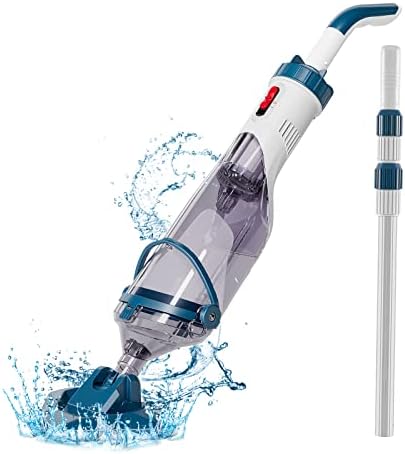
Our Best Overall pick: a rechargeable handheld vacuum built around a clear suction head so you can watch debris disappear in real time, backed by strong flow and a nearly 5-foot reach.
A lightweight, no-hose cordless vacuum that independent testers found genuinely lifts the fine debris that settles on the pool floor, not just the big leaves.
A full-power cordless vacuum with the fastest recharge in this lineup, and the one wellwhisk.com named the best handheld cordless pool vacuum it tested. A 40W motor, 18.5 GPM suction and a 1.5-hour full charge round out the package.
Up to 75-min runtime · 2 filter mesh sizes · Fits standard telepoles
A wheel-guided handheld cleaner built around automatic safety shutoffs and two swappable filter meshes, designed to attach to any standard pool telepole you already own.
Our Best Affordable pick: a cordless vacuum rated at 26.5 GPM, the strongest suction in this lineup, with two interchangeable heads and four filter bags at the lowest price here.
Short on time? These three cover most buyers: our Best Overall visible-suction InoKraft, the Best Affordable UIRWAY V3 Pro, and the wide-head Enhulk PC15 built for large pools.
Handheld Pool Vacuums 101: What They Do & How to Choose
Understand the category before you buy - what the science actually says, and which specs matter.
Every handheld vacuum here promises strong suction and cordless freedom, but the way they are built decides whether they clear your pool in one charge or leave you recharging halfway through. Here is how they work, the one expectation to set before you buy, and the features actually worth comparing.
What does a handheld pool vacuum actually do?
A handheld pool vacuum is a battery-powered wand you dip into the water and drive by hand over the pool floor, steps, and walls. As you pass it over debris, an internal motor pulls water and dirt through the head, traps the solids in a filter or mesh bag, and lets the clean water flow back out. Because it is cordless and rechargeable, there is no hose, no pump hookup, and no cord to trip over.
It runs on a rechargeable lithium-ion battery, so you charge it, then clean.
Debris collects in a reusable filter chamber or mesh bag that you rinse and reuse.
Most attach to a telescopic pole for reach, or work as a short handheld wand for spot jobs and spas.
Know what it is for: a spot cleaner, not a robot
This is the most important thing to understand before you spend a dollar. A handheld pool vacuum is a spot cleaner, not a whole-pool robot. It is made to grab leaves, sand, and debris from steps, corners, and small or above-ground pools quickly by hand, not to patrol a big in-ground pool on its own while you do something else.
Once you accept that, the specs sort themselves out. Runtime per charge becomes the number that decides whether you finish in one pass or stop to recharge. Most models here run for about an hour on a charge, with the VIVOHOME the longest runner at up to 75 minutes. A small above-ground pool or a spa is easy work for any of them. A large in-ground pool may need you to plan around the battery, or accept that you are targeting the dirty spots rather than covering every square foot.
After runtime, suction plus debris-chamber size plus pole fit decide how well the vacuum actually lifts and holds what it finds. Suction across this lineup is tightly clustered around 18.5 GPM, so the bigger differences come from how much a unit can hold before it clogs and whether it reaches where you need it. A vacuum that picks up beautifully but fills after one corner still means constant emptying.
Which specs actually matter?
Once you know it is a spot cleaner, a few features decide which one fits your pool:
Runtime per charge: The headline number. Most models here run about an hour per charge, with the VIVOHOME the longest runner at up to 75 minutes. Match it to your pool size, and remember charging times vary too, from 90 minutes on the InoKraft and both ENHULK models up to about 2 hours on the VIVOHOME.
Suction flow: Measured in gallons per minute, this lineup sits at about 18.5 GPM across the board, so it is rarely the deciding factor. Treat strong suction as table stakes, not a tiebreaker.
Debris chamber and filter: This is how much it holds before you empty it. Look for a real capacity figure like the 1.5-liter filter on the PC10, or multiple filter bag mesh sizes so you can switch between coarse leaves and fine sand, such as the 180/500 micron pair included with the LANCHEZ.
Pole and reach: Check that it fits a telescopic pole and how far it extends. Reach here spans a short 59-inch extendable pole up to 98.4 inches on the longest telescoping model here.
Head and mobility: A wider head clears faster. The ENHULK PC15 uses a 13.4-inch wide head with side brushes for more coverage per pass.
Weight: You hold this at the end of a pole, so lighter is easier. These range from 6 pounds on the Teguy V40 to about 7.8 pounds on the InoKraft.
Waterproofing: If you plan to submerge the body fully, confirm the rating. Only the LANCHEZ PCT403T-L2 and the Teguy V40 in this comparison list a formal IPX8 full-submersion rating; treat the rest as splash- and dunk-resistant rather than built for constant full submersion.
How we grade products
Graded Picks rankings are aggregated from several independent signals: verified buyer ratings and the size of the review base for credibility, recent monthly purchase volume for relevance, assessments from trusted pool and spa publications, and how each product places in leading category lineups. For handheld pool vacuums we weigh:
Runtime per charge against typical pool size
Suction strength and consistency
Debris chamber size and filter options
Pole reach and telescopic-pole compatibility
Head width and maneuverability
Weight and ease of one-handed use
Build quality, waterproofing, and warranty
Maintenance note: Rinse the filter or mesh bag after every use and let it dry before storing, because trapped debris and moisture shorten the life of both the filter and the seals. Charge the battery fully before the season starts, and avoid submerging the motor body past its rated waterproof level, since only some models here are built for full submersion.
In-Depth Reviews
Everything we learned from buyer reviews and expert testing, product by product.
InoKraft K1.5 Pro
Best Overall30% OFF
1. InoKraft K1.5 Pro Cordless Pool Vacuum
5.0
Our Best Overall pick. The K1.5 Pro pairs an 18.5 GPM suction rating with a transparent suction port, so instead of guessing whether a pass actually worked, you can watch fine silt and sand get pulled up as you go. Independent reviewers who tested it found it delivers on the core promise of cordless spot-cleaning: real suction, minimal setup, and no hose to fight with the pool's own filtration system. A 59-inch extendable pole and a self-supporting body let it stand upright between passes, while a dual-mode brush head adapts from shallow steps to the deep end. On a full charge it runs for about an hour, plenty for routine maintenance between full pool cleanings, and it recharges in about 90 minutes. It's a manual vacuum you guide yourself rather than a set-and-forget robot, and testers note it can feel a bit bulky during extended sessions, but for spot-cleaning debris between deeper cleans it remains one of the strongest all-around picks in this comparison.
Suction flow18.5 GPM (1,110 gal/hr)
Runtime per chargeAbout 60 minutes
Charging time90 minutes
Pole length59" extendable
Battery18V rechargeable lithium-ion, 5-cell pack
Weight7.78 lbs
Warranty1-year limited
Pros
Transparent suction head shows debris being picked up in real time
Strong 18.5 GPM suction rated flow
59-inch extendable pole with a self-supporting, stand-upright body
Dual-mode brush head suits both shallow steps and deep ends
About an hour of runtime on a full charge
Cons
Manual, hands-on operation rather than a set-and-forget robot
Can feel bulky to maneuver during longer cleaning sessions
Large debris loads may need a mid-clean recharge
Who is it for?
Pool owners who want a reliable, visible-suction spot-cleaner for routine maintenance between deeper cleanings.
Who is it not for?
Anyone who wants a fully automated robotic cleaner that runs without supervision.
The PC10 is Enhulk's original cordless handheld design, and independent testing found it does what most pool owners actually need day to day: quick setup, real suction on fine debris that settles on the floor, and cordless freedom from wrestling a hose against the pool's own filtration system. Its 20-volt motor and 18.5 GPM suction rating power a full hour of runtime on a single charge, recharging in about 90 minutes, and a touch control panel keeps operation simple. Reviewers consistently frame it as an easy recommendation for keeping an in-ground or above-ground pool tidy between deeper cleans, especially for the fine material that a pool's built-in filter alone won't catch. The main limitation echoed across testing is the same one shared by every battery-powered model here: a large pool with heavy debris buildup can outlast a single charge.
Suction flow18.5 GPM
Runtime per chargeAbout 60 minutes
Charging time90 minutes
Pole length7.3 ft (87.6") telescopic
Filter capacity1.5 liters
Weight6.4 lbs
Warranty2-year manufacturer
Pros
Independently tested to genuinely lift fine floor debris, not just leaves
Full hour of runtime on a single charge
Simple touch controls, no hose required
Lightweight and easy to maneuver
Cons
Heavy debris buildup in large pools may require a mid-session recharge
No wide cleaning head like the newer PC15
Manual operation requires guiding it yourself across the whole floor
Who is it for?
Pool owners who want a proven, independently tested cordless vacuum for regular fine-debris maintenance.
Who is it not for?
Owners of very large pools who let debris build up between cleanings and need maximum single-charge runtime.
The PC15 is Enhulk's upgraded successor to the PC10, built around a 13.4-inch wide cleaning head with side brushes that clear more surface area per pass than a standard narrow head. It keeps the same 18.5 GPM suction rating and hour-long runtime as its sibling, powered by a 5x2000mAh battery pack that recharges in about 90 minutes, and extends to an 87.5-inch telescopic pole for reaching across a full-size pool without repositioning constantly. As Enhulk's most recent release, it carries less accumulated owner feedback than the established PC10, but shares the same manufacturer and 2-year tool warranty. The wider head is the clearest differentiator: for pools with a lot of open floor area, fewer passes to cover the same space is a genuine time-saver over a standard-width head.
Suction flow18.5 GPM (70 L/min)
Runtime per chargeAbout 60 minutes
Charging time90 minutes
Pole length87.5" telescopic
Cleaning head13.4" wide head with side brushes
Battery5 x 2000mAh lithium-ion cells
Warranty2-year manufacturer
Pros
13.4-inch wide cleaning head covers more floor per pass
Side brushes help dislodge debris ahead of suction
Same 18.5 GPM suction and hour-long runtime as the proven PC10
87.5-inch telescopic pole reaches across a full-size pool
2-year manufacturer tool warranty
Cons
Newest release with less accumulated owner feedback than the PC10
Wider head is bulkier to maneuver in tight corners and steps
Costs more than the standard-width PC10
Who is it for?
Owners of larger pools with open floor area who want fewer passes per cleaning session.
Who is it not for?
Buyers with lots of steps, corners or a tight above-ground pool shape where a narrower head maneuvers more easily.
The Teguy V40 pairs a 40W motor with an 18.5 GPM suction rating and what wellwhisk.com called "the fastest recharge time in its class": a full charge in just 1.5 hours via its Supercharge Technology, versus the 2 to 3.5 hours several rivals in this comparison require, for about 60 minutes of runtime per charge. Reviewers highlight real-world suction against sand, leaves and insects, with wellwhisk.com noting it clears a 15-foot above-ground pool without needing to empty its filter bag mid-session, and naming it their overall pick for best handheld cordless pool vacuum. Four reusable 500-mesh filter bags ship in the box, an IPX8 waterproof rating covers full submersion, and a smart protection system automatically cuts power if the unit runs more than a minute without being submerged. A 7-foot telescopic pole extends its reach across above-ground and inground pools, hot tubs and spas alike, at one of the more wallet-friendly prices in this comparison. The main knock from testers is mechanical: the handle and pole show some flex during aggressive side-to-side sweeping, though most owners report no issues in normal use.
Suction flow18.5 GPM (40W motor)
Runtime per chargeAbout 60 minutes
Charging time1.5 hours (Supercharge Technology)
Pole length7 ft telescopic
Waterproof ratingIPX8 (full submersion)
Weight6 lbs
Warranty1-year manufacturer
Pros
Fastest recharge in its class: a full charge in 1.5 hours via Supercharge Technology
wellwhisk.com named it the best handheld cordless pool vacuum it tested
IPX8 waterproof rating with an automatic dry-run shutoff to protect the motor
Four reusable 500-mesh filter bags included for fine sand and debris
7-foot telescopic pole reaches across above-ground pools, inground pools, spas and hot tubs
Cons
Handle and pole show some flex during aggressive side-to-side sweeping
60-minute runtime means larger pools may need a recharge mid-session
No dedicated wide cleaning head like the Enhulk PC15 above
Who is it for?
Pool owners who want the fastest charge-to-clean turnaround in this comparison and a fully waterproof, motor-protected design.
Who is it not for?
Owners who want the longest possible single-charge runtime or the lowest price in this comparison.
The Jet Sweep takes a different approach from the rest of this lineup: instead of shipping its own pole, it's designed to click onto any standard pool telepole you likely already have in the garage, then glide across the pool or spa floor on four 360-degree swivel wheels. Two reusable filter bags - a 250-micron standard mesh and a 75-micron intensive mesh - swap in tool-free depending on whether you're chasing leaves or fine silt, and the unit automatically shuts off both when lifted out of the water and if debris ever clogs the impeller, a safety layer none of its rivals here call out explicitly. It's rated for saltwater pools up to 5,000 ppm and depths to 9.8 feet, and runs up to 75 minutes on a charge with about a 3.5-hour recharge. As a newer arrival, it has a thinner independent-testing footprint than the established brands in this comparison, and it carries the highest price and shortest warranty of the group, so weigh the pole-free flexibility against those trade-offs.
Runtime per chargeUp to 75 minutes
Charging timeAbout 3.5 hours
Pole compatibilityFits standard pool telepoles (sold separately)
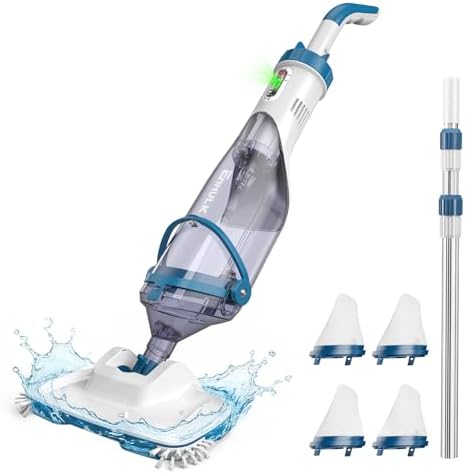
The UIRWAY V3 Pro takes our Best Affordable spot after undercutting the rest of this lineup on price while delivering the strongest suction here: a 120W motor rated at 26.5 GPM, enough that independent testing found it lifts large pebbles and light algae that gentler vacuums leave behind. It ships with two interchangeable heads, a compact spot head for tight corners and steps and a wider 10.5 by 5.4 inch triangular head for open floor area, plus four reusable filter bags split between a 100-micron fine mesh for sand and silt and a 420-micron coarse mesh for leaves and larger debris. An adjustable telescopic pole extends from 31 to 118 inches, covering both shallow steps and deep ends, and the fully IPX8-rated body can be submerged to that same 118-inch depth without concern. Runtime is about an hour per charge on its four 2,600mAh cells, with roughly 3.5 hours to recharge from empty. As a newer listing it carries less accumulated independent testing than some established rivals here, and testers note the metal extension pole can flex under hard use and the filter bags need frequent emptying on heavy debris loads, but the suction-per-dollar is the strongest case in this comparison.
Suction flowUp to 26.5 GPM (120W motor)
Runtime per chargeAbout 60 minutes
Charging timeAbout 3.5 hours
Pole length31" - 118" adjustable telescopic
Cleaning heads2 heads included: compact spot head and 10.5" x 5.4" wide triangular head
Filter bags4 filter bags included (100 micron fine x2, 420 micron coarse x2)
Waterproof ratingIPX8 (full submersion to 118" depth)
Pros
Highest suction rating in this comparison at 26.5 GPM / 120W, enough to lift pebbles and algae gentler vacuums miss
Ships with two interchangeable heads: a compact spot head and a wide 10.5" x 5.4" triangular head
Four filter bags split between 100-micron fine mesh and 420-micron coarse mesh for different debris
IPX8 waterproof rating supports full submersion to 118 inches
Lowest price in this comparison at the time of this scan
Cons
Newer listing without the years of independent testing some rivals here have built up
Metal extension pole can feel flimsy under aggressive side-to-side sweeping, per testers
Filter bags fill quickly and need frequent emptying on heavy debris loads
Who is it for?
Budget-focused pool owners who want the strongest raw suction in this comparison for pebbles, sand and algae.
Who is it not for?
Buyers who want the longest independent testing track record or the lightest possible wand (see the Teguy V40 or InoKraft above).
The stars you see are the Graded Picks cumulative score, not a single retailer's average. It blends verified buyer reviews aggregated across major retailers, assessments from professional reviewers and expert testers, and how prominently the product features in leading category lineups.
Advertising Disclosure
Our rankings are compiled by aggregating several independent signals, including verified buyer feedback, how popular a product currently is with shoppers, and evaluations published by professional reviewers. Editorial opinions are our own.
Please note that we participate in affiliate marketing programs. When you purchase through links on our site, we may earn a commission. As an Amazon Associate we earn from qualifying purchases. This comes at no additional cost to you and helps support the resources required to provide valuable content.