Lie back, lock in your ankles, and let gravity do the stretching: an inversion table tilts you head-down so your own body weight gently pulls your spine apart and eases pressure on the discs and joints in your lower back. The catch is that a wobbly frame, a fiddly ankle lock, or an angle you cannot control turns a soothing stretch into a nervous one. We analyzed thousands of verified buyer reviews, recent sales data, and expert evaluations to find seven inversion tables that hold you securely and let you take it at your own pace.
300 lb capacity · 4'8"-6'6" fit · Full 90° inversion
Our Best Overall pick: Teeter's premium FitSpine model, an FDA-registered, UL-certified table with Teeter's FlexTech backrest and 8-point floating suspension, an EZ-Reach ankle lock and a 300 lb capacity for users from 4'8" to 6'6". Independent testers consistently describe it as one of the better-balanced inversion tables for comfort and build quality.
300 lb capacity · FDA 510(k) registered · 5-year warranty
Teeter's most accessible entry into medical-device territory, with the flexible ComforTrak backrest, Ergo-Embrace ankle supports and a full 5-year warranty, all at a price well under the FitSpine X3 above.
Our Best Non-Inversion Alternative pick: a motorized push-pull traction bench that decompresses the spine at the touch of a button, with no tilting, blood rush or eye strain involved. It's built around an adjustable air bag and sponge roller rated for a 400 lb user, and early buyers have compared the sensation to a chiropractor's traction table.
300 lb capacity · Tested to 1,200 lbs (4x factor) · Top-of-line model
Teeter's flagship inversion table: the same FlexTech backrest and EZ-Reach ankle lock as the X3, tested to a 4x safety factor (1,200 lbs), with a raised boarding platform and the brand's most complete accessory set.
The higher-capacity heat-and-massage sibling to the ITM4800: a vertical massage pad that runs the full length of the spine, a contoured lumbar section, and the same six-position angle pin system in a larger frame.
350 lb capacity · 4'3"-6'8" fit · 4-position pin lock
Our pick for larger and taller users: a 350 lb-rated inversion table with a wider backrest, a safety belt and a double-locking ankle system that testers describe as stable and comfortable. Its 4'3" to 6'8" height range and four-position pin lock make it one of the most size-inclusive tables in this comparison.
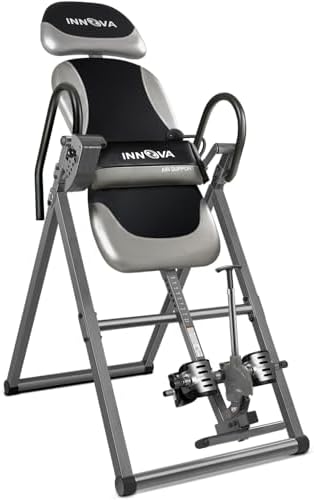
Innova ITX9900 Inversion Table with Air Lumbar Support
4.6
300 lb capacity · Adjustable air lumbar pad · 6-position angle pins
A heavy-duty inversion table built around an air lumbar pad that lets users dial in their own lower-back support, plus the same six-position angle pin system found on Innova's other models.
Short on time? These three cover most buyers - our top-graded choice, the motorized non-inversion alternative for anyone who can't safely tilt upside down, and the pick with built-in heat and massage therapy.
Inversion Tables 101: What They Do & How to Choose
Understand the category before you buy - what the science actually says, and which specs matter.
The inversion tables worth owning are the ones you feel safe using, which comes down to a secure ankle lock, a sturdy frame rated for your weight, and an angle you can actually limit. Here is how inversion works, why you almost never need to hang fully upside down, and the features worth comparing before you buy.
What does an inversion table actually do?
An inversion table is a padded backrest on a pivoting frame. You secure your ankles at the bottom, lie back, and shift your arms to tip the table so your head goes below your feet. As you tilt, your body weight decompresses the spine instead of compressing it the way sitting and standing do all day.
It stretches the spine, so the small spaces between your vertebrae open slightly.
It takes load off the discs and the muscles around your lower back.
It lets you control how far you go, and returns you upright when you shift your weight back.
The relief comes from the decompression, not from being dramatically upside down.
You don't need to flip fully upside down
This is the part most shoppers get wrong. The marketing images show people hanging at a full 90 degrees, so buyers assume that is the goal. It is not. Most of the decompression benefit arrives at modest angles, and going gentle is both safer and more comfortable, especially for beginners.
That is why the single most important feature is angle control: the ability to stop the table exactly where you want and trust that it will hold. The Teeter FitSpine X3 uses EZ-Angle tether presets that stop you cleanly at 20, 40, and 60 degrees before you ever reach full inversion, so you can start shallow and progress over weeks. The Innova ITM4800, ITX9900, and Advanced models use a six-position pin, and the Teeter EP-560 uses a spring-loaded T-pin lock. A table you can limit is a table you can relax on, and relaxed muscles are what let the stretch work.
Fit is the other half of safety. The ankle lock is your only anchor, and balance depends on your center of mass sitting where the table expects it. If you are outside the supported height or weight range, the ankle hold and the tilt both go off. Most tables here support up to 300 pounds and roughly 4 feet 8 inches to 6 feet 6 inches of height on the Teeter models, or 4 feet 10 inches to 6 feet 6 inches on the Innova models. Confirm you land inside those numbers before anything else. And note that the FF Finer Form listing is a multi-function weight bench rated to 660 pounds, not an inversion table.
Which specs actually matter?
Once you understand that control and fit come first, a few features decide which table suits you:
Angle control: This is the safety lever. Preset stops like Teeter's tethered 20, 40, and 60 degree points are easier to trust than balancing by feel, and they let you build up gradually.
Ankle lock system: You want it secure and easy to reach without straining, since you fasten it before you tip back. Teeter's EZ-Reach ankle lock and Ergo-Embrace supports are designed for that; the Innova models use U-shaped or extended-handle ankle holders.
Weight capacity and frame: Most tables here are rated to 300 pounds, and Teeter models like the EP-560 are tested to a 4x safety factor. A wide, stable base keeps the whole motion feeling planted.
Height range: Confirm your height falls inside the supported window - about 4 feet 8 inches to 6 feet 6 inches on the Teeter models, or 4 feet 10 inches to 6 feet 6 inches on the Innova models - so the pivot and ankle hold line up with your body.
Certification: The Teeter X3 and EP-560 are FDA-registered medical devices and UL safety certified. The Innova models carry no FDA registration, a real difference in how the product is vetted.
Backrest and padding: Look at how the surface supports your spine, from Teeter's FlexTech and ComforTrak backrests to Innova's massage and air-lumbar pads.
Weight and storage: These tables run from roughly 55 to 66 pounds, so factor in where it will live and how often you will move it.
How we grade products
Graded Picks rankings are aggregated from several independent signals: verified buyer ratings and the size of the review base for credibility, recent monthly purchase volume for relevance, assessments from trusted health and fitness publications, and how each product places in leading category lineups. For inversion tables we weigh:
Angle control and how gently you can start
Ankle lock security and ease of reach
Frame stability and weight capacity
Fit across the supported height range
Safety certification and build quality
Backrest comfort and padding
Overall value for the price
Safety note: Inversion loads your whole body and raises the pressure in your head and eyes, so talk to your doctor before you start, especially if you have high blood pressure, heart disease, glaucoma or other eye conditions, or if you are pregnant. Begin at a small angle for short periods, keep a hand ready to return upright, and come back up slowly if you feel any dizziness or discomfort.
In-Depth Reviews
Everything we learned from buyer reviews and expert testing, product by product.
The Teeter FitSpine X3 is our Best Overall pick, on the strength of its FlexTech backrest and 8-point floating suspension, which testers single out as noticeably more comfortable through the stretch than a rigid backrest surface. It carries FDA registration as a medical device for ten back-pain conditions and UL safety certification, and its heat-treated steel frame is rated for a 300 lb user and folds down from an 81-inch footprint to a 20-inch storage width in seconds. The Deluxe EZ-Reach ankle lock lets users secure their feet without bending all the way over first, a real advantage for anyone dealing with acute back pain, and an EZ-Angle tether with markings at 20, 40 and 60 degrees lets first-time users work up to full 90-degree inversion gradually rather than committing to it on day one. Reviewers note occasional assembly hiccups and that shoppers under about 4'11" may find the frame awkward, but for buyers who want Teeter's most refined backrest feel and the brand's full medical-device pedigree, it tops this comparison as the best-built table in the lineup. The EP-560 below remains the pick for buyers who want core Teeter inversion therapy at a lower price.
Weight capacity300 lbs
User height range4'8" to 6'6"
Angle adjustmentEZ-Angle tether presets (20°/40°/60°), full 90° inversion
CertificationsFDA-registered medical device, UL safety certified
FDA-registered medical device and UL safety certified
FlexTech backrest with 8-point floating suspension deepens the stretch
EZ-Reach ankle lock secures feet without bending fully over
Folds from an 81-inch footprint down to a 20-inch storage width
5-year warranty, well beyond the category's 1-year norm
Cons
Users under about 4'11" may find the frame awkward to use
Costs more than the Innova options in this lineup
A minority of buyers report inconsistent assembly tolerances
Who is it for?
Most buyers who want Teeter's most refined backrest feel and full medical-device pedigree in our top-graded pick, and don't mind paying more than the EP-560 below for it.
Who is it not for?
Very short users (under about 4'11") who may find the frame awkward to use, and budget-focused buyers who should look at the EP-560 below instead.
The EP-560 pairs Teeter's medical-device pedigree, FDA 510(k) registration for back pain, muscle spasm, herniated disc, sciatica and several other conditions, with the most accessible price point in the brand's current lineup. Its ComforTrak backrest surface and four removable pairs of acupressure nodes at varied heights are designed for trigger-point relief along the spine, and a removable, adjustable lumbar bridge adds targeted lower-back support that the pricier FitSpine tables handle differently. The heat-treated steel frame carries the same 300 lb capacity and 4'8" to 6'6" height range as its siblings, and Teeter backs it with a full 5-year warranty covering parts, labor and transportation. The most common complaint from long-term owners is that the frame is heavier and more awkward to fold than the FitSpine models, so buyers in small apartments should plan storage space accordingly. At a price well under Teeter's FitSpine X3 above, it delivers genuine FDA-registered inversion therapy without giving up the core backrest comfort and ankle-lock security that make Teeter the category's most trusted name.
Weight capacity300 lbs (400% safety rating)
User height range4'8" to 6'6"
Angle adjustmentSpring-loaded T-pin lock, full inversion
CertificationsFDA 510(k)-registered medical device, UL safety certified
FDA 510(k)-registered medical device at Teeter's lowest current price
ComforTrak backrest plus 4 removable acupressure node pairs
Adjustable, removable lumbar bridge for targeted lower-back support
Full 5-year warranty covering parts, labor and transportation
Lower price than the FitSpine X3 makes it the value pick of the Teeter lineup
Cons
Heavier and harder to fold than the FitSpine X3 and LX9
Lacks the FlexTech backrest and 8-point suspension of the pricier models
Some owners find it awkward to maneuver in tight storage spaces
Who is it for?
Buyers who want genuine FDA-registered inversion therapy with a strong balance of comfort, safety features and price, at the most accessible price point in the Teeter lineup.
Who is it not for?
Buyers with very limited storage space who need a table that folds down easily - and anyone who wants the FitSpine line's more advanced FlexTech backrest, covered by the X3 above.
3. HOTMUZ Electric Spinal Decompression Machine (400 lb Capacity)
4.8
The HOTMUZ Electric Spinal Decompression Machine earns our Best Non-Inversion Alternative pick by taking a fundamentally different approach than every other product in this comparison: instead of pivoting you upside down, a linear motor pulls your body horizontally along a padded bench, using an adaptive air bag and a low-friction sponge roller to apply steady, non-pulsating traction to the lower back. Traction intensity is adjustable at the push of a button rather than by shifting your own body weight, and because you stay flat and level throughout, there's none of the head-rush, eye-pressure or balance concerns that come with tilting fully upside down - a real advantage for buyers who can't safely invert due to glaucoma, high blood pressure or heart conditions. The bench, motor unit, air bag, roller and strap all ship together, and HOTMUZ rates the setup for users up to 400 lbs. Early buyer feedback is positive, with at least one reviewer comparing the sensation favorably to a chiropractic traction table, though the product is new enough - first available in late 2025 - that it lacks the multi-year track record and dedicated professional lab testing of the Teeter and Innova tables here. HOTMUZ backs it with a standard 1-year manufacturer warranty.
Included componentsMotor unit, air bag, bench frame, sponge roller, strap
Shipping weight13.61 kg (about 30 lbs)
Warranty1 year (manufacturer)
Pros
Motorized traction adjusts with a button press - no shifting your own body weight to control intensity
Horizontal, non-inversion design avoids the head-rush and eye-pressure concerns of tilting fully upside down
A genuine option for buyers who can't safely invert due to glaucoma, high blood pressure or heart conditions
Complete kit: motor unit, air bag, roller and strap all included
Positive early buyer feedback comparing the sensation to a chiropractic traction table
Cons
No FDA registration or safety certification like the Teeter tables in this lineup
Too new to market to have the multi-year track record or dedicated lab testing of the Teeter or Innova tables
Only a 1-year warranty, shorter than the 5-year coverage on Teeter's tables
Who is it for?
Buyers who want genuine spinal decompression but can't or don't want to invert - especially anyone with glaucoma, high blood pressure or heart conditions who should avoid tilting upside down.
Who is it not for?
Anyone who wants the deepest professional-testing history and longest warranty in this comparison - the Teeter tables are the safer, more proven choice.
The FitSpine LX9 sits at the top of Teeter's current lineup, and it's built to match: the frame is engineered to a 4x safety factor, meaning it's tested to withstand 1,200 lbs against a rated 300 lb user capacity, and the ergonomic LX frame uses high-gauge, heat-treated steel the company markets as substantially stronger than rival frames. It shares the FlexTech backrest and 8-point floating suspension with the X3, adds a raised boarding platform for easier entry and exit, and includes the same Deluxe EZ-Reach ankle lock with a micro-adjusting closure. The accessory set is Teeter's most complete: a lumbar bridge, acupressure nodes with a storage holder, a headrest pillow, a storage caddy, Stretch Max handles and EZ-Stretch traction handles all ship in the box, alongside free access to the Teeter Move app. Owners consistently report reduced stiffness and less discomfort within weeks of regular use, and assembly is reported as straightforward, at roughly 30 minutes with app-guided instructions. It carries the same FDA registration and UL certification as the rest of the FitSpine line, and Teeter backs it with a full 5-year warranty; the trade-off is that it's the most expensive table in this comparison.
Weight capacity300 lbs (tested to a 4x safety factor)
User height range4'8" to 6'6"
Angle adjustmentEZ-Angle tether presets (20°/40°/60°), full 90° inversion
CertificationsFDA-registered medical device, UL safety certified
Sold as the ITM5900 and finished in light gray, this is Innova's larger heat-and-massage table and a longtime favorite among the Innova options here. Where the ITM4800's massage pad focuses on the lower back, the ITM5900 runs a vertical pad the full length of the spine with a separate contoured lumbar section, adding heat and vibration therapy with auto and manual mode selection. Its frame measures a larger 61 inches deep than the ITM4800's, with the same six-position pin angle system and protective cover, and improved front-and-rear ankle holders sized differently to reduce pressure points during inversion. It carries the same 300 lb capacity and 4'10" to 6'6" fit as its siblings. Owners consistently praise the sturdy build and describe it as effective for everyday back tension, with the usual caveats around ankle-holder fit and a standard 1-year warranty that trails the Teeter tables here.
Weight capacity300 lbs
User height range4'10" to 6'6"
Angle adjustmentSix-position pin system with protective cover
Teclor built this table around a higher 350 lb weight capacity and a 4'3" to 6'8" height range, wider than the 4'8" to 6'6" window on the Teeter tables in this lineup, which is why it earns our pick for larger and taller users who the rest of the category can leave out. A dedicated T7FIT review found it "rock-solid" with minimal wobble at full inversion, praised ankle holders that do not pinch the shins, and called the safety belt confidence-building for first-time invertors, while Michigan State University Health Care's doctors-and-chiropractors roundup singled it out for its padded back, cushioned handles and double-locking ankle system that keeps the table firmly locked during use. A four-position pin lock lets users work from a shallow 90 degree tilt up to full 180 degree inversion, and the frame folds down small enough for closet storage. The tradeoffs mirror its budget price: the firmer backrest pad draws some complaints on longer sessions, folding can be noisy, and unlike the Teeter tables here it carries no FDA registration. Teclor backs the frame with a 1-year warranty and the mat with a shorter 60-day warranty.
Weight capacity350 lbs
User height range4'3" to 6'8"
Angle adjustment4-position pin lock; 90° to full 180° inversion
CertificationsNone (no FDA registration)
Backrest & ankle systemPadded backrest, double-locking ankle holders, safety belt
Backrest dimensions30.3" L x 15.3" W, adjustable 4" headrest
Warranty1 year (frame), 60 days (mat)
Pros
350 lb weight capacity and a 4'3" to 6'8" height range, wider than the Teeter tables in this lineup
Independent testing found it rock-solid with minimal wobble at full inversion
Double-locking ankle holders that testers say do not pinch the shins
Four-position pin lock covers a shallow 90 degree tilt through full 180 degree inversion
Folds down compact enough for closet storage
Cons
No FDA registration, unlike the Teeter tables in this comparison
Backrest padding runs firm and can feel less cushioned on longer sessions
Only a 60-day warranty on the mat, well short of the 1-year frame coverage
Who is it for?
Larger or taller buyers near or above the 300 lb Teeter cutoff, or anyone up to 6'8" tall, who want a straightforward, well-reviewed table without paying Teeter prices.
Who is it not for?
Buyers who specifically want FDA-registered medical-device certification or a plush, heavily cushioned backrest for long sessions - look at the Teeter tables in this comparison.
7. Innova ITX9900 Inversion Table with Air Lumbar Support
4.6
The ITX9900 swaps Innova's heat-and-massage pad for an air lumbar cushion: an inflatable pad users can pump up or deflate to control exactly how much lower-back support they get while inverted, an approach unique to this table in the lineup. It shares the brand's six-position angle pin system with a protective cover, a True Balance System with adjustable headrest and height points, and the standard 300 lb capacity for users from 4'10" to 6'6". Reviewers describe the frame as sturdy and easy to assemble in under an hour, and most buyers report genuine relief from pinched nerves and tight back muscles after short, regular sessions. The recurring criticism across owner feedback is the ankle-holder design: some find the restraints hard and difficult to size correctly, and a subset report their ankles slipping loose mid-inversion, which shifts the center of gravity unexpectedly. The air lumbar pad itself gets mixed reactions, with some owners calling it more of a novelty than a meaningful therapeutic feature.
Weight capacity300 lbs
User height range4'10" to 6'6"
Angle adjustmentSix-position pin system with protective cover
CertificationsNone (no FDA registration)
Backrest & ankle systemAdjustable air lumbar pad, extended-handle ankle holders
Product weightApprox. 55 lbs
Warranty1 year
Pros
Adjustable air lumbar pad lets users control their own support level
Six-position angle pin system with protective cover
Sturdy frame that reviewers say assembles in under an hour
Lower price than the Teeter tables in this lineup
Cons
Ankle restraints run hard and can be difficult to size correctly
Some owners report ankles slipping loose mid-inversion
Air lumbar pad is viewed by some owners as more novelty than therapy
Who is it for?
Buyers who want to fine-tune their own lumbar support level and don't need heat or massage features.
Who is it not for?
Anyone prone to ankle discomfort who needs the most secure, well-padded ankle lock in this lineup - look at the Teeter models instead.
The stars you see are the Graded Picks cumulative score, not a single retailer's average. It blends verified buyer reviews aggregated across major retailers, assessments from professional reviewers and expert testers, and how prominently the product features in leading category lineups.
Advertising Disclosure
Our rankings are compiled by aggregating several independent signals, including verified buyer feedback, how popular a product currently is with shoppers, and evaluations published by professional reviewers. Editorial opinions are our own.
Please note that we participate in affiliate marketing programs. When you purchase through links on our site, we may earn a commission. As an Amazon Associate we earn from qualifying purchases. This comes at no additional cost to you and helps support the resources required to provide valuable content.