A good massage gun can loosen a knot in your shoulders in minutes and turn post-workout soreness into something manageable. But the marketing leans hard on one number, the top speed, and that number tells you surprisingly little about whether the device will actually reach the tight muscle underneath. We analyzed thousands of verified buyer reviews, recent sales data, and expert evaluations to find six massage guns that deliver real relief rather than just fast, shallow buzzing.
Every product we compared, in ranked order. Tap through to Amazon to check today's price, or jump to the full review below.
1
RENPHO Active Thermacool 2 Massage Gun with Heat and Cold
Best Overall Black Friday Deal20% OFF
RENPHO Active Thermacool 2 Massage Gun with Heat and Cold
5.0
45 lbs stall force · 4-level heat & cold head · 40 dB quiet motor
The Active Thermacool 2 pairs deep-tissue percussion with a dedicated head that switches between four heat and four cold settings. It is our top pick for anyone who wants recovery and temperature therapy in a single quiet tool.
Bob and Brad T2 Pro Massage Gun with Heat and Cold
Best for Heat and Cold Therapy Black Friday Deal32% OFF
Bob and Brad T2 Pro Massage Gun with Heat and Cold
4.9
Two heat & two cold presets · 45 dB quiet motor · 4000mAh battery
The T2 Pro is our Best for Heat and Cold Therapy pick, with color-coded presets that give two distinct cold settings and two distinct heat settings instead of one blended range. It stays near 45 dB even with the thermal head attached.
50 lbs stall force · Heat to 117°F / cool to 50°F · Bluetooth app control
The original Active Thermacool trades the newer model's multi-level presets for a wider continuous range, heating to 117F or cooling to 50F. It still delivers a 50-lb stall force for a sub-$90 gun.
85 lbs stall force · 16mm amplitude · 7 attachments
The D6 Pro steps up to a 16mm amplitude and an 85-lb stall force, putting it closer to professional-grade guns than anything else in this lineup. Seven attachments and six speed levels round out the package.
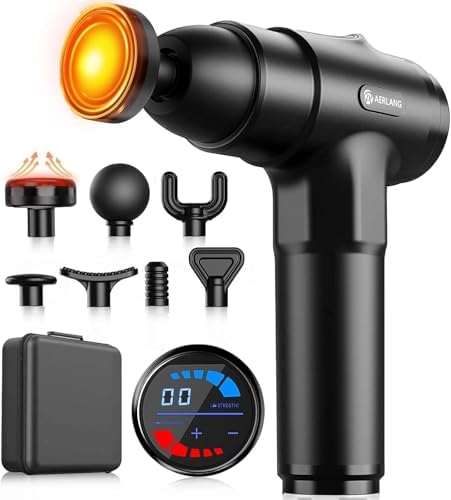
Our Best Affordable pick: AERLANG's EM13 pairs 20 speed levels with a heated massage head, giving budget shoppers both percussion and warmth in one $45 gun. It ships with a padded case and six additional heads, making it a full kit for occasional use.
0.78 lbs · Heats to 114°F in ~1 min · 4 speed levels
At 0.78 lbs, the Mini Thermal is built for travel and quick warmups rather than deep tissue work, with a steel head that heats to 114F in about a minute. It rounds out this lineup as the most portable option.
Short on time? These three cover most buyers - our Best Overall pick (RENPHO's Active Thermacool, a well-rounded 12mm-amplitude gun with genuine swappable heat-and-cold therapy), RENPHO's upgraded Active Thermacool 2 for buyers who want even stronger heat-and-cold therapy in a quieter, lighter build, and Lifepro's 8-head kit for the best value with a lifetime warranty.
Best Overall
RENPHO Active Thermacool 2 Massage Gun with Heat and Cold
RENPHO Active Thermacool 2 Massage Gun with Heat and Cold
Understand the category before you buy - what the science actually says, and which specs matter.
Every massage gun promises deep-tissue percussion, but how deep it goes and how hard it pushes back before stalling vary a lot from model to model. Here is how they work, the two specs that decide whether you actually feel relief, and the features worth comparing once you understand them.
What does a massage gun actually do?
A massage gun, also called a percussion massager, drives a padded head rapidly in and out against your muscle. That repeated tapping is a form of percussive therapy, and the idea is straightforward:
It increases blood flow to the area you are working.
It helps relax tight, overworked muscle tissue.
It can reduce the stiffness and soreness that follow hard exercise.
It gives you a way to reach knots you cannot easily press on by hand.
You pick a head for the muscle group, choose a speed, and move the gun slowly over the area. Some models in this lineup add heat or cold, like the RENPHO Active Thermacool, the RENPHO Active Thermacool 2 and the BOB AND BRAD T2 Pro, but the core job is always the same mechanical percussion.
Why speed is the wrong number to shop on
This is the part most shoppers get backward. Marketing leads with percussions per minute, the RPM figure, because a bigger number sounds more powerful. In this lineup those top speeds run from 2,500 RPM up to 3,200 RPM, a fairly narrow band. The specs that actually decide how much relief you feel are amplitude and stall force, and they vary far more.
Amplitude is how far the head travels on each stroke, measured in millimeters. It is the difference between a massage that vibrates on the surface and one that reaches the muscle belly underneath. Across these six guns amplitude ranges from 10mm on models like the RENPHO Active Thermacool 2 up to a full 16mm on the BOB AND BRAD D6 Pro. That is a 60% difference in stroke depth, and you feel every bit of it.
Stall force is the second half of the story. It is how many pounds of pressure you can lean into the gun before the motor gives up and the head stops moving. A low stall force means the device quits exactly when you press into the tight spot you were trying to treat. Here stall force ranges from 40 lbs on the BOB AND BRAD T2 Pro up to 85 lbs on the D6 Pro.
Now look at how that reshuffles the lineup. The RENPHO Active Thermacool 2 spins up to 3,200 RPM, a higher top speed than the D6 Pro's 2,500 RPM, yet the D6 Pro reaches far deeper (16mm versus 10mm) and pushes back far harder (85 lbs versus 50 lbs). The faster-sounding gun is the gentler one. If deep-tissue relief for large muscles is your goal, chase amplitude and stall force. If you want something lighter and easier to manage for the neck and travel, a lower-amplitude model like the Thermacool 2 is easier to handle without sacrificing meaningful stall force.
Which specs actually matter?
Once you know amplitude and stall force lead, a few more features round out the decision:
Amplitude: The clearest predictor of depth. Around 10mm to 12mm suits most people for general recovery, as on the RENPHO Active Thermacool, the RENPHO Active Thermacool 2 and the BOB AND BRAD T2 Pro. Step up to 16mm only if you want serious deep-tissue reach.
Stall force: How much pressure the gun tolerates before stalling. The 40 lbs to 50 lbs range covers everyday use; the 85 lbs D6 Pro is built for athletes who lean in hard.
Battery life: Runtimes here span roughly 3 hours on the BOB AND BRAD D6 Pro up to about 6 hours on the Lifepro, so match it to how often you will charge.
Weight: Lighter is easier to hold at arm's length. These range from 1.47 lbs on the RENPHO Active Thermacool 2 to 2.86 lbs on the D6 Pro, and heavier usually tracks with deeper power.
Attachments: Different heads target different areas. The lineup runs from 5 heads up to 8 on the Lifepro, with a case on most.
Heat, cold, and extras: Useful if you like contrast therapy, found on the RENPHO Active Thermacool, RENPHO Active Thermacool 2 and BOB AND BRAD T2 Pro, but treat them as bonuses, not the main event.
How we grade products
Graded Picks rankings are aggregated from several independent signals: verified buyer ratings and the size of the review base for credibility, recent monthly purchase volume for relevance, assessments from trusted fitness and recovery publications, and how each product places in leading category lineups. For massage guns we weigh:
Amplitude and real stroke depth
Stall force under pressure
Battery life and charging
Weight and one-handed handling
Attachment range and case quality
Extras like heat, cold, and quiet operation
Overall value for the price
Safety and usage note: A massage gun is meant for muscle, not bone, joints, or the front or sides of your neck. Keep it moving over an area for a short session rather than holding it on one spot, and avoid using it over injuries, inflammation, varicose veins, or recent surgery. If you are pregnant, take blood thinners, or have a medical condition, check with a healthcare provider before starting percussive therapy.
In-Depth Reviews
Everything we learned from buyer reviews and expert testing, product by product.
RENPHO Active Thermacool 2 Massage Gun with Heat and Cold
Best Overall Black Friday Deal20% OFF
1. RENPHO Active Thermacool 2 Massage Gun with Heat and Cold
5.0
RENPHO built the Thermacool 2 around a swappable head that heats or cools on demand, giving it four heat levels and four cold levels instead of a single fixed temperature. A brushless motor keeps operating noise around 40 dB even at higher speeds, which matters for a tool meant to run through a full warmup or cooldown. The five included speed settings and a 45-lb stall force put it in range of guns that cost considerably more. Battery life is rated to last several days of normal use between charges, and the included heads cover both general percussion and the dedicated thermal attachment. Build quality and control layout carry over from RENPHO's earlier Thermacool line, with a simplified single-button interface for switching temperatures mid-session.
Amplitude10mm (advertised)
Stall Force45 lbs (advertised)
Speed Levels5 speeds, 1800 to 2800 RPM
Heat and Cold4 heat levels, 4 cold levels
Noise Level40 dB (rated)
ChargingUSB-C, 15W fast charging
Attachments5 heads: 1 heat/cold head, 4 standard
Pros
Dedicated head switches between four heat and four cold settings
Quiet brushless motor stays near 40 dB at most speeds
45-lb stall force handles deep tissue work
Five speed settings cover light warmup through aggressive recovery
Battery holds a charge across several sessions
Cons
Heat and cold head needs a few seconds to reach target temperature
No pressure sensor to flag when you are pressing too hard
Thermal head attachment is bulkier than the standard heads
Who is it for?
Athletes and lifters who want on-demand heat or cold built into their recovery routine without carrying separate tools.
Who is it not for?
Anyone who only wants straightforward percussion and does not plan to use the temperature feature.
Bob and Brad T2 Pro Massage Gun with Heat and Cold
Best for Heat and Cold Therapy Black Friday Deal32% OFF
2. Bob and Brad T2 Pro Massage Gun with Heat and Cold
4.9
Bob and Brad built the T2 Pro around a hot-and-cold head with four distinct presets rather than a sliding scale: a 50F and a 59F cold setting, plus a 104F and a 113F heat setting, each marked with its own LED color. A 4000mAh battery is rated for up to five hours of use and recharges over 15W PD. The gun runs five speeds between 2000 and 3200 RPM with a 10mm amplitude and 40 lbs of stall force, staying around 45 dB at typical speeds. At 1.9 lbs it is light enough for extended use on larger muscle groups. Five attachments ship in the box, including the dedicated thermal head alongside four standard massage heads. The four-preset approach gives more granular control than a single fixed hot or cold setting, even if the temperature swings run milder than some competing thermal heads.
Amplitude10mm (advertised)
Stall Force40 lbs (advertised)
Speed Levels5 speeds, 2000 to 3200 RPM
Heat and Cold PresetsCold at 50F and 59F, heat at 104F and 113F
Noise Level45 dB (rated)
Battery4000mAh, up to 5 hours per charge, 15W PD charging
Weight1.9 lbs
Pros
Four distinct heat and cold presets instead of one blended range
Stays quiet, around 45 dB, even with the thermal head on
4000mAh battery rated for up to five hours of use
Light at 1.9 lbs for extended sessions
10mm amplitude and 40-lb stall force cover most deep tissue work
Cons
Heat and cold presets run milder than some rival thermal heads
40-lb stall force trails higher-force guns in this lineup
Five attachments is fewer than some competitors include
Who is it for?
Anyone who wants structured, repeatable heat and cold settings rather than a single temperature extreme.
Who is it not for?
Buyers chasing the strongest possible stall force for very deep tissue work.
This earlier Thermacool model uses the same heat-and-cold head concept as the newer Thermacool 2 but spans a wider range, advertised at up to 117F on the hot end and down to 50F on the cold end. Five speed settings run from 1800 to 2800 RPM, and RENPHO rates the stall force at 50 lbs, slightly ahead of its successor. A brushless motor keeps noise between roughly 40 and 55 dB depending on speed, and the gun pairs over Bluetooth with the RENPHO Health App for tracking sessions. USB-C charging at 15W gets the battery back up relatively quickly, though runtime is rated around 2.5 hours of continuous use. Five heads ship in the box, including the dedicated thermal attachment.
Amplitude10mm (advertised)
Stall Force50 lbs (advertised)
Speed Levels5 speeds, 1800 to 2800 RPM
Heat and Cold RangeUp to 117F heat, down to 50F cold (advertised)
Noise Level40 to 55 dB (rated)
Battery LifeUp to 2.5 hours per charge, USB-C 15W charging
App ConnectivityBluetooth to RENPHO Health App
Pros
Wide temperature range, up to 117F heat and down to 50F cold
50-lb stall force among the strongest in this price range
Bluetooth app connectivity for tracking sessions
Fast USB-C 15W charging
Cons
Rated battery life is shorter than some rivals at about 2.5 hours
Motor noise climbs closer to 55 dB at top speed
App connectivity adds a setup step some buyers skip entirely
Who is it for?
Buyers who want the broadest heat and cold range available at this price and don't mind a shorter runtime between charges.
Who is it not for?
Anyone who wants the longest battery life or the quietest possible motor.
At 16mm amplitude and an advertised 85 lbs of stall force, the D6 Pro pushes deeper into muscle tissue than the heat-and-cold-focused guns in this lineup, which typically top out around 10mm. Six speed settings range from 1500 to 2500 RPM, and the motor is tuned to stay relatively quiet despite the added power. Battery life is rated at up to 180 minutes per charge, and the gun ships with seven attachment heads, more than any other product here. There is no heat or cold function, so the design stays focused entirely on percussion depth and force. The higher price reflects that shift toward raw stall force and amplitude rather than added features. Bob and Brad position it as a budget alternative to professional-grade guns costing well over double its price.
Amplitude16mm (advertised)
Stall Force85 lbs (advertised)
Speed Levels6 speeds, 1500 to 2500 RPM
Battery LifeUp to 180 minutes per charge (advertised)
Attachments7 massage heads
Noise LevelLow-decibel brushless motor (rated)
ChargingUSB-C quick charge (advertised)
Pros
85-lb stall force and 16mm amplitude rival professional-grade guns
Seven attachment heads, the most in this lineup
Six speed settings from 1500 to 2500 RPM
Motor stays relatively quiet despite the added power
Cons
No heat or cold function
Highest price in this lineup
Rated 180-minute battery life trails lighter, lower-force guns
Who is it for?
Users who want maximum percussion depth and stall force and do not need heat or cold therapy.
Who is it not for?
Buyers on a budget or anyone prioritizing heat and cold features over raw power.
AERLANG built the EM13 around a 2,500mAh battery rated for roughly two and a half hours of runtime, with a 5-hour recharge time typical for guns in this price range. The motor spins through 20 speed levels across an advertised 1,400 to 3,200 RPM range, and the included heated head adds three warmth settings up to 131°F for muscles that need loosening before percussion work. Independent testers have found the EM13's actual stroke travel runs short of its advertised 16mm amplitude, so it suits light, everyday tension better than aggressive deep-tissue sessions. The kit bundles seven total heads, six standard attachments plus the dedicated heated one, in a padded carrying case, giving new users a full toolkit without add-on purchases. At 2.2 pounds it stays easy to hold through a full-body routine, and AERLANG rates the motor noise at 41 to 49 decibels for quieter use around others.
Speed Levels20 (1,400-3,200 RPM, advertised)
Amplitude16mm advertised; testing found shorter actual travel
Massage Heads7 total (6 standard, 1 heated)
Heated Head3 settings up to 131°F (55°C)
Battery2,500mAh, rated about 2.5 hours per charge
Charge TimeAbout 5 hours
Weight2.2 lb
Pros
Heated massage head with three temperature settings up to 131 degrees Fahrenheit
20 speed levels cover light tension through firmer pressure
Seven total heads and a padded carrying case included in the price
Lightweight 2.2-pound body is easy to hold for a full routine
Lowest price in this lineup at $44.99
Cons
Independent testing found actual amplitude falls short of the advertised 16mm
Rated runtime of about 2.5 hours trails several higher-priced guns here
Motor noise can run toward the louder end of its 41-49dB rating
Who is it for?
Shoppers who want a heated head and a full attachment kit at the lowest price in this lineup, for light daily tension rather than heavy deep-tissue work.
Who is it not for?
Athletes or bodyworkers who need maximum stall force and amplitude for deep-tissue recovery should look at a higher-powered pick instead.
RENPHO scaled the Mini Thermal down to 0.78 lbs, light enough to toss in a bag, while keeping a heat-conductive steel head that reaches 114F in about a minute with a double press of the power button. Four speed settings run from roughly 1800 to 3000 RPM at a 6mm amplitude, which is shallower than the full-size guns in this lineup and better suited to light recovery than aggressive deep tissue work. Stall force is rated at 26 lbs, and the motor stays at or below 55 dB. Battery life is rated at up to three hours, with a 10-minute auto-off timer to help prevent accidental drain. Four silicone-cased heads ship in the included carry case, letting the shape change for different muscle groups. The combination of low weight and quick heat makes it better suited to warming up tight muscles than resolving serious soreness.
Amplitude6mm (advertised)
Stall Force26 lbs (advertised)
Speed Levels4 speeds, 1800 to 3000 RPM
Heated HeadWarms to 114F in about 1 minute (advertised)
Weight0.78 lbs
Battery LifeUp to 3 hours per charge
Noise LevelUp to 55 dB (rated)
Pros
Extremely light at 0.78 lbs for travel
Steel head heats to 114F in about a minute
Includes a carry case and four interchangeable heads
Auto-off timer after 10 minutes prevents accidental drain
Cons
6mm amplitude is shallow next to the full-size guns in this lineup
26-lb stall force limits it to lighter recovery work
Only 4 speed settings compared to competitors with far more
Who is it for?
Travelers and anyone who wants a compact tool for quick warmups rather than deep tissue sessions.
Who is it not for?
Buyers who need strong stall force or deep amplitude for serious muscle work.
The stars you see are the Graded Picks cumulative score, not a single retailer's average. It blends verified buyer reviews aggregated across major retailers, assessments from professional reviewers and expert testers, and how prominently the product features in leading category lineups.
Advertising Disclosure
Our rankings are compiled by aggregating several independent signals, including verified buyer feedback, how popular a product currently is with shoppers, and evaluations published by professional reviewers. Editorial opinions are our own.
Please note that we participate in affiliate marketing programs. When you purchase through links on our site, we may earn a commission. As an Amazon Associate we earn from qualifying purchases. This comes at no additional cost to you and helps support the resources required to provide valuable content.