One machine that runs MIG, flux-core, stick, and often TIG sounds like the end of a cluttered shop, and for most people it genuinely is. The catch is that a do-it-all box asks you to understand a little more before you buy, because the same welder can be brilliant on thin sheet and underpowered on a thick trailer hitch depending on how you set it up and where you plug it in. We analyzed thousands of verified buyer reviews, recent sales data, and expert evaluations to find seven multi-process welders that cover the widest range of jobs without pretending to be something they are not.
Every product we compared, in ranked order. Tap through to Amazon to check today's price, or jump to the full review below.
1
ARCCAPTAIN MIG205MP
Best Overall
ARCCAPTAIN MIG205MP 9-in-1 Welder & Plasma Cutter
5.0
205A + 50A plasma · 9-in-1 · 120V/240V
Our Best Overall pick: the flagship of the lineup, with nine functions including pulsed MIG, DC HF TIG and a built-in plasma cutter, plus app control for saving unlimited presets. Runs on 120V or 240V and posts the strongest combined buyer and expert marks in this comparison.
Our Best for Beginners pick: a 200A synergic 6-in-1 that runs MIG, flux-core, Stick, Lift TIG, spot and spool-gun modes on 110V/220V. Buyers and pro reviewers alike praise how easy it is to get a clean bead straight out of the box.
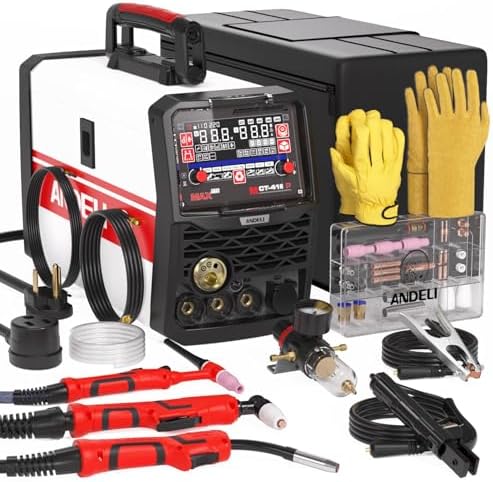
A 160A pulse-MIG combo with a 40A plasma cutter, built around IGBT pulsed-arc tech aimed at cleaner aluminum welds. Covers pulse MIG, HF TIG, Stick, flux-core and cutting on 110V or 220V.
Our Best Affordable pick: a genuinely capable 160A 4-in-1 (MIG, flux-core, Lift TIG, Stick) that weighs under 20 lb, runs on 110V or 220V, and costs less than anything else in this comparison. Reviewers say gas MIG mode lays down strong, low-spatter welds well beyond its price.
A dedicated AC/DC TIG machine for aluminum and stainless, with pulse control, adjustable AC balance and 110V/220V dual-voltage input. Reviewers single out its steady arc on aluminum and a straightforward three-button, one-knob control panel, and it posts some of the strongest combined buyer and expert marks in this comparison.
A 200A machine that runs synergic MIG, gasless MIG, Lift TIG and Stick and adds a 50A plasma cutter, all in a 25 lb box on 110V or 220V - the only weld-and-cut combo in this lineup at a sub-$400 price.
A 200A MIG, HF TIG and Stick welder with a 50A plasma cutter and spool-gun compatibility for aluminum, sold as a kit with wire, rod and gloves. It is a heavier, more feature-rich alternative to the other budget combos here.
Short on time? These three cover most buyers: our top-graded pick (a 9-in-1 flagship with pulsed MIG, HF TIG and a built-in plasma cutter), the friendliest all-rounder for beginners (a 200A synergic 6-in-1 that adds spool-gun aluminum), and the most affordable machine here that still covers MIG, flux-core, TIG and Stick (a 160A 4-in-1 at the lowest price in the lineup).
Multi-Process Welders 101: What They Do & How to Choose
Understand the category before you buy - what the science actually says, and which specs matter.
Every welder here promises several processes from one unit, but the honest differences are in amperage, duty cycle, and whether the machine wants shielding gas or runs bare. Here is how these welders actually work, the one tradeoff that decides whether a single box is right for you, and the specs worth comparing before you spend.
What does a multi-process welder actually do?
A multi-process welder is one power source that can run several welding processes, so you switch modes instead of buying separate machines. Most of the lineup uses inverter-based IGBT electronics, which keeps the units light and lets them fine-tune the arc for each process. Depending on the model, one welder can:
Run MIG with a solid wire and shielding gas for clean, fast welds on steel.
Run flux-core (gasless) with a self-shielding wire that works outdoors and in wind.
Run stick (MMA) for thicker metal and rougher, rusty, or outdoor conditions.
Run TIG, either lift-start or high-frequency, for precise, tidy welds on thin steel, stainless, and on some units aluminum.
Several models add extras such as a spool gun port for aluminum, spot welding, or even a built-in plasma cutter, like the ARCCAPTAIN MIG205MP and the YESWELDER MCT-520, which pair welding with a 50A cut.
One machine, several jobs: where a combo shines and where it does not
Here is the thing most shoppers miss. The real value of a multi-process welder is that it replaces a rack of single-purpose machines, running MIG, flux-core, stick, and often TIG from one box for the price and footprint of one. That is a genuinely good deal for a home shop or a mobile setup. But the honest tradeoffs are worth knowing before you buy.
First, each process still needs its own consumables and gas. MIG and TIG want a bottle of shielding gas (plus the right wire or tungsten and, for TIG, filler rod), while flux-core and stick need no gas at all because the wire or electrode shields the weld itself. So a machine that lists MIG and TIG does not mean you are done spending. You will still buy gas, wire, tungsten, and tips per process.
Second, a machine built to do everything rarely matches a dedicated welder's finesse on the hardest jobs. A lift-TIG combo, for example, is fine for general work but will not feel like a dedicated high-frequency AC/DC TIG unit on thin aluminum; the ARCCAPTAIN AC/DC TIG welder in this lineup exists precisely for people who want that focus.
The practical move is to match the amperage and the duty cycle to the metal you actually weld. Duty cycle is how many minutes out of ten the machine can weld before it must stop and cool. In this lineup that means numbers like 60% at 160A on the YESWELDER 160A or 60% at 205A on the ARCCAPTAIN MIG205MP, though real-world tests can trip thermal protection sooner than the advertised figure suggests. Thicker steel needs more amps and a duty cycle that holds up under a long bead, while thin sheet is forgiving. And if you only have a standard household outlet, confirm the welder runs on 110V, because many need 220V for full output. The YESWELDER MIG-205DS PRO, for example, falls from 205A on 220V to 160A on 110V, so check which voltage you will actually use before buying.
Which specs actually matter?
Processes included: Decide which of MIG, flux-core, stick, and TIG you truly need. Most units here cover four or more; the ARCCAPTAIN 205MP stacks nine, including pulsed MIG and plasma cut.
Amperage output: More amps means thicker metal. This lineup ranges from 160A on the budget YESWELDER YWM-160 up to 200A to 205A on the ARCCAPTAIN and other YESWELDER models.
Duty cycle: Read it at the rated amperage, not just the headline number. Most machines here claim 60% at rated output, but real-world testing on the ARCCAPTAIN MIG200 found thermal protection tripping after about five and a half minutes of continuous welding at the full 200A, a reminder that advertised numbers deserve a grain of salt.
Input voltage: Dual 110V/220V (or 120V/240V) models give you flexibility, but check whether full output needs the higher voltage. The ARCCAPTAIN MIG205MP auto-senses 120V/240V.
Gas vs gasless: MIG and TIG need shielding gas; flux-core and stick do not. If you weld outdoors or want a simpler start, lean on the gasless modes.
Weight and portability: IGBT inverters keep these light, from about 19.4 lb on the YESWELDER YWM-160 to 46.2 lb on the ARCCAPTAIN 205MP.
Synergic and digital controls: Auto or synergic settings match voltage and wire speed for you, which flattens the learning curve. Look for a clear LED digital display and features like the ARCCAPTAIN MIG205MP's app-based saved presets.
How we grade products
Graded Picks rankings are aggregated from several independent signals: verified buyer ratings and the size of the review base for credibility, recent monthly purchase volume for relevance, assessments from trusted welding and metalworking publications, and how each product places in leading category lineups. For multi-process welders we weigh:
Range and usefulness of included processes
Amperage output relative to the metal thicknesses it targets
Honest duty cycle at rated output
Dual-voltage flexibility and full-output requirements
Arc quality and ease of setup, including synergic controls
Build quality, portability, and warranty
Overall value for the price
Safety note: Welding produces intense light, heat, fumes, and sparks. Always wear an auto-darkening helmet rated for your process, plus flame-resistant gloves and clothing that cover your skin from ultraviolet burn. Ventilate your workspace well, especially when running flux-core or welding stainless and coated metals, since those fumes are more hazardous. Respect the machine's duty-cycle limits and let it cool when it says to, so you protect both the welder and yourself.
In-Depth Reviews
Everything we learned from buyer reviews and expert testing, product by product.
The ARCCAPTAIN MIG205MP is our Best Overall pick and the flagship of the brand's lineup, folding nine functions into one machine: gas and flux-core MIG, pulsed MIG, DC HF TIG, Lift TIG, Stick, spool-gun aluminum, a cleaning mode and a built-in plasma cutter. Its iControl app lets you change parameters remotely and store unlimited named presets, which is genuinely useful in a shared shop or when you switch materials often. Reviewers report cutting up to 1/2 inch plate with the plasma torch and welding up to 1/4 inch steel, noting that the 240V input welds and cuts noticeably better than 120V. A large LED display with synergic matching keeps settings clear. The tradeoffs versus the cheaper MIG200 are weight and price: it is roughly twice as heavy at 46 lb and costs more than double - but you gain pulsed MIG, HF TIG and integrated cutting and the widest process range in this comparison, which is why it tops this lineup. It suits DIYers and repair-focused users who want one of the most capable machines available, MIG, TIG, Stick and plasma cutting included.
The ARCCAPTAIN MIG200 packs six processes: MIG, flux-core, Stick, Lift TIG, spot and spool-gun aluminum, into a compact 25 lb box, and its synergic system auto-matches voltage and wire speed so beginners can lay down solid welds fast. A professional welder with two decades of experience tested every mode and singled out the clean synergic behavior and a handy built-in light over the drive roll. It outputs up to 200A and runs on either 110V or 220V, and at the time of our scan it carried a 26% discount that makes the value case even stronger. Independent reviewers note the limits too: continuous welding at the full 200A tripped thermal protection after roughly five and a half minutes, and the DC TIG and aluminum modes need a torch and spool gun that are not in the box. Compared with its bigger sibling, the MIG205MP flagship, the MIG200 skips the plasma cutter and app control but costs far less, which is why it is our Best for Beginners pick: the easiest learning curve in this comparison for anyone who does not need integrated cutting.
The ANDELI MCT-416P is a compact 6-in-1 that leans on IGBT inverter and pulsed-arc technology to smooth out aluminum MIG welding, a process that trips up many budget machines. It runs pulse MIG, synergic MIG, manual MIG, HF TIG, Stick and flux-core, and adds a 40A plasma cutter that cleanly parts up to about 3/8 inch on 110V and more on 220V. A 5-inch LED screen with guided settings and saved presets keeps mode changes quick. ANDELI backs it with a 3-year warranty and free replacement parts, plus over-heat and auto shut-off protection. Coverage from independent testers is thinner than for the bigger brands, so buyers lean more on the pulsed-MIG feature set and warranty than on a deep review record. Against the YESWELDER MCT-520 it offers similar versatility with pulsed MIG but a lower 160A ceiling and smaller plasma output. It suits hobbyists who specifically want pulsed aluminum capability and cutting on a budget.
The YESWELDER YWM-160 is our Best Affordable pick: a genuinely capable 160A multiprocess machine at the lowest price in this comparison, and it was discounted 37% at our scan on top of that. It covers gas MIG, gasless flux-core, Lift TIG and Stick, uses synergic control to auto-set parameters, and accepts both 2 lb and 10 lb wire spools. Independent reviewers report that gas MIG mode produces strong, clean welds with minimal spatter, while flux-core is slightly rougher, as expected. At just over 19 lb with a carry handle and dual 110V/220V input, it is easy to move around a garage or take to a job. The honest limits: 160A tops out around 1/8 inch steel in a single pass, so it is not for heavy structural work, and the included Lift TIG is basic next to a dedicated TIG setup. Versus the pricier YESWELDER MCT-520, the YWM-160 drops the plasma cutter and 200A ceiling but is far lighter, simpler and less expensive, making it the machine to reach for when budget and portability matter more than raw process count.
The TIG200P is the only true AC/DC TIG-focused machine in this lineup, built for aluminum, stainless, steel and copper work that Lift-TIG-only combos can't match. Reviewers highlight genuine AC TIG capability with adjustable AC balance and pulse control that produces a stable, controllable arc on aluminum plate, plus VRD and over-current, over-voltage and over-temperature protection for safer operation. TIG output runs 10 to 200A and Stick runs 10 to 160A at a rated 60% duty cycle, and the machine ships light for its class at around 25 lb, with dual 110V/220V input for garage or shop power. The control panel is deliberately simple, one display, three buttons and a knob, which reviewers say keeps the learning curve manageable despite the machine's advanced pulse features. The honest gaps: a foot pedal is not included despite being common on rival budget TIG machines, and some buyers report slow order and customer-service response times. Against the MIG-focused machines elsewhere in this comparison, and even against the plasma-cutter-equipped MIG205MP, it remains the pick specifically for buyers who need dedicated, high-quality AC TIG rather than a Lift TIG afterthought.
The PUWU CT-418PRO packs synergic and manual MIG, gasless flux-core MIG, Lift TIG, Stick and a plasma cutter into a 25.6 lb inverter, making it the only weld-and-cut combo in this lineup at a sub-$400 price. Published specs list up to 200A on 240V at a 60% duty cycle (about 130A on 120V), and the 20 to 50A plasma torch is rated for a clean cut of 5/16 inch on 110V and 1/2 inch on 220V. Synergic mode matches voltage, current and wire speed for lower-spatter welds, digital displays keep settings readable, and the kit includes MIG, TIG and plasma torches, two drive rollers and air and gas hoses. Independent expert coverage is thin compared with the bigger brands, so expect to lean on the spec sheet and user feedback rather than lab tests. Next to the ANDELI MCT-416P it trades pulsed MIG for a higher amperage ceiling and a lower price.
The TOOLIOM TL-MCT520 covers MIG, flux-core, HF TIG, Stick and plasma cutting in one 200A machine, with a spool-gun connection for aluminum (gun sold separately). Specs list 60% duty at 200A on 220V and a 50A plasma cutter rated for a clean 1/2 inch cut and a 5/8 inch maximum on 220V, with a large LCD to show settings. The listing ships with welding wire, rod and gloves, which helps first-time buyers get started without extra purchases, and TOOLIOM backs it with a 2-year warranty. Welder reviewers describe multi-process TOOLIOM machines as compact and good value but note setup can be complicated for novices, the case is plastic and a gas regulator may be missing. At a listed 45.7 lb it is far heavier than the PUWU CT-418PRO, and expert coverage of this exact model is limited, so it suits garage users who value HF TIG and spool-gun support over portability.
The stars you see are the Graded Picks cumulative score, not a single retailer's average. It blends verified buyer reviews aggregated across major retailers, assessments from professional reviewers and expert testers, and how prominently the product features in leading category lineups.
Advertising Disclosure
Our rankings are compiled by aggregating several independent signals, including verified buyer feedback, how popular a product currently is with shoppers, and evaluations published by professional reviewers. Editorial opinions are our own.
Please note that we participate in affiliate marketing programs. When you purchase through links on our site, we may earn a commission. As an Amazon Associate we earn from qualifying purchases. This comes at no additional cost to you and helps support the resources required to provide valuable content.