A portable charger is the difference between a dead phone at the airport gate and one that lasts until you land. But the big mAh number on the box is where most shoppers get misled, because it rarely reflects how many real charges you actually get. We analyzed thousands of verified buyer reviews, recent sales data, and expert evaluations to find eight portable chargers that deliver the power they promise and hold up on the road.
Every product we compared, in ranked order. Tap through to Amazon to check today's price, or jump to the full review below.
1
INIU P62 20K 65W
Best Overall
INIU P62 20,000mAh 65W Laptop Power Bank
5.0
20,000 mAh (74 Wh) · 65W USB-C · 3 ports
Our Best Overall pick: the smallest 20,000mAh 65W bank testers have measured, with genuine laptop and phone charging in a palm-size brick, a digital display and INIU's 3-year warranty.
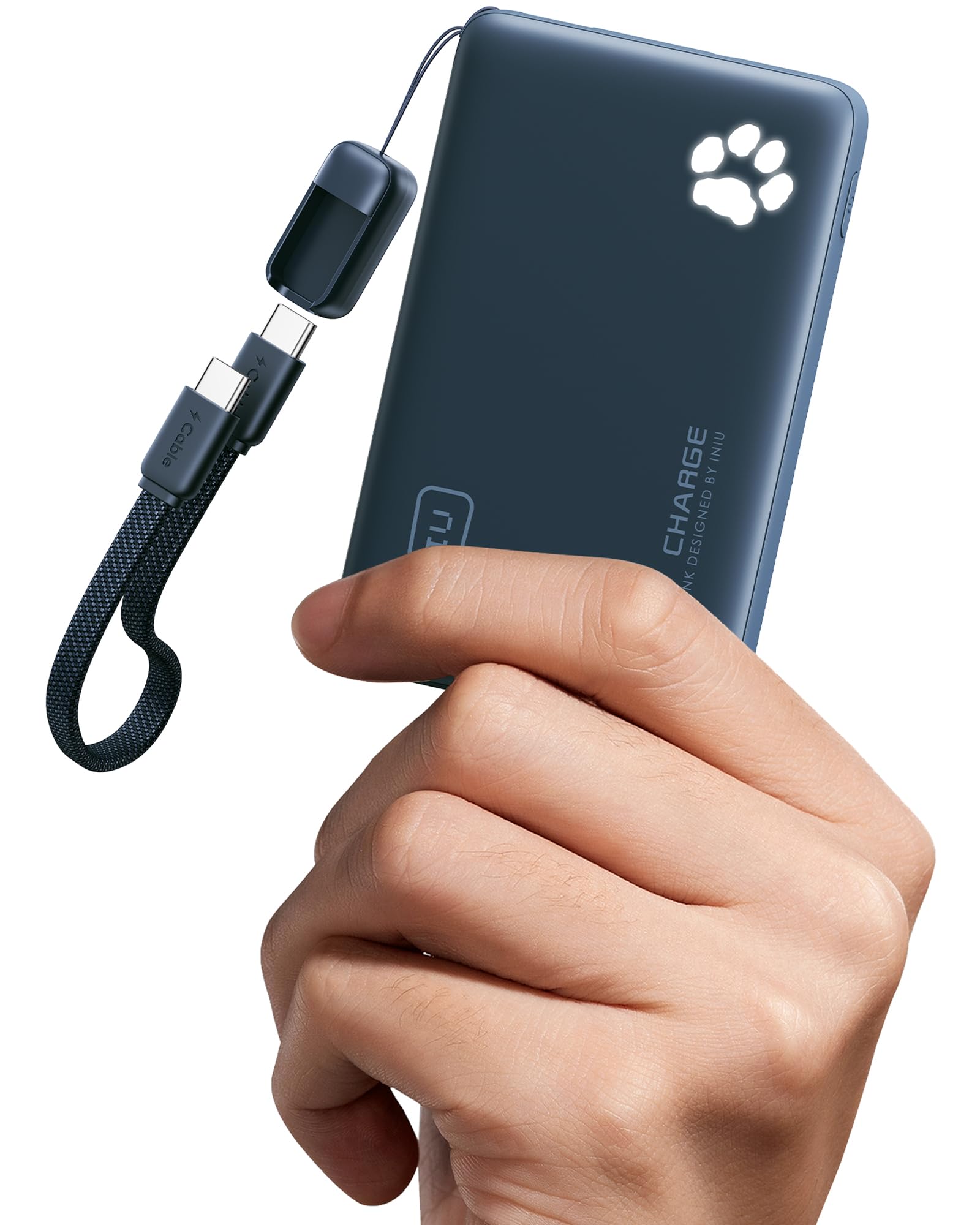
Our Best Affordable pick: INIU's well-reviewed 45W fast-charging formula in a 10,000 mAh body with a built-in USB-C cable, a paw-shaped battery gauge and an emergency flashlight, all at the lowest price in this comparison.
Anker Laptop Power Bank 25,000mAh 165W (Retractable Cables)
4.9
25,000 mAh (90 Wh) · 165W total · retractable cable
Our Best for Laptops & Travel pick: a proven high-wattage workhorse with 165W total output, a retractable USB-C cable plus a built-in strap cable, a smart display, and a 90 Wh capacity that stays just inside airline carry-on rules.
An all-in-one bank with built-in cables, a fold-out AC wall plug and an LED display in a 0.78-inch slim body, so you never buy or pack a separate charger or cable.
Anker's newer Qi2-certified magnetic bank: the same slim, pocketable 5,000mAh format as the 621 MagGo elsewhere in this lineup, but with 15W wireless charging - double the older model's speed.
A 45W fast charger in a bank about the size of two stacked AirPods cases. Testers took an iPhone from dead to 70% in around 25 minutes, and it slips into any pocket.
A Qi2-certified magnetic bank with a full 10,000mAh capacity: 15W wireless charging, double the speed of older MagSafe-compatible packs, in a slim body.
The proven entry point to magnetic charging: a thin, light 5,000mAh MagSafe-compatible pack that snaps onto any recent iPhone and adds roughly a 60% top-up, backed by Anker's reliability.
Short on time? These three cover most buyers: the INIU P62 as our Best Overall pick for genuine laptop-and-phone charging in a compact body, the INIU P41 as our Best Affordable pick, and the Anker 25,000mAh 165W bank as our Best for Laptops & Travel pick for the heaviest-duty charging needs.
Portable Chargers 101: What They Do & How to Choose
Understand the category before you buy - what the science actually says, and which specs matter.
Every power bank advertises a headline capacity, yet two chargers with the same mAh can behave very differently in your pocket. Here is how they actually work, why the printed mAh is not the number that reaches your phone, and the specs worth comparing before you buy.
What does a portable charger actually do?
A portable charger is a rechargeable battery you fill up from a wall outlet, then carry with you to top up your phone, tablet, or laptop when there is no outlet nearby. You charge the bank, it stores the energy, and later it pushes that energy back out through a cable or a wireless pad.
It holds a fixed amount of energy, rated in mAh and, more honestly, in watt-hours (Wh).
It sends power out through USB-C, USB-A, a built-in cable, or a magnetic wireless pad.
Its output wattage sets how fast it refills your device, and USB-C Power Delivery (PD) governs the fastest, most efficient charging.
Why the printed mAh is not what reaches your phone
This is the single most useful thing to understand before you compare capacities. The mAh number printed on a power bank is the raw capacity of the cells inside, measured at their native voltage of about 3.7 volts. Your phone charges at 5 volts or higher, so the bank has to step that voltage up, and every conversion loses some energy as heat. After those losses, you typically get only about 60 to 70 percent of the rated mAh as usable charge.
That is why the data lists both numbers. A 10,000 mAh bank like the INIU Ultra Mini or the INIU P41 is really 37 Wh of stored energy, and the 20,000 mAh INIU P62 is 74 Wh. Watt-hours are the honest figure, because they already account for voltage. When you compare two chargers, compare their Wh, not just their mAh, and expect a 10,000 mAh unit to deliver roughly two full phone charges rather than the three the raw number might suggest.
Just as important is output. A bigger battery that trickles power out slowly is less useful than a smaller one that charges fast and can drive a laptop. The 45W PD on the INIU Ultra Mini refills a phone quickly, while the 65W INIU P62 carries enough PD headroom to top up a MacBook Air. If you only ever charge a phone, a 15W magnetic bank like the Anker Nano may serve you better than a heavier high-capacity model.
Which specs actually matter?
Once you know that Wh and wattage tell the real story, a few features decide which charger fits you:
Watt-hours, not just mAh: Read the Wh rating. The lineup ranges from 18.5 Wh on the 5,000 mAh Anker models up to 74 Wh on the 20,000 mAh INIU P62, and Wh predicts real charges far better than mAh.
Output wattage and PD: This sets charging speed and whether it can power a laptop. Phone-only banks sit around 15W to 45W; laptop-capable ones like the 65W INIU P62 go much higher.
Ports and built-in cables: More ports charge more devices at once. Several models here include a built-in or detachable USB-C cable, like the INIU P41's built-in lanyard cable or the citicr's integrated cords, so you carry less.
Wireless and magnetic charging: A Qi2-certified magnetic bank like the Anker Nano snaps to the back of a recent iPhone for cable-free 15W charging, at the cost of some efficiency versus wired.
Size and weight: A 5,000 mAh bank slips into a pocket, while a 20,000 mAh laptop bank like the INIU P62 is a noticeably bigger handful. Match capacity to how long you need to stay off the grid.
Airline carry-on: Every charger here stays under the 100 Wh limit airlines set for carry-on, so all are flight-safe, but always pack a power bank in your carry-on, never checked luggage.
How we grade products
Graded Picks rankings are aggregated from several independent signals: verified buyer ratings and the size of the review base for credibility, recent monthly purchase volume for relevance, assessments from trusted tech and travel publications, and how each product places in leading category lineups. For portable chargers we weigh:
Real usable capacity in watt-hours
Output wattage and Power Delivery support
Port count and built-in or included cables
Wireless and magnetic charging quality
Size and weight for the capacity offered
Recharge speed and build quality
Overall value for the price
Travel and safety note: Lithium power banks must fly in your carry-on bag, never in checked luggage, and airlines cap loose batteries at 100 Wh without special approval. Every charger in this guide stays under that limit. Avoid leaving a power bank in a hot car or charging it unattended overnight, and stop using any unit that swells, overheats, or takes far longer than usual to recharge.
In-Depth Reviews
Everything we learned from buyer reviews and expert testing, product by product.
INIU P62 20K 65W
Best Overall
1. INIU P62 20,000mAh 65W Laptop Power Bank
5.0
Our Best Overall pick. The P62 (INIU's Cougar) is the lineup's genuine laptop charger: it is the sibling of the well-rounded P50 elsewhere in this lineup, scaled up for laptop duty, and it pairs real 65W laptop-charging power with genuinely pocketable size, double the capacity of the P50, in what Macworld called the smallest and lightest 20K laptop bank it had tested, at 4.3 x 2.8 x 1.1 inches and 11.4 ounces. In their testing it recharged an M2 MacBook Pro to 87% from flat, and the 45W input refills the bank itself in under two hours. INIU credits the size reduction to high-density TinyCell cells and a stacked circuit design, and the price undercuts rival 20K laptop banks by a wide margin, a rare combination of real laptop wattage, serious capacity and a price that does not punish you for either. Compared with the P50 elsewhere in INIU's range, you trade pocketability for capacity and true laptop wattage - a tradeoff worth making for anyone who needs to keep a laptop alive on the road.
Capacity20,000 mAh (74 Wh)
Max output65W USB-C PD
Ports & cables2x USB-C + USB-A, USB-C cable included
Wireless chargingNone (wired only)
Airline carry-onYes - 74 Wh, under the 100 Wh limit
Dimensions4.3" x 2.8" x 1.1"
Warranty3 years
Pros
Smallest and lightest 20,000 mAh 65W bank in expert testing at 11.4 oz
Recharged an M2 MacBook Pro to 87% from flat in Macworld's test
45W input refills the whole bank in under two hours
Undercuts rival 20K laptop banks on price by a wide margin
3-year warranty, triple the category norm
Cons
65W single-port ceiling - larger laptops charge slower than on 100W rivals
Output steps down when multiple devices share the ports
No built-in or retractable cable - pack the included USB-C cord separately
Who is it for?
Buyers who want a bank that genuinely charges a laptop as well as a phone, in the smallest, lightest 20,000 mAh package tested, without paying a premium for it.
Who is it not for?
Power users who need to charge a laptop plus several accessories at full speed simultaneously - the 65W output is strong but shares across just two USB-C and one USB-A port.
2. INIU P41 45W Portable Charger with Paw Indicator (10,000mAh)
4.9
Our Best Affordable pick. The P41 delivers INIU's core 45W PD/QC fast-charging formula at the lowest price in this comparison, and reviewers at Pack Hacker, CleverHiker, HighTechDad and FiveSecondTech all found the core charging performance holds up, with 45W PD/QC output pushing an iPhone 16 to 63% and a Galaxy S24 Ultra to 73% in 25 minutes in testing. Its signature feature is the illuminated paw-print gauge, where each of five paw pads lights up to show remaining charge at a glance, and a built-in USB-C cable doubles as a carry lanyard so there is one less cord to pack. A hidden flashlight activates with a double-press of the power button for emergencies or fumbling for keys in the dark. The tradeoffs reviewers flag: at 4.3 x 2.6 x 0.7 inches and 182 grams it is noticeably larger and heavier than the pocket-sized P50 elsewhere in this lineup, and more than one reviewer found the flashlight switches on accidentally when the bank gets jostled in a bag.
Airline carry-onYes - 37 Wh, under the 100 Wh limit
Dimensions4.3" x 2.6" x 0.7"
Warranty3 years
Pros
Real 45W fast charging at the lowest price in this comparison
45W PD/QC fast charging pushed an iPhone 16 to 63% in 25 minutes in reviewer testing
Illuminated paw-print gauge shows remaining charge in five clear steps
Built-in USB-C cable doubles as a carry lanyard, no separate cable needed
Built-in emergency flashlight for camping, commuting or emergencies
Cons
Larger and heavier than the pocket-sized P50 elsewhere in this lineup - a noticeably bigger carry for the same 10,000mAh
Reviewers report the flashlight can switch on accidentally when jostled in a bag
The novelty paw indicator and flashlight add bulk that buyers who just want the smallest bank won't need
Who is it for?
Budget-minded, phone-first buyers: anyone who wants fast 45W charging plus a built-in cable, flashlight and an at-a-glance battery gauge for camping, commuting or emergencies at the lowest price here.
Who is it not for?
Anyone who wants the smallest possible everyday-carry bank (the P50 elsewhere in this lineup delivers the same charging speed in a smaller body) or who needs to charge a laptop (see the INIU P62, our Best Overall pick elsewhere in this lineup).
3. Anker Laptop Power Bank 25,000mAh 165W (Retractable Cables)
4.9
Our Best for Laptops & Travel pick. Anker's 165W laptop bank is the one testers keep calling the handiest high-capacity pack they have used, and the numbers back it up: reviewers pushed a 16-inch MacBook Pro (M3) to 50% in 33 minutes, recharged an M2 Pro MacBook Pro to 92% from a single fill, and measured sustained output around 82W to each of two USB-C ports simultaneously. The retractable USB-C cable and the second built-in cable that doubles as a carry strap mean you can leave the cable pouch at home, and the smart display reads out per-port wattage in real time. At 90 Wh it clears airline carry-on rules without paperwork, and the whole package recharges itself to full in about 2 hours. The costs are physical and financial: it weighs about 1.3 pounds, and once a third device joins, the secondary ports collapse into a shared 30W pool.
4. citicr 10,000mAh Power Bank with Built-in Cables & Wall Plug
4.7
The citicr's whole appeal is an all-in-one design that legitimately replaces a whole cable pouch, at a price that keeps it among the cheapest full-featured banks here. The wall plug folds directly out of the bank, the cables are built in, and USB-C and USB-A ports handle everything else, up to five devices at once. The 20W PD output (22.5W over SuperCharge) takes an iPhone from 0 to 50% in about 25 minutes, and pass-through charging lets it refill itself while topping up your phone overnight from one outlet. At 0.78 inches thick it stays genuinely slim for a bank hiding an AC plug, and the LED display reads out exact remaining percentage. Buyers consistently praise how it replaces a whole cable pouch on trips. The tradeoffs are a modest 18W self-recharge speed over the plug, a roughly 5-hour refill, and a young brand without the service track record of Anker or INIU.
5. Anker Nano MagSafe 5,000mAh Qi2 Magnetic Power Bank
4.7
The Nano MagSafe is Anker's Qi2-certified update to the 621 MagGo also in this lineup: the same 5,000 mAh cell and ultra-slim 0.33-inch profile, but with Qi2 certification that doubles wireless output to 15W instead of 7.5W. Anker's magnets snap on with the same reliable grip the brand is known for, and the bank itself recharges quickly - Anker rates it at 0 to 100% in about 104 minutes over USB-C. At 18% off at the time of our scan, it undercuts most of the other Qi2 magnetic packs in this lineup while carrying Anker's usual 2-year warranty and MultiProtect safety circuitry. The tradeoff is capacity: 5,000 mAh is the smallest cell among the magnetic packs here, good for a partial top-up on a large iPhone rather than a full charge, and it is new enough to market that it does not yet have the multi-year ownership track record of the 621 it sits alongside.
Capacity5,000 mAh (18.5 Wh)
Max output15W wireless (Qi2) / 15W wired USB-C
Ports & cables1x USB-C (in/out)
Wireless chargingQi2-certified 15W magnetic
Airline carry-onYes - 18.5 Wh, under the 100 Wh limit
The P50 (INIU calls it the Pocket Rocket) nails the everyday-carry formula: real 45W output, genuine pocketability and honest capacity. Testers measured above-average efficiency for its class, took an iPhone from dead to roughly 70% in 25 minutes, and got about 1.5 to 2 full phone charges from the 10,000 mAh cell, exactly what a bank this size should deliver. Reviewers at multiple outlets praised how small it is for the capacity, roughly two AirPods cases stacked together, with a digital charge display and a detachable USB-C cable. The honest caveats: its 15V output ceiling means some laptops fast-charge below the printed 45W (one tester found it merely held a MacBook Air's level rather than adding charge), and the glossy shell picks up surface scratches. INIU backs it with a 3-year warranty, triple the category norm.
7. Baseus Qi2 15W Magnetic Power Bank 10,000mAh (22.5W Wired)
4.6
The Baseus Qi2 10K pairs a full 10,000 mAh cell with true Qi2 certification, which guarantees 15W magnetic wireless charging - double what MagSafe-compatible packs like the Anker 621 deliver - plus a 22.5W wired USB-C port for faster full-speed charging when you plug in. Baseus quotes an iPhone 16 Pro reaching 37% in 30 minutes on the magnet, and strong magnets hold the phone steady even while it's in use one-handed. Reviewers covering Baseus's Qi2 magnetic line rate its charging speed at the top of the pile for wireless packs, and multi-layer safety protections (over-current, over-voltage, temperature) run quietly in the background. It was also carrying a 22% discount at the time of our scan. At 0.7 inches thick it isn't the slimmest bank in this lineup, but it holds double the capacity of the 5,000 mAh magnetic packs here in a still-pocketable size.
Capacity10,000 mAh (37 Wh)
Max output22.5W wired USB-C / 15W wireless
Ports & cablesUSB-C (in/out), USB-C cable included
Wireless chargingQi2-certified 15W magnetic
Airline carry-onYes - 37 Wh, under the 100 Wh limit
Dimensions4.6" x 2.7" x 0.7"
Warranty2 years
Pros
Qi2-certified 15W wireless - double the speed of MagSafe-compatible packs
Full 10,000 mAh capacity, double the 5,000 mAh magnetic packs in this lineup
iPhone 16 Pro to 37% in 30 minutes on the magnet per manufacturer testing
2-year warranty and multi-layer safety protections
Cons
0.7 inches thick - noticeably less slim than the thinnest magnetic banks
22.5W wired output is modest next to the wired-only fast chargers in this lineup
Little model-specific expert coverage yet - most testing covers the Baseus Qi2 line broadly
Who is it for?
Buyers who want true Qi2 15W magnetic charging and double the Anker 621's capacity at the lowest price Baseus offers it.
Who is it not for?
Thinness-first buyers who want the slimmest possible magnetic bank, and anyone who charges over cables only.
The 621 MagGo is the magnetic bank a huge number of iPhone owners started with, and reviewers still recommend it for the same reasons: at 0.45 inches and about 5 ounces it is thin and light enough to use the phone comfortably while attached, the magnets snap on firmly, and Anker's MultiProtect temperature and overcharge safeguards do their work invisibly. TechRadar called it the ideal light and thin phone power bank. The realistic expectations: wireless output is 7.5W - a slow, steady top-up rather than a fast charge - and testers measured about a 60% refill on a large iPhone from the 5,000 mAh cell, or roughly one full charge on smaller models. Wired charging through the USB-C port is quicker at 12W. The newer Qi2-certified Anker Nano MagSafe elsewhere in this lineup charges twice as fast wirelessly, but the 621 still undercuts it on price with a much longer track record.
Capacity5,000 mAh (18.5 Wh)
Max output12W wired USB-C / 7.5W wireless
Ports & cables1x USB-C (in/out), USB-C cable included
The stars you see are the Graded Picks cumulative score, not a single retailer's average. It blends verified buyer reviews aggregated across major retailers, assessments from professional reviewers and expert testers, and how prominently the product features in leading category lineups.
Advertising Disclosure
Our rankings are compiled by aggregating several independent signals, including verified buyer feedback, how popular a product currently is with shoppers, and evaluations published by professional reviewers. Editorial opinions are our own.
Please note that we participate in affiliate marketing programs. When you purchase through links on our site, we may earn a commission. As an Amazon Associate we earn from qualifying purchases. This comes at no additional cost to you and helps support the resources required to provide valuable content.