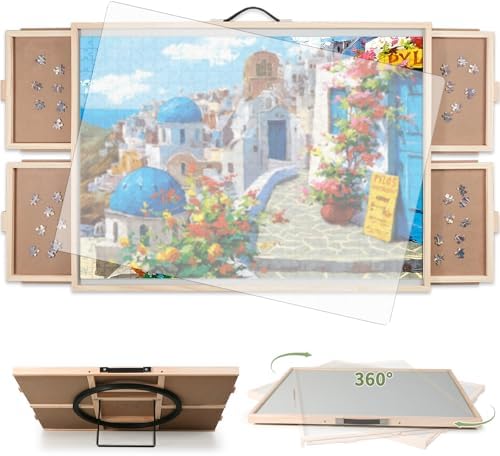
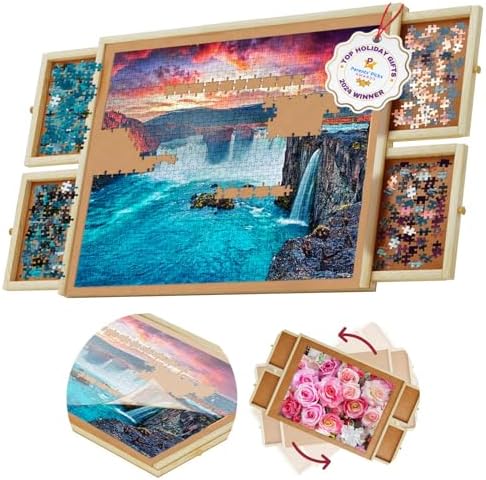
A puzzle table turns a scattered mess on the dining room table into a dedicated space you can actually leave alone. It gives you a flat, non-slip surface to build on, drawers or trays to sort loose pieces, and often a cover so dinner does not have to wait on your last 200 pieces. But a cheap board can be too small for the puzzle you bought, or so flimsy that pieces slide the moment you nudge it. We analyzed thousands of verified buyer reviews, recent sales data, and expert evaluations to find six puzzle tables that hold the puzzle you actually own and keep your progress safe between sessions.
Up to 1,500 pieces · 24.53" x 33.19" · Tilt stand + rotating lazy Susan
Our Best Overall pick: ALL4JIG's 2-in-1 board pairs a rotating lazy-Susan base with an easel-style metal tilt stand, four sorting drawers and a dust cover, backed by dedicated third-party coverage and strong recent buyer momentum.
Up to 2,000 pieces · 28.5" x 40.16" · Rotating lazy Susan + 4 drawers
Our pick for large puzzles: the biggest work surface in this lineup at 28.5 x 40.16 inches, built to handle 2,000-piece puzzles with the same rotating lazy Susan and 4-drawer storage as ALL4JIG's smaller boards.
Up to 1,500 pieces · 33.58" x 24.92" · Wheels, height & 45-degree tilt
A rolling puzzle table on locking casters, with height adjustment and up to 45-degree tilt, so an in-progress puzzle can be wheeled to another room instead of staying put.
Up to 1,500 pieces · 34.25" x 25.2" · Tilt stand + rotating lazy Susan
BuilderButler's tabletop tilt-and-rotate board pairs an easel-style stand with a stainless-steel lazy Susan in a lighter, tabletop-only body than the brand's own wheeled model.
Up to 1,000 pieces · 30" x 22.25" · Rotating lazy Susan + 4 drawers
Our Best Affordable pick: a lacquered wood rotating puzzle board with a built-in 360-degree lazy Susan, 4 sorting drawers and a removable cover, priced the lowest in this comparison. It's sized for puzzles up to 1,000 pieces rather than the 1,500-piece capacity of the pricier boards here.
ALL4JIG Adjustable Puzzle Table with Legs (1,500 Pieces)
4.6
Up to 1,500 pieces · 24.53" x 33.19" · 3 tilt angles, adjustable legs
ALL4JIG's height-adjustable table on real legs pairs 3 tilt angles with 4 sorting drawers and a dust cover built for everyday stability and lasting use.
Short on time? These three cover most puzzlers: our top-graded height-adjustable table with legs, the most affordable table in this lineup, and the biggest board here, built for oversized 2,000-piece puzzles.
Understand the category before you buy - what the science actually says, and which specs matter.
Every puzzle table promises to make assembly easier, but the surface size, the sorting storage, and whether it tilts or folds decide how well it fits your puzzles and your room. Here is how they work, the one thing to check before anything else, and the features actually worth comparing.
What does a puzzle table actually do?
A puzzle table gives your build a permanent home so you never have to clear it away half-finished. At its simplest it is a flat board with a raised edge that keeps pieces from sliding onto the floor. Most models add a few practical extras:
A non-slip surface, often felt or a smooth lacquered finish, so pieces stay put when you move the board.
Sorting drawers or trays that hold loose pieces by color or edge while you work.
A cover or lid that lets you set an unfinished puzzle aside and protect it from dust, pets, and curious hands.
A tilting or adjustable top on some models, which angles the surface toward you so you are not hunched over a flat table for hours.
Match the surface to your puzzle before anything else
This is the step most shoppers skip, and it is the one that matters most. A board is built and rated for a specific piece count, and a table rated for 1,000 pieces will simply not hold a 1,500-piece puzzle. The two numbers that decide what you can build are the piece capacity and the actual working dimensions, so start there and let everything else follow.
In this lineup, capacity ranges from 1,500 pieces on the ALL4JIG and BuilderButler boards up to 2,000 pieces on the largest ALL4JIG board, whose 28.5" x 40.16" surface is the roomiest working area in this comparison for spreading an oversized puzzle out; the 1,500-piece boards run mid-size working surfaces from the BuilderButler 2-in-1 at 34.25" x 25.2" to the BuilderButler with wheels at 33.58" x 24.92". Check the box on your favorite puzzles, then buy the board that clears it. A surface that is too small forces you to break the puzzle into sections and defeats the entire purpose of a dedicated table.
Once the size is right, the rest is about comfort and convenience. A non-slip felt surface, like the one on the BuilderButler, keeps pieces from sliding when you tilt or carry the board. Sorting drawers or trays organize the loose pieces so you are not hunting through a pile. A cover lets you walk away without losing progress. And a tilting top eases your neck and back over long sessions.
Which specs actually matter?
Once the capacity and size fit, a few features decide which table is right for you:
Piece capacity and working dimensions: The first filter, always. Capacity in this lineup runs from 1,500 to 2,000 pieces, with working surfaces from 24.53" x 33.19" up to the largest ALL4JIG board's 28.5" x 40.16". Buy for the largest puzzle you plan to build.
Surface material and grip: A non-slip felt top, as on the BuilderButler, holds pieces best when the board moves. Smooth lacquered fiberboard and wood finishes are easy to slide pieces across on a flat, stationary table.
Sorting storage: Most boards here include 4 drawers, with the BuilderButler adding 2 extra fabric drawers for 6 total. More trays mean more room to sort by color and edge.
Tilt and height adjustment: Flat boards like the ALL4JIG rotating board sit on any table, while the BuilderButler with wheels tilts up to 45 degrees and adjusts height, and the BuilderButler 2-in-1 pairs an easel-style tilt stand with a rotating lazy Susan base.
Cover or lid: Every board in this lineup ships with a dust cover or protective lid, letting you pause a puzzle for days without losing pieces or drawing dust.
Portability and storage: Some boards include a carry handle for easy storage, some roll on casters like the BuilderButler, and tabletop boards tuck under a bed or sofa.
How we grade products
Graded Picks rankings are aggregated from several independent signals: verified buyer ratings and the size of the review base for credibility, recent monthly purchase volume for relevance, assessments from trusted hobby and home publications, and how each product places in leading category lineups. For puzzle tables we weigh:
Piece capacity and working surface size
Grip and quality of the surface finish
Sorting drawer and tray capacity
Tilt and height adjustment
Cover or lid protection
Portability and storage footprint
Overall value for the price
Setup and care note: Confirm the assembled dimensions and piece rating against the puzzles you own before you buy, since a board that is too small cannot be fixed later. Keep the cover on whenever you step away to protect an unfinished build, and if your table has a felt surface, lift pieces rather than dragging them and vacuum the felt gently so it keeps its grip over time.
In-Depth Reviews
Everything we learned from buyer reviews and expert testing, product by product.
Our Best Overall pick. This ALL4JIG board combines two mechanisms other tables here offer separately: a rotating stainless-steel lazy Susan base built into an easel-style tilt stand, backed by dedicated third-party coverage and strong recent buyer momentum. Reviewers who have used it for extended sessions report that the non-slip surface holds pieces securely even when the board is tilted and rotated, and one long-time puzzler called it the best puzzle board they have owned for how smoothly pieces slide into place while staying put once set down. Four drawers sort pieces by color or edge, a dust cover protects a puzzle in progress, and a carry handle lets you tuck the whole thing under a bed or sofa between sessions - a complete 2-in-1 feature set that tops this comparison. The one tradeoff to know going in is that it's a tabletop board rather than a standalone piece of furniture, so it needs a table or other flat surface underneath it.
Puzzle capacityUp to 1,500 pieces
Work surface dimensions24.53" x 33.19"
Storage drawers4 sorting drawers
Tilt & height adjustmentEasel-style metal tilt stand + rotating lazy Susan
Surface material & finishWood-finish board, non-slip surface
PortabilityCarry handle, fits under a bed or sofa
Included coverYes, dust cover included
Pros
Rotating lazy Susan base lets you reach every part of the puzzle without moving
Easel-style tilt stand angles the board without a full leg assembly
4 sorting drawers and an included dust cover
Non-slip surface holds pieces securely even tilted and rotated
Backed by dedicated professional coverage and the strongest buyer momentum in this lineup
Cons
Needs a table or other flat surface underneath - not freestanding
Smaller working surface than the larger 2,000-piece ALL4JIG board elsewhere in this comparison
Tilt stand offers fixed angles rather than a continuous incline
Who is it for?
Most puzzlers: our Best Overall pick's 2-in-1 tilt-and-rotate design pairs a full feature set with strong buyer momentum and dedicated reviewer praise.
Who is it not for?
Anyone who wants a completely freestanding table that doesn't depend on other furniture, or who wants the roomiest possible surface - see the larger 2,000-piece ALL4JIG board elsewhere in this comparison.
ALL4JIG scales its rotating lazy-Susan design up for this 2,000-piece board, giving serious puzzlers meaningfully more room to spread out pieces than the 1,500-piece boards elsewhere in this lineup. The natural wood finish and non-slip surface follow the same formula that has made the brand a recurring name across puzzle-table roundups, and the built-in rotating base means you can spin a puzzle this large around to reach every edge without walking around a table. Four drawers store sorted pieces, and an included cover keeps a multi-week 2,000-piece project dust-free and safe from household pets between sessions. Because it is a tabletop board rather than a standalone table, it still needs a large enough surface underneath it to make use of the extra size, and the bigger footprint takes up correspondingly more storage space when not in use.
Puzzle capacityUp to 2,000 pieces
Work surface dimensions28.5" x 40.16"
Storage drawers4 sorting drawers
Tilt & height adjustmentRotating lazy Susan base, flat (no tilt)
Surface material & finishNatural wood finish, non-slip surface
PortabilityCarry handle, tabletop board (no legs)
Included coverYes, dust cover included
Pros
Largest work surface in this comparison, built for 2,000-piece puzzles
Rotating lazy Susan base reaches every edge without walking around the table
4 sorting drawers plus an included dust cover
Natural wood finish with a non-slip puzzling surface
Cons
Needs a large table or surface underneath to use the extra size
Bigger footprint is harder to store than the smaller ALL4JIG boards
No standalone legs or height adjustment - it's a flat tabletop board only
Who is it for?
Puzzlers who regularly tackle 2,000-piece puzzles and want the most working room in this lineup.
Who is it not for?
Anyone working smaller 1,000-1,500 piece puzzles who doesn't need the extra surface area - the 1,500-piece boards elsewhere in this comparison cost less.
BuilderButler's table solves a problem the flat boards in this lineup can't: four casters, two of them lockable, let you roll a half-finished puzzle out of the way and back again without disturbing a single piece. The height-adjustable stand tilts up to 45 degrees, and a specialist puzzle retailer's own listing highlights the wheeled design specifically for letting a project move between rooms while staying secure. A non-slip felt surface sits atop the frame alongside four wooden drawers plus two deeper fabric drawers for extra storage, and a semi-transparent cover protects the puzzle from dust, spills and curious pets when it's parked. Owner feedback is mixed on manufacturing consistency - most buyers are happy with the adjustable height and tilt, but a few report a drawer that doesn't fit its slot correctly, so it's worth inspecting the drawers on arrival.
Tilt & height adjustmentHeight-adjustable stand, tilts up to 45 degrees
Surface material & finishNon-slip felt surface, wood frame
PortabilityRolls on 4 casters, 2 lockable
Included coverYes, semi-transparent dust cover included
Pros
Rolls on 4 casters, 2 lockable, to move an in-progress puzzle between rooms
Height-adjustable stand with tilt up to 45 degrees
6 total drawers (4 wood, 2 fabric) for sorting and extra storage
Semi-transparent cover protects against dust, spills and pets
Cons
Some owners report a drawer that doesn't fit its slot correctly
Rolling frame and cover add bulk versus a simple flat board
Priced above the flat and rotating boards in this comparison
Who is it for?
Puzzlers who need to move a project between rooms or want height and tilt adjustment on wheels.
Who is it not for?
Buyers who keep their puzzle in one fixed spot and don't need mobility - the BuilderButler 2-in-1 board elsewhere in this comparison costs less without the rolling frame.
BuilderButler brings its tilt-and-rotate formula to a lighter, tabletop-only body priced well below the brand's own height-adjustable, wheeled BuilderButler table elsewhere in this lineup: an easel-style metal stand angles the 34.25 x 25.2-inch surface for a comfortable puzzling angle, while a stainless-steel lazy Susan base built into the stand spins the puzzle around so every edge is within reach without walking around the table. A non-slip felt puzzling surface keeps pieces from sliding once the board is tilted or rotated, and four drawers plus an included transparent cover round out the same core feature set as the pricier wheeled model, at a lower cost. Beyond puzzles, BuilderButler markets the same board as a portable easel for diamond painting and fuse beads projects, a versatility owners of the design cite as a reason to keep it out even between puzzles. Independent professional coverage of this specific tabletop version is thin - it is sold mainly through Amazon, eBay and specialty puzzle-supply retailers rather than reviewed by dedicated testing sites - so weigh it primarily on buyer feedback and the strength of BuilderButler's established wheeled model in this same lineup.
Puzzle capacityUp to 1,500 pieces
Work surface dimensions34.25" x 25.2"
Storage drawers4 sorting drawers
Tilt & height adjustmentEasel-style tilt stand + rotating lazy Susan
Surface material & finishNon-slip felt surface, wood frame
PortabilityTabletop easel design, no legs or wheels
Included coverYes, transparent dust cover included
Pros
One of the more affordable tables in this comparison
Keeps the same core tilt-and-rotate feature set as BuilderButler's pricier wheeled table
Stainless-steel lazy Susan base spins the puzzle for full-edge reach
Easel-style tilt stand angles the board without a full leg assembly
Non-slip felt surface holds pieces securely even tilted and rotated
Cons
Needs a table or other flat surface underneath - not freestanding like BuilderButler's wheeled model
No height adjustment or wheels, unlike its BuilderButler sibling above
Thin independent professional review coverage - sold mainly through marketplace listings
Who is it for?
Budget-focused puzzlers who want BuilderButler's tilt-and-rotate design at a lower price than the brand's wheeled model.
Who is it not for?
Anyone who wants to roll a puzzle between rooms or adjust table height - see the wheeled BuilderButler elsewhere in this comparison - or who needs a completely freestanding table.
Our Best Affordable pick. This Beyond Innoventions board undercuts every other table in this lineup on price while still covering the core features puzzlers look for: a full 360-degree rotating lazy Susan base, four sliding drawers for sorting pieces, and a removable transparent cover to protect a project in progress. A dedicated buyer's-guide review credits the lacquered natural-wood construction for resisting the warping and sagging that cheaper boards can develop under a fully spread-out puzzle, and the line is carried across Walmart, Target and Kmart in addition to Amazon, a sign of steady mainstream demand beyond a single retailer. At 30 x 22.25 inches it's sized for puzzles up to 1,000 pieces, smaller than the 1,500-piece capacity of the other boards here, which is exactly the tradeoff that keeps its price the lowest in this comparison. Unlike the ALL4JIG and BuilderButler tables in this comparison, it has no tilt stand or height-adjustable legs - it's a flat rotating board meant to sit on an existing table or other flat surface.
Puzzle capacityUp to 1,000 pieces
Work surface dimensions30" x 22.25"
Storage drawers4 sliding drawers
Tilt & height adjustmentRotating lazy Susan base, flat (no tilt)
Surface material & finishLacquered natural wood finish
PortabilityTabletop board, no legs or wheels
Included coverYes, removable transparent cover included
Pros
Lowest price of any table in this comparison
360-degree rotating lazy Susan base reaches every part of the puzzle
4 sliding drawers plus a removable transparent cover
Lacquered natural-wood construction praised for resisting warping
Sold across Walmart, Target and Kmart in addition to Amazon
Cons
Caps out at 1,000 pieces - smaller capacity than the other boards here
No tilt stand or height-adjustable legs, unlike the ALL4JIG and BuilderButler tables
Smaller 30 x 22.25-inch surface than the larger ALL4JIG 2,000-piece board's 28.5 x 40.16 inches
Who is it for?
Budget-focused puzzlers who want our Best Affordable pick: a rotating board with drawers and a cover at the lowest price in this comparison.
Who is it not for?
Anyone assembling 1,500-piece or larger puzzles, or who wants a tilt stand or standalone legs - see the ALL4JIG or BuilderButler tables elsewhere in this comparison.
6. ALL4JIG Adjustable Puzzle Table with Legs (1,500 Pieces)
4.6
It's a steady, adjustable option for dedicated puzzle corners. This ALL4JIG table works as a genuine dedicated puzzling workspace rather than a tabletop board propped on furniture: freestanding legs put it at a comfortable working height whether you sit or stand, and reviewers specifically credit the ability to alternate between sitting and standing during long sessions with reducing back strain. Three tilt angles let you angle the 24.53 x 33.19-inch surface for easier reach without leaning over a flat board, and four drawers keep sorted pieces organized and dust-free under the included cover. Because it stands on its own legs rather than needing a table underneath, owners also use it as a drafting table or a laptop stand on the couch when it's not holding a puzzle. Feedback is strong on stability and drawer fit, and it's been named a Premium Option across multiple roundups - real legs and height adjustability make it the most complete, well-rounded table in this comparison.
Puzzle capacityUp to 1,500 pieces
Work surface dimensions24.53" x 33.19"
Storage drawers4 sorting drawers
Tilt & height adjustmentHeight-adjustable legs, 3 tilt angles for sit or stand use
Surface material & finishWood-finish board, non-slip surface
PortabilityFreestanding legs double as a drafting or laptop table
Included coverYes, dust cover included
Pros
Freestanding, height-adjustable legs support sitting or standing work
3 tilt angles reduce neck and back strain during long sessions
4 sorting drawers plus a dust cover keep pieces organized between sessions
Doubles as a drafting table or couch laptop stand when not puzzling
Strong buyer feedback on build quality, stability and drawer fit
Cons
Among the priciest tables in this lineup, though not the most expensive
Legs and larger footprint need more floor space than a tabletop board
3 tilt angles are fixed steps rather than a continuous incline
Who is it for?
Most puzzlers: our Best Overall pick's dedicated, standalone design offers adjustable height and tilt, not just a board that sits on furniture.
Who is it not for?
Buyers on a tight budget - the Beyond Innoventions rotating board, this comparison's Best Affordable pick, costs significantly less.
The stars you see are the Graded Picks cumulative score, not a single retailer's average. It blends verified buyer reviews aggregated across major retailers, assessments from professional reviewers and expert testers, and how prominently the product features in leading category lineups.
Advertising Disclosure
Our rankings are compiled by aggregating several independent signals, including verified buyer feedback, how popular a product currently is with shoppers, and evaluations published by professional reviewers. Editorial opinions are our own.
Please note that we participate in affiliate marketing programs. When you purchase through links on our site, we may earn a commission. As an Amazon Associate we earn from qualifying purchases. This comes at no additional cost to you and helps support the resources required to provide valuable content.