A rebounder turns a small patch of floor into cardio you will actually look forward to, a bouncy few square feet where you can raise your heart rate without pounding your knees. The catch is that these mini trampolines feel wildly different underfoot depending on how they are built, and the cheap ones can be stiff, loud, or wobbly enough to put you off. We analyzed thousands of verified buyer reviews, recent sales data, and expert evaluations to find eight rebounders that bounce well, hold up, and fit the person actually using them.
Every product we compared, in ranked order. Tap through to Amazon to check today's price, or jump to the full review below.
1
BCAN BT2 40in
Best Overall13% OFF
BCAN BT2 40-Inch Rebounder with Adjustable Handle Bar
5.0
40-inch frame · 450 lb capacity · Bungee cords
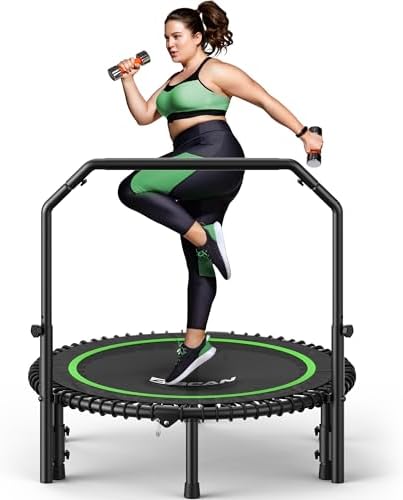
Our Best Overall pick: a longtime favorite in BCAN's lineup that independent trampoline reviewers consistently single out for quiet bungee-cord suspension, a 3-level adjustable handlebar and a 450 lb frame rating built for daily cardio.
BCAN's premium one-piece-frame rebounder, built around dual-tension latex bungee cords that can be mixed and matched to dial in resistance. Reviewed favorably by multiple hands-on testers for its joint-friendly, adjustable bounce and standout build quality.
A newer bungee rebounder built around a 1.8mm steel frame and a patented mat-to-cord connection, independently tested to ASTM safety standards. Also sold in 46-inch and 50-inch sizes, with a 4-level handlebar that adjusts higher than most rivals here.
A no-assembly hexagonal rebounder that arrives ready to unfold and bounce on, built around 24 quiet bungee cords and a wide, stable base. Senior-focused fitness reviewers single it out as one of the fastest rebounders in this category to set up and put away.
The same acclaimed BT2 bungee frame used in BCAN's handled model above, minus the handlebar, at the lowest price of any BCAN here. A longtime lineup staple that tucks under a bed or sofa between workouts.
ANCHEER 50-Inch Bungee Rebounder with Bar (550 lbs)
4.7
50-inch hexagonal · 550 lb capacity · 48 bungees
ANCHEER's standard 50-inch bungee rebounder: the same big hexagonal jumping surface and 48-cord suspension as its newer sibling, with a 550 lb rating and a foam-covered adjustable bar.
The highest weight rating and one of the largest jumping surfaces in this comparison: a 50-inch hexagonal frame on 48 bungee cords, rated to 560 lbs, that still folds to about 4 inches thick.
A large 48-inch foldable bungee rebounder rated to 550 lbs, with an adjustable U-handle, a full-wrap safety edge over the cords and a 99% pre-assembled frame, at a price below the other 50-inch models here.
Rebounder Trampolines 101: What They Do & How to Choose
Understand the category before you buy - what the science actually says, and which specs matter.
Every rebounder promises a fun, low-impact workout, but the way each one is sprung decides how that workout feels, how quiet it is, and how kind it is to your joints. Here is how a rebounder works, why the suspension system matters more than anything else, and the features worth comparing before you buy.
What does a rebounder actually do?
A rebounder is a small trampoline sized for one adult and built for exercise rather than play. You bounce on a taut mat suspended inside a round or hexagonal frame, and that mat flexes with each landing so your feet meet a soft surface instead of a hard floor. The result is aerobic exercise that gets your heart and lungs working while sparing the joints that normally absorb every step.
It raises your heart rate for cardio, whether you are jogging in place, doing high-knees, or gentle health bounces.
The mat absorbs the landing your ankles, knees, and hips would otherwise take.
Many models add a handle bar so you can hold on for balance while you move.
Most fold or break down for storage, so a workout station tucks away when you are done.
The suspension system defines the whole workout
This is the one thing most shoppers overlook, and it matters more than size or looks. How the mat is suspended decides how the rebounder feels, sounds, and treats your joints.
There are two main systems. Bungee-cord models suspend the mat on elastic cords, which gives a soft, deep, quiet bounce that is gentler on knees and ankles. That makes bungees the friendlier choice for low-impact cardio and slow, lymphatic-style health bouncing. Steel-spring models use metal coils instead, which feel firmer, springier, and noticeably louder. Every rebounder in this lineup runs on bungees rather than metal springs, from the 32-cord BCAN BT2 up to the 48-cord ANCHEER models, and the EAST MOUNT and ANCHEER units even call out that they use no metal springs at all. The BCAN BT4 goes a step further with dual-tension bungees you can mix and match to dial the bounce softer or firmer.
Either way, the reason a rebounder is genuinely easy on the body comes down to that suspended mat: it absorbs the impact your joints would normally take, so you get real cardio at a fraction of the jarring you would feel running on pavement.
Which specs actually matter?
Once you understand the bounce, a few features decide which rebounder fits you:
Suspension type and cord count: Bungees give the soft, quiet, joint-friendly bounce these models are known for. More cords generally spread the load and smooth the feel, ranging from 24 on the HXD-ERGO up to 48 on the ANCHEER units.
Weight capacity: Match this to the user with room to spare. Static ratings here span 450 lbs on several 40 to 42-inch models up to 560 lbs on the ANCHEER 50-inch, so a heavier user or anyone wanting extra margin should size up.
Diameter and shape: Bigger means more room to move and a more stable feel. Sizes run from 40 inches round on the BCAN models to 42 and 50 inches on the hexagonal HXD-ERGO, EAST MOUNT and ANCHEER units.
Handle or stability bar: A bar is a real help for beginners and older users who want something to hold. Adjustable bars here offer 3 to 4 height levels, while a handle-free BCAN BT2 keeps the profile low for storage.
Adjustable height: Multiple handle levels let you match the bar to your height and swap it between users.
Folding and storage: If floor space is tight, look for a folding frame. Several here fold flat or to about 4 inches thick to slide under a bed, while the BCAN BT4 uses a sturdier non-folding one-piece frame.
Assembly: Setup ranges from roughly 5 to 10 minutes on most models to the HXD-ERGO and EAST MOUNT, which unfold ready to use.
How we grade products
Graded Picks rankings are aggregated from several independent signals: verified buyer ratings and the size of the review base for credibility, recent monthly purchase volume for relevance, assessments from trusted fitness publications, and how each product places in leading category lineups. For rebounders we weigh:
Bounce quality and how quiet the suspension is
Weight capacity and frame stability
Handle design and adjustability
Size and mat surface
Ease of folding and storage
Assembly and durability
Overall value for the price
Safety note: A rebounder puts you off the ground on a moving surface, so give yourself clear space overhead and around the frame, and use a handle bar if your balance is not rock solid. Start with gentle, controlled bounces before working up to jogging or higher moves, keep to the stated weight capacity, and check the bungees and legs periodically so nothing works loose over time.
In-Depth Reviews
Everything we learned from buyer reviews and expert testing, product by product.
BCAN BT2 40in
Best Overall13% OFF
1. BCAN BT2 40-Inch Rebounder with Adjustable Handle Bar
5.0
Our Best Overall pick. The BT2 is BCAN's original flagship bungee rebounder and remains one of the most widely-praised designs in this comparison - testers describe the bounce as smooth, stable and close to silent, a real difference from spring-based mini trampolines. The 32 bungee cords are rated to tens of thousands of jump cycles, and the three-level adjustable handlebar (roughly 2'7" to 3'2") gives balance-conscious users and rehab exercisers a stable point of contact. With a 450 lb static capacity and an alloy-steel frame that folds down between sessions, it comfortably covers most adult body types and living situations. A 13% discount at the time of our scan makes an already well-rounded package easier to justify, and it earns the top spot in this comparison on the strength of that quiet, stable bounce and broad buyer praise.
Trampoline size40 inches, round
Max weight capacity450 lbs (static)
Suspension system32 bungee cords, quiet operation
Handle barAdjustable, 3 height levels (2'7"-3'2")
Folding & storageFolds flat for closet or under-bed storage
Included extrasAdjustable handlebar, assembly tools
AssemblyBolt-on legs and handlebar, tools included
Pros
Bungee-cord bounce is noticeably quieter and softer than spring rebounders
Adjustable 3-level handlebar suits a wide range of heights and abilities
450 lb frame rating covers most adult users with room to spare
Folds down reasonably flat for closet or under-bed storage
Consistently favored by independent trampoline reviewers
Cons
Leg bolts can loosen over time and need periodic re-tightening
Assembly instructions are light on detail for first-timers
Handlebar adds bulk that partly offsets the folding design
Who is it for?
Most buyers: our Best Overall pick for a quiet, stable bounce for daily low-impact cardio, balance work or light rehab exercise.
Who is it not for?
Anyone tight on storage space who would prefer the lower-profile, handle-free BT2 variant below.
The BT4 Soft Land Pro is BCAN's premium rebounder, built around engineering upgrades over the brand's standout BT2 - our Best Overall pick elsewhere in this comparison: a one-piece 16-gauge steel chassis replaces the usual bolt-together legs, and two swappable sets of natural-latex bungee cords - a softer 8mm set and a firmer 9mm set, each rated past 100,000 jump cycles - let you mix cords to customize resistance for lighter cardio or harder intervals. Hands-on reviewers praised the forgiving, joint-friendly bounce as an immediate standout versus basic bungee rebounders, and Forbes Health has singled out BCAN for its capacity-to-price ratio. The 500 lb static rating, tool-free adjustable handlebar and included phone holder and grip socks round out one of the most complete packages in this lineup, with a 17% discount at the time of our scan taking some sting out of the premium price.
Trampoline size40 inches, round
Max weight capacity500 lbs (static)
Suspension systemDual-tension bungees (32 x 8mm + 22 x 9mm, mixable)
Mixable dual-tension bungee sets let you customize resistance
One-piece 16-gauge steel frame feels noticeably sturdier than bolt-leg designs
500 lb static rating is among the highest in this comparison
Comes with a phone holder and two pairs of grip socks
Roughly 10-minute assembly since bungees ship pre-installed
Cons
Costs meaningfully more than every other model here
Some testers noted squeaking that carries to rooms below or beside it
Non-folding one-piece frame takes up permanent floor space
Who is it for?
Buyers who want the most refined bounce and build quality in this lineup and are willing to pay a premium for it over the BT2, our Best Overall pick elsewhere in this comparison.
Who is it not for?
Anyone who needs to fold their rebounder away between uses or is shopping on a tight budget.
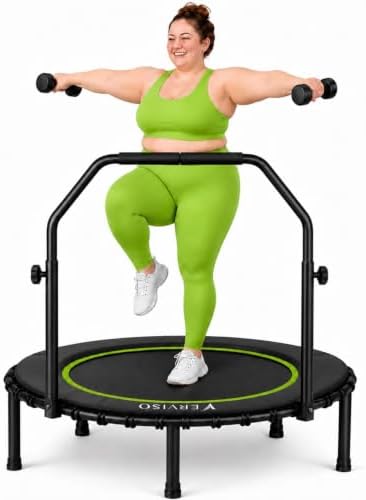
Verviso is the newest brand in this comparison, and its 40-inch bungee rebounder leans on engineering rather than a track record to make its case: a 1.8mm commercial-grade steel frame rated to 460 lbs static load, a patented mat-to-cord connection meant to eliminate the fraying and popped cords that plague cheaper rebounders, and more than 360 latex bungee cords delivering roughly 90% impact absorption for a soft, quiet landing. Independent testing confirms it meets ASTM safety standards and California's Prop 65 lead-content limits, a level of third-party verification most budget rebounders in this category skip entirely. The four-level handlebar adjusts from 42 to 54 inches - taller than the handlebars on the BCAN or ANCHEER units in this lineup - and locks in place with a Triple-Lock knob system, while the legs and handlebar detach for flat storage. It is also sold in 46-inch and 50-inch sizes for buyers who want a larger jumping surface. As a brand-new entrant with a much smaller track record than BCAN or ANCHEER, it has yet to build the kind of broad buyer history the category leaders in this lineup have earned.
Trampoline size40 inches, round (also sold in 46" and 50")
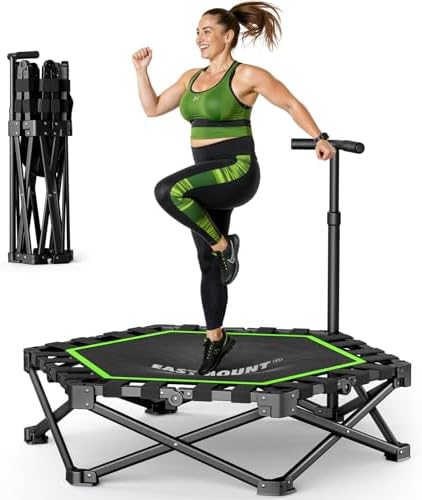
The EAST MOUNT skips the bolt-together assembly nearly every other rebounder in this lineup requires: it ships almost fully built, so unfolding the hexagonal frame and clipping on the handle is the entire setup. Reviewers at GoingLikeSixty gave it an Excellent rating in this exact 42-inch no-assembly format, praising the whisper-quiet 24-cord bungee system and calling its folded profile among the slimmest they tested, while noting the compact handle is more basic than wraparound designs and the bounce runs a touch firmer than some bungee competitors. The wide hexagonal footprint is built to resist the tipping and wobble that can plague round frames, and the whole unit folds back down to roughly 9 inches thick for storage under a bed or in a closet. A 26% discount at the time of our scan makes it one of the cheaper ways into a bungee rebounder in this comparison, backed by a 450 lb static frame rating that covers most adult users.
Trampoline size42 inches, hexagonal
Max weight capacity450 lbs (static)
Suspension system24 bungee cords, no metal springs
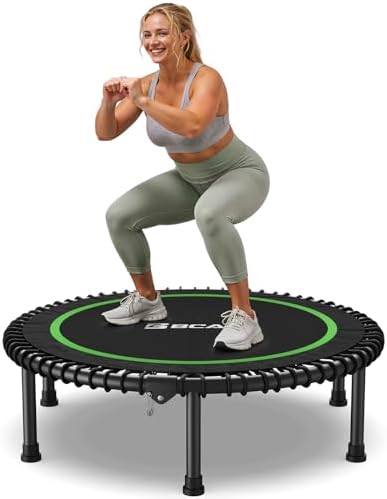
This is the handle-free version of BCAN's flagship BT2 rebounder - the same 32-cord bungee suspension and alloy-steel frame that earn the handled BT2 its reputation for a smooth, quiet bounce, just without the stability bar. Dropping the handle cuts the assembled height to about 12 inches, which matters if the rebounder needs to live under furniture or in a low-ceiling space between sessions, and it also makes this the lightest BCAN in the lineup at around 17 lbs. The 450 lb static frame rating and tool-included assembly carry over unchanged, and the six-leg base with non-slip caps keeps the unit planted on hard flooring or carpet. At a 29% discount at the time of our scan, it is the cheapest way into BCAN's well-regarded bungee platform - the trade-off is that beginners and balance-conscious users lose the stability bar.
Trampoline size40 inches, round
Max weight capacity450 lbs (static)
Suspension system32 bungee cords, quiet operation
Handle barNone (handle-free design)
Folding & storage12-inch profile slides under a bed or sofa
Included extrasAssembly tool, instruction manual
AssemblySix bolt-on legs, tools included
Pros
Same quiet bungee suspension as the handled BT2 at a lower price
Low 12-inch profile slides under a bed, sofa or low shelving
Lighter than the handled version, easier to move room to room
450 lb frame rating matches the flagship model
Straightforward six-leg assembly with included tools
Cons
No handlebar means less stability for balance-challenged users
Not ideal for anyone doing rehab or seated-support exercises
Legs can need occasional re-tightening like other BCAN models
Who is it for?
Budget-minded buyers and experienced rebounders who want BCAN's quiet bungee bounce without paying for a handlebar they won't use.
Who is it not for?
Beginners, seniors or anyone doing rehab work who benefits from a stability bar.
6. ANCHEER 50-Inch Bungee Rebounder with Bar (550 lbs)
4.7
This is ANCHEER's earlier 50-inch model, and it shares nearly everything with the 560 lb version below: a hexagonal frame, 48 high-strength bungee cords that stretch evenly to roughly three times their length for a deeper bounce, and a taller frame stance than a traditional mini trampoline that ANCHEER credits for a smoother, more intensive movement. The foam-covered handrail adjusts across three levels and resists sweat corrosion, and the unit arrives about 80% pre-assembled. At a 14% discount at the time of our scan it usually undercuts its newer sibling slightly, making it the sensible choice if the extra 10 lbs of rated capacity doesn't matter to you. Like the rest of ANCHEER's range, published engineering details are thin, and the two 50-inch models are similar enough that buyers should simply take whichever is cheaper on the day.
Trampoline size50 inches, hexagonal
Max weight capacity550 lbs (static)
Suspension system48 bungee cords, no metal springs
ANCHEER's updated 50-inch rebounder is the pick for larger users and anyone who wants more room to move: the hexagonal frame spreads 48 bungee cords around a jumping surface noticeably bigger than the 40-inch units here, and independent trampoline reviewers at ProTrampolines call it the largest budget handlebar rebounder in its price bracket. The 560 lb static rating leads this lineup, the foam-grip handlebar adjusts across three levels from 33 to 46 inches, and despite the size the frame folds to roughly 4 inches thick for storage. It ships about 80% pre-assembled, so setup runs around 10 minutes. The same reviewers temper their praise with transparency criticisms - ANCHEER does not publish frame tube gauge or bungee tensile ratings and claims no ASTM or CE certification - so treat it as a strong value rather than a documented piece of engineering.
Trampoline size50 inches, hexagonal
Max weight capacity560 lbs (static)
Suspension system48 bungee cords, no metal springs
The Zupapa 48-inch rebounder is a high-capacity folding model with a thickened high-carbon steel frame rated to 550 lbs and 36 heavy-duty 8mm UV-resistant bungee cords that the maker says absorb most of the impact for a joint-friendly bounce. A 12-inch full-wrap safety edge conceals the cords, dense rubber base pads damp noise and vibration, and the three-height U-handle adds a stable point of contact. It ships almost fully assembled, so setup is mostly clipping on the handlebar, and the frame folds to roughly 15 by 30 inches in under 30 seconds for storage under a bed or in a closet. At about 25 lbs it is light for its size, and it comes with a 1 to 3 year manufacturer warranty. Next to the two ANCHEER 50-inch models in this lineup it offers a similar capacity at a lower price, but it has little independent expert coverage, so buyer feedback and the manufacturer's specs are the main evidence.
Trampoline size48 inches, round
Max weight capacity550 lbs (static)
Suspension system36 bungee cords (8mm), no metal springs
Handle barAdjustable U-handle, 3 height levels
Folding & storageFolds to about 15 x 30 inches
Included extrasHandlebar, 12-inch full-wrap safety edge
AssemblyAbout 99% pre-assembled, just add the handlebar
Pros
550 lb static rating covers heavier users
Large 48-inch jumping surface
Bungee suspension for a quiet, joint-friendly bounce
Full-wrap safety edge hides the cords
Folds quickly for storage and ships nearly assembled
Cons
Little independent expert testing behind it
Handlebar height range is listed inconsistently across retailers
Lesser-known brand with a shorter track record than BCAN or ANCHEER
Who is it for?
Heavier users or anyone who wants a big, foldable bungee rebounder with a 550 lb rating at a modest price.
Who is it not for?
Anyone who wants a long-established brand or documented independent testing, who should look at the BCAN or ANCHEER models higher up this lineup.
The stars you see are the Graded Picks cumulative score, not a single retailer's average. It blends verified buyer reviews aggregated across major retailers, assessments from professional reviewers and expert testers, and how prominently the product features in leading category lineups.
Advertising Disclosure
Our rankings are compiled by aggregating several independent signals, including verified buyer feedback, how popular a product currently is with shoppers, and evaluations published by professional reviewers. Editorial opinions are our own.
Please note that we participate in affiliate marketing programs. When you purchase through links on our site, we may earn a commission. As an Amazon Associate we earn from qualifying purchases. This comes at no additional cost to you and helps support the resources required to provide valuable content.