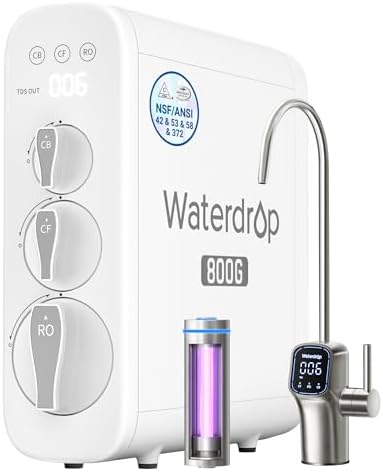
A reverse osmosis system does something no pitcher filter can: it pushes your tap water through a membrane fine enough to strip out dissolved salts, lead, and the stuff that makes water taste like the pipes it came through. But the marketing leans hard on a "stage count" that tells you almost nothing, and the cheap units can waste several gallons down the drain for every clean gallon they make. We analyzed thousands of verified buyer reviews, recent sales data, and expert evaluations to find eight reverse osmosis systems that filter deeply, waste less, and fit the space you actually have.
Every product we compared, in ranked order. Tap through to Amazon to check today's price, or jump to the full review below.
1
Waterdrop G3P600
Best Overall19% OFF
Waterdrop G3P600 Tankless Reverse Osmosis System
5.0
600 GPD · 8-stage RO · Smart TDS display faucet
Our Best Overall pick: a space-saving tankless system where lab testing found it reduces major contaminants, including disinfection byproducts, copper, barium and uranium, to below detection levels, with a smart LED faucet, live TDS readings, and a design that saves roughly 70% of the cabinet space traditional tank-based RO systems need.
Our pick for mineral-enhanced water: the highest-capacity system in this comparison pairs alkaline remineralization with a smart stainless faucet, and lab testing found it eliminated essentially every contaminant that exceeded safe levels.
A compact, installation-free countertop RO system with a 3-liter tank and autofill pitcher, the newest and most affordable system in this comparison, trading permanent plumbing for a plug-in dispenser you can move between counters or apartments.
A strong all-around pick: iSpring's pumped, alkaline 6-stage system keeps output consistent even on weak household water pressure, and reviewers say the remineralization stage gives it noticeably better taste than a standard RO system.
Waterdrop's fastest and highest-capacity tankless system in this comparison produces a 6-ounce cup in about 5 seconds, and lab testing found it removes lead, fluoride and arsenic to near-undetectable levels with far less water waste than older RO designs.
64 oz glass carafe · 4-stage RO · 4:1 pure-to-drain
A no-installation countertop system that fills a 64-ounce borosilicate glass carafe instead of a dispenser tank. Independent lab testing found it eliminated 100% of several major contaminants, including uranium, fluoride and chloroform, at a 4:1 pure-to-drain ratio, among the most water-efficient systems in this comparison.
Our Best Affordable pick: one of the most extensively lab-tested budget RO systems on the market, the RCC7AK pairs 6-stage filtration and alkaline remineralization with reduction figures that rival systems costing twice as much.
No installation · 5-stage RO + UV · 4:1 pure-to-drain
A no-installation countertop system that adds UV sterilization on top of standard RO filtration, aimed at renters and anyone who doesn't want to touch their under-sink plumbing.
Short on time? These three cover most buyers: our Best Overall pick for a high-output tankless system with a smart TDS faucet, the best value for most households, and the top choice for mineral-enhanced water.
Understand the category before you buy - what the science actually says, and which specs matter.
Every system advertises a big number of "stages," but that number is mostly a sales figure, not a measure of how clean your water gets. Here is how these systems actually work, why the stage count matters far less than you would think, and the specs that genuinely separate a good system from a wasteful one.
What does a reverse osmosis system actually do?
Reverse osmosis works by forcing water under pressure through a semipermeable membrane with openings so small that dissolved contaminants cannot pass. What comes through is purified water; what gets held back is flushed away as concentrate, or "drain" water. A full system usually surrounds that membrane with a few supporting filters:
A sediment pre-filter that catches grit and rust so it does not clog the membrane.
A carbon block that removes chlorine, which would otherwise damage the membrane over time.
The RO membrane itself, which does the heavy lifting on dissolved solids.
Optional post-filters for polishing taste, adding minerals back, or UV sterilization.
That is the whole job. Water goes in, most of the dissolved solids come out, and clean water heads to your faucet.
Why "more stages" is mostly a marketing number
Here is the part almost no shopper is told. The stage count sells systems, but it does not describe how clean your water gets. The RO membrane is the one component that removes dissolved solids, and nearly every quality system uses a single high-grade membrane. The extra stages are pre-filters and post-filters doing supporting work, and vendors count them generously.
Look at the lineup and the pattern is obvious. The Waterdrop G3P600 is labeled 8-stage and the SimPure Y7P-BW is labeled 5-stage, yet both rely on one RO membrane to do the actual purifying. The NU Aqua system advertises "7-Stage (12 Step Filtration)," which shows how elastic the counting can get. A 5-stage unit with a strong membrane and a smart drain ratio will out-perform an 8-stage unit built around a weak one.
So treat the stage number as a rough hint at features, not a quality score. Then judge the system on the three things that truly decide how it lives in your kitchen: how much water it wastes, how fast it delivers, and whether it puts minerals back into the water it just stripped clean.
Which specs actually matter?
Pure-to-drain ratio: This is how much water is wasted per clean gallon, and it varies here, from 2:1 on the Waterdrop G3P600 up to 4:1 on the SimPure Y7P-BW and the AquaTru Glass Carafe. A 4:1 ratio wastes roughly a quarter gallon per pure gallon, while a 1:1 system wastes a full gallon for every one it makes. Higher first numbers mean a lower water bill.
Rated output (GPD): Gallons per day sets how long you wait at the faucet. The range in this lineup runs from 75 GPD on the iSpring RCC7P-AK to 800 GPD on the Waterdrop G3P800. Higher-GPD tankless units pour on demand; lower-GPD models lean on a storage tank.
Remineralization: RO strips beneficial minerals along with contaminants, which can leave water tasting flat. Models like the Waterdrop X12 Alkaline, iSpring RCC7AK, and iSpring RCC7P-AK add an alkaline or remineralization stage to restore taste and raise pH.
Tank vs tankless: Tankless systems like the Waterdrop G3P600 filter on demand and save cabinet space, while tank-based units like the NU Aqua keep a reserve for faster pours but take up more room under the sink.
Feed water TDS limit: This is the hardness of water each system can handle, measured in parts per million of total dissolved solids. It spans from 300 ppm on the NU Aqua to 2,000 ppm on the iSpring RCC7P-AK. Match it to your local water.
Certifications: Look for NSF/ANSI standards. Several units here carry NSF/ANSI 58 for RO performance and 372 for lead-free materials, including the Waterdrop G3P600 and Waterdrop G3P800.
How we grade products
Graded Picks rankings are aggregated from several independent signals: verified buyer ratings and the size of the review base for credibility, recent monthly purchase volume for relevance, assessments from trusted home water and plumbing publications, and how each product places in leading category lineups. For reverse osmosis systems we weigh:
Pure-to-drain efficiency
Rated output and flow speed
Filtration certifications and membrane quality
Remineralization and taste
Tank or tankless fit for the space
Feed water TDS tolerance
Filter replacement cost and warranty
Installation and maintenance note: Most of these systems mount under the sink and tap into your cold water line and drain, so check your available cabinet space and water pressure before buying, since low pressure can cut output and worsen the drain ratio. Replace the pre-filters and membrane on the maker's schedule, and if your water source is untested or from a private well, have it checked so you match the system to your actual water.
In-Depth Reviews
Everything we learned from buyer reviews and expert testing, product by product.
Waterdrop G3P600
Best Overall19% OFF
1. Waterdrop G3P600 Tankless Reverse Osmosis System
5.0
The G3P600 is our Best Overall pick, pairing lab-verified contaminant removal, a space-saving tankless design and a smart faucet that keeps you informed between filter changes: lab testing found it removes nearly all major contaminants - including disinfection byproducts, copper, barium and uranium - to below minimum detection levels across its 8 filtration stages. The tankless build saves roughly 70% of the cabinet space a traditional tank-based system needs, and the smart LED faucet displays TDS readings alongside filter-life status so you know when a change is due. Long-term hands-on testers report the filter-change process is notably simpler than older RO designs, with longer-lasting cartridges. The tradeoffs: installation needs an electrical outlet and basic DIY skills, filter replacement costs run higher than on tank-based systems, and a handful of owners describe the unit as audibly noisy during operation. Buyers who want the highest raw capacity and fastest fill time can step up to the X12 or G3P800 elsewhere in this lineup.
Filtration stages8-stage RO + carbon block
Rated output600 GPD
Pure-to-drain ratio2:1
Feed water TDS max1,500 ppm
InstallationUnder sink, tankless
CertificationsNSF/ANSI 42, 58 & 372
Warranty1 year
Pros
Lab-tested to reduce major contaminants to below detection levels
Saves roughly 70% of cabinet space versus traditional tank-based RO systems
Smart faucet displays TDS and filter-life status
Filter changes are simpler and less frequent than on older RO designs
Cons
Requires an under-sink electrical outlet and basic DIY installation skills
Replacement filters cost more than tank-based system cartridges
Some owners describe the unit as noisy during operation
Who is it for?
Buyers who want a compact, lab-verified tankless system with a smart TDS faucet and don't need the highest capacity.
Who is it not for?
Anyone installing in a cabinet without an accessible outlet, buyers who want the lowest possible filter-replacement cost, or anyone who wants the highest available output - see the G3P800 elsewhere in this comparison.
The X12 is our pick for mineral-enhanced water: it pairs an 11-stage filtration process with alkaline remineralization, aiming at buyers who want RO-level purification without the flat taste RO water can otherwise have. Independent lab testing found it reduced 100% of contaminants that exceeded safe thresholds in the sample water, along with cobalt, copper, molybdenum and zinc, and it's certified against NSF/ANSI 42, 58 and 372. The smart digital faucet shows TDS and filter-life status, and its 1,200 GPD rating and 3-second 6-ounce fill make it the fastest system in this lineup. Waterdrop backs it with a 2-year warranty, longer than its G3 siblings. It's also the newest of the three Waterdrop systems here, so it has less real-world track record than the longer-established G3P600 and G3P800, and it carries the highest price in this comparison.
The 112 is DREO's compact entry into reverse osmosis, built around a 3-liter tank and a 37-ounce autofill pitcher so you can place it anywhere near an outlet rather than cutting into under-sink plumbing. A hands-on review from MacSources scored it 95% overall, praising a real-time TDS display that's easy to read at a glance and crediting the compact 7-stage design with noticeably better-tasting water, though the reviewer flagged the initial flushing process as somewhat tedious and noted a more basic control set than pricier countertop units. DREO cites SGS testing aligned to NSF/ANSI 58 performance standards and rates the filter at 99.99% contaminant reduction, with a single cartridge lasting roughly 265 gallons (1,000 liters) before replacement. At a 3:1 pure-to-drain ratio and about 260 mL per minute of output, filling the pitcher takes a few minutes rather than the instant flow of an under-sink system - a tradeoff for skipping installation entirely. It's also the newest and least expensive system in this comparison, with the shortest track record of the group.
Filtration stages7-stage RO (countertop)
Rated outputAbout 260 mL/min (fills a 37oz pitcher in about 4 minutes)
Pure-to-drain ratio3:1
Feed water TDS max500 ppm
InstallationCountertop, no installation required
CertificationsSGS-tested, aligned to NSF/ANSI 58 (not independently certified as a complete system)
Warranty1 year
Pros
No installation or plumbing required - just fill the tank and plug it in
Independent hands-on review scored it 95% overall, citing easy daily use and a clear TDS display
99.99% rated contaminant reduction with SGS testing aligned to NSF/ANSI 58 standards
Lowest price of any system in this comparison
Autofill pitcher and compact footprint make it easy to move between counters or apartments
Cons
Fills a pitcher in a few minutes rather than the instant flow of an under-sink system
Initial flushing process is more tedious than simpler countertop units, per hands-on testing
Newest system in this lineup, with the shortest ownership track record
Who is it for?
Renters or anyone who wants installation-free RO water in a compact, movable countertop unit at the lowest price in this comparison.
Who is it not for?
Anyone who wants instant on-demand flow or the deeper track record of an established under-sink system.
The RCC7P-AK stands out in this comparison for adding a booster pump to iSpring's classic 6-stage RO design, which keeps filtration efficient and output consistent regardless of your home's water pressure - a common weak point for tank-based RO systems on low-pressure supplies. The alkaline remineralization stage restores calcium and magnesium for water reviewers describe as tasting noticeably better than standard RO output, and the reported reduction figures - the high-90% range for TDS, PFAS and chlorine - are in line with iSpring's better-known RCC7AK sibling. Installation uses the same DIY-friendly quick-fit connections and color-coded tubing as the rest of the RCC7 family, typically done in under an hour. A minority of owners report occasional leaks or the need for replacement fittings over time.
5. Waterdrop G3P800 Tankless Reverse Osmosis System
4.7
The G3P800 leads this comparison on raw output and speed, combining the highest rated capacity here with a fill time testers clocked at about 5 seconds per cup. It has been named a top tankless pick by multiple water-testing publications, and lab results consistently show it stripping lead, fluoride, arsenic and other contaminants to levels that noticeably change the water's taste. Its tankless design fits easily inside most cabinets without sacrificing storage, and the 3:1 pure-to-drain ratio wastes far less water than the 4:1-or-worse ratios common on older systems. There's no built-in remineralization filter by default - that's an optional add-on - and while detailed instructions are included, testers note that unless you have plumbing experience, hiring a professional for installation is the safer route. Even with that added cost, it remains far less expensive than a whole-house treatment system. Buyers who want a smaller footprint and a lower price can step down to the more compact G3P600 elsewhere in this comparison, which trades some of this raw capacity for space savings and a gentler price tag.
Filtration stages10-stage RO
Rated output800 GPD
Pure-to-drain ratio3:1
Feed water TDS max500 ppm
InstallationUnder sink, tankless
CertificationsNSF/ANSI 42, 53, 58 & 372
Warranty1 year
Pros
Lab testing confirms strong removal of lead, fluoride and arsenic
3:1 pure-to-drain ratio wastes less water than older RO designs
Produces a 6-ounce cup in about 5 seconds
Tankless design fits inside most cabinets without sacrificing storage
Far less expensive than whole-house treatment for comparable water quality
Cons
No remineralization filter included by default - it's an optional add-on
Installation is involved enough that testers recommend a professional for most owners
Requires an under-sink electrical outlet
Who is it for?
Buyers who want the fastest, highest-capacity tankless RO system here, and don't mind paying for professional installation.
Who is it not for?
Anyone who wants remineralized, less-flat-tasting water out of the box without buying an add-on filter, or who wants a smaller, less expensive tankless system - see the G3P600 elsewhere in this comparison.
The Glass Carafe is AquaTru's compact countertop system, trading the brand's larger tank-based unit for a slimmer base that fills a 64-ounce borosilicate glass carafe instead of a dispenser reservoir. Independent lab testing found its 4-stage filtration (pre-filter, RO membrane and carbon VOC filter) eliminated 100% of 8 of the 10 health-related contaminants tested, including uranium, fluoride, copper and chloroform, and reduced the remaining two by 89% and 91%. It's also IAPMO-tested to NSF/ANSI standards for reduction of 84 contaminants overall, including PFAS, lead, chromium-6 and microplastics. Its 4:1 pure-to-drain ratio is among the most efficient in this comparison, wasting just one gallon for every four it purifies, and no plumbing or installation is required - just fill the 2.5-liter tap water tank and let it run. The tradeoffs are the ones inherent to any pitcher-style countertop RO: independent testing clocked a full carafe fill at around 15 minutes when the filter is fresh, slowing toward an hour as the RO membrane nears replacement, and the glass carafe's half-gallon capacity means refilling multiple times a day for a household that drinks a lot of water.
Rated outputAbout 0.03 GPM (full 64 oz carafe in 15-60+ min depending on filter age)
Pure-to-drain ratio4:1
Feed water TDS max300 ppm
InstallationCountertop, no installation required
CertificationsIAPMO-tested to NSF/ANSI standards (84 contaminants reduced)
Warranty1 year
Pros
Independent lab testing found it eliminated 100% of 8 of 10 major contaminants tested, including uranium, fluoride and chloroform
4:1 pure-to-drain ratio is among the most water-efficient systems in this comparison
No plumbing or installation required - fill the tank and it purifies straight into the glass carafe
IAPMO-tested to NSF/ANSI standards for reduction of 84 contaminants, including PFAS and microplastics
Borosilicate glass carafe avoids the plastic taste some pitcher filters pick up over time
Cons
Slow fill rate - around 15 minutes per carafe when the filter is fresh, slowing toward an hour as the RO membrane ages
Half-gallon carafe capacity means frequent refilling for a household that drinks a lot of water
No remineralization stage, so water can taste flatter than the alkaline under-sink systems elsewhere in this comparison
Who is it for?
Buyers who want a sleek, no-installation countertop RO pitcher with lab-verified contaminant removal and don't mind a slower fill.
Who is it not for?
Anyone who wants fast on-demand output or remineralized, alkaline-boosted water - the under-sink alkaline systems elsewhere in this comparison fill faster and add minerals back.
The RCC7AK is our Best Affordable pick. Independent lab testing measured fluoride reduction in the 97-99% range and PFAS removal from roughly 90% up to 100%, results a water-quality testing outlet called significantly above average for the systems it tested alongside it. After testing multiple systems and reviewing hundreds of owner reports, one water-filter publication recommended the RCC7AK for most households, and it's frequently cited as the best RO system for the money given a feature set, including alkaline remineralization, that otherwise shows up on pricier systems. The transparent first-stage housing and color-coded tubing make installation approachable for DIY owners, typically finished in under 90 minutes, and iSpring's customer support is repeatedly praised in long-term owner reviews. As with any tank-based system, it takes up meaningful under-sink cabinet space and produces some wastewater during normal operation.
The Y7P-BW skips plumbing entirely: fill its feed tank, plug it in, and it's producing filtered water within minutes. A data-driven independent review found it effectively removes fluoride, uranium, barium, copper and strontium, and cuts nitrate levels by roughly 78%, with UV sterilization added on top of the RO membrane for bacteria and virus neutralization. Its 4:1 pure-to-drain ratio is efficient for a countertop unit, and the system reminds owners when filters need changing. The tradeoff for going installation-free is speed: testers clocked the internal pure-water tank taking over 7 minutes to fill at a roughly 0.29 GPM flow rate, meaningfully slower than any under-sink system in this comparison.
The stars you see are the Graded Picks cumulative score, not a single retailer's average. It blends verified buyer reviews aggregated across major retailers, assessments from professional reviewers and expert testers, and how prominently the product features in leading category lineups.
Advertising Disclosure
Our rankings are compiled by aggregating several independent signals, including verified buyer feedback, how popular a product currently is with shoppers, and evaluations published by professional reviewers. Editorial opinions are our own.
Please note that we participate in affiliate marketing programs. When you purchase through links on our site, we may earn a commission. As an Amazon Associate we earn from qualifying purchases. This comes at no additional cost to you and helps support the resources required to provide valuable content.