A solar generator is a big battery you can recharge from the sun, so it keeps the lights, fridge, and phones going through an outage or a weekend off-grid without a drop of gas. But the marketing loves to lead with one giant number, and the number that sells a unit is not always the one that decides whether it can run your gear. We analyzed thousands of verified buyer reviews, recent sales data, and expert evaluations to find seven that pair honest power with real backup capacity.
Every product we compared, in ranked order. Tap through to Amazon to check today's price, or jump to the full review below.
1
Jackery 1000 v2 +Panel
Best Overall20% OFF
Jackery Solar Generator 1000 v2 (with 200W Solar Panel)
5.0
1070Wh LiFePO4 · 1500W AC · 200W solar panel included
Our Best Overall pick: a 1070Wh LiFePO4 power station bundled with a 200W bifacial solar panel, recharging to full from a wall outlet in about an hour and from the sun in a single sunny day.
EcoFlow Delta 3 Classic Portable Power Station (1024Wh)
4.9
1024Wh LiFePO4 · 1800W AC (2600W X-Boost) · ~50 min charge
A 1024Wh LiFePO4 station with 1800W continuous output (2600W with X-Boost) that testers clocked recharging in under an hour, sold without a solar panel.
A 293Wh LiFePO4 station, at the lowest price in this lineup, that outlets including OutdoorGearLab, TechRadar and The Gadgeteer keep returning to as a consistently well-regarded, dependable station.
2042Wh LiFePO4 · 2200W AC (4400W peak) · 3 AC outlets
With 2042Wh of LiFePO4 capacity and 2200W continuous output (4400W peak), it packs the most energy in this lineup into a body testers measured as 40% smaller and about a third lighter than the previous generation.
Our Best for Home Backup pick: a 1024Wh LiFePO4 station with a Guinness World Record-certified 49-minute full charge, a 10ms UPS switchover and a 5-year warranty, reviewed by The Solar Lab and The Gadgeteer.
1152Wh LiFePO4 · 1800W AC (2700W surge) · 80% in 45 min
A 1152Wh LiFePO4 station with TurboBoost charging to 80% in about 45 minutes and a 5-year warranty, tested by StorageReview and longtime independent reviewer Ken Rockwell, with more capacity and output than the 1070Wh Jackery stations at a similar price.
Short on time? These three cover most buyers: our top-graded Jackery Solar Generator 1000 v2, a 1070Wh station bundled with a 200W solar panel; the BLUETTI Elite 30 V2, a compact 288Wh LiFePO4 station at the lowest price in this lineup; and the Anker SOLIX C1000 Gen 2, with a 10ms UPS switchover and 2000W continuous output for genuine home backup.
Best Overall
Jackery 1000 v2 +200W Panel
Jackery Solar Generator 1000 v2 (with 200W Solar Panel)
Solar Generators 101: What They Do & How to Choose
Understand the category before you buy - what the science actually says, and which specs matter.
Every solar generator advertises a headline wattage and a headline capacity, and shoppers routinely mix the two up. Here is how these units work, the difference that trips up most buyers, and the specs worth comparing before you spend.
What does a solar generator actually do?
A solar generator is a portable power station: a rechargeable battery, an inverter that turns stored power into standard wall-outlet electricity, and a set of ports. The "solar" part means it can refill from panels, though not every unit ships with one in the box.
It stores energy in a battery, measured in watt-hours (Wh).
Its inverter delivers that energy as AC power, measured in watts (W).
It recharges from a wall outlet, a car socket, or solar panels.
It makes no fumes and almost no noise, so it works indoors.
Capacity and output are two different numbers, and confusing them is the classic mistake
Capacity in watt-hours is how much energy the battery holds. Output in watts is how much it can push at any one instant. A unit can be strong in one while weak in the other.
A big battery with a weak inverter still cannot start a high-draw appliance. The BLUETTI Elite 30 V2 holds a useful 288Wh but its inverter runs just 600W continuous, so it powers laptops and lights for a long time yet still falls well short of a 1500W space heater on its honest rating. Flip it around and a strong inverter on a small battery starts almost anything but drains fast. Read both numbers together.
Watch the honest continuous rating, not the higher surge number. Nearly every unit lists two figures: the EcoFlow Delta 3 Plus is "1800W (3600W surge)" and the Jackery Explorer 2000 v2 is "2200W (4400W peak)." Surge is a momentary allowance for a motor kicking on. Continuous is what your appliances live on.
Prize the battery chemistry too. Every model here uses LiFePO4, the chemistry you want, rated for thousands of cycles: the EcoFlow Delta 3 Plus, for example, is built around cells rated for roughly a decade of daily use.
Then check the solar input, because a large battery paired with a low solar ceiling can take all day to refill. The Jackery Explorer 2000 v2 holds 2042Wh but caps solar input at 400W, so off-grid recharging lags well behind its fast wall-charging speed. And "solar generator" does not guarantee a panel is in the box: the Jackery Solar Generator 1000 v2 ships with its own 200W panel included, while the BLUETTI AC180, BLUETTI Elite 30 V2, Explorer 2000 v2, EcoFlow Delta 3 Classic and Anker SOLIX C1000 Gen 2 all list a panel as optional.
Which specs actually matter?
Battery capacity (Wh): How long it runs your gear. This lineup spans 288Wh on the BLUETTI Elite 30 V2 up to 2042Wh on the Jackery Explorer 2000 v2.
Continuous output (W): What it can run at once. Ratings go from 100W on the ZeroKor R100 to 2400W on the EcoFlow Delta 3 Max (3400W with X-Boost). Match this to the total draw of everything you plug in.
Battery chemistry: Every unit in this lineup uses LiFePO4, which lasts far longer than older lithium-ion cells and is the chemistry to insist on for daily cycling, typically rated for thousands of charge cycles rather than a few hundred.
Solar input and recharge time: The BLUETTI AC180 hits an 80% charge in about 45 minutes from the wall; the Jackery Explorer 2000 v2's solar input is capped at 400W, so off-grid recharging is far slower than its wall-charging speed.
Included panel: Some units include the panel, some sell it separately. Verify before you assume you can charge from the sun on day one.
Ports: Count the AC outlets and USB you need, from the ZeroKor R100's 7 total ports to the EcoFlow Delta 3 Plus's 13 total ports.
Weight: From the 3.3-pound ZeroKor R100 to the 44.8-pound EcoFlow Delta 3 Max you leave in place.
How we grade products
Graded Picks rankings are aggregated from several independent signals: verified buyer ratings and the size of the review base for credibility, recent monthly purchase volume for relevance, assessments from trusted power and outdoor publications, and how each product places in leading category lineups. For solar generators we weigh:
Battery capacity and honest continuous output
Battery chemistry and rated cycle life
Solar input speed and whether a panel is included
Port selection and appliance compatibility
Portability and weight
Overall value for the price
Sizing and safety note: To size a unit, add up the watts of everything you plan to run at once and keep that total under the continuous output rating, then divide the capacity in watt-hours by that draw to estimate runtime. A 1070Wh battery feeding a 100W load runs it for roughly 10 hours. And because a solar generator produces no fumes, it is safe to run indoors, unlike a gas generator, which must never be used inside.
In-Depth Reviews
Everything we learned from buyer reviews and expert testing, product by product.
Jackery 1000 v2 +Panel
Best Overall20% OFF
1. Jackery Solar Generator 1000 v2 (with 200W Solar Panel)
5.0
Our Best Overall pick pairs Jackery's well-reviewed Explorer 1000 v2 power station with a 200W SolarSaga bifacial panel, and outlets including The Drive, Solar Power Guides and Battery Skills all single out the panel as the standout part of the kit: reviewers measured up to 26.7% conversion efficiency and IP68 waterproofing, outperforming the panels bundled with rival kits in this category. The station itself carries over the core strengths that have made the Explorer 1000 v2 platform a longtime favorite: 1070Wh of LiFePO4 capacity rated for roughly a decade of regular cycling, 1500W continuous output with a 3000W surge for power tools and small appliances, and a wall-outlet fast charge that reviewers clocked at about an hour from empty to full. CampingSolar.us called it one of the stronger complete off-grid kits at this capacity, crediting the panel's real-world output for meaningfully shortening full-sun recharge time versus panels that only claim their wattage on paper. Because it arrives ready to charge from the sun with no separate panel to shop for, it is the pick that suits the widest range of buyers. Reviewers do flag the tradeoffs of the 1000 v2 platform itself: the 1500W output ceiling means it isn't sized for heavier continuous loads, and port count is modest next to larger units in this lineup.
Battery capacity1070Wh LiFePO4
Continuous AC output1500W (3000W surge)
Recharge time (AC)~1 hr wall-outlet fast charge; bundled 200W panel recharges off-grid
Cycle life4,000+ cycles to 70% capacity (~10 years)
Output ports3 AC, 2 USB-C (100W/30W), 1 USB-A, 1 DC car port
Weight23.8 lbs (power station only)
Warranty5 years (manufacturer)
Pros
Bundled 200W SolarSaga panel measured at up to 26.7% conversion efficiency and IP68 waterproof rated, genuinely useful for off-grid recharging
1070Wh LiFePO4 battery rated for roughly a decade of regular cycling
Wall-outlet fast charge from empty to full in about an hour
1500W continuous output with a 3000W surge covers most power tools and small appliances
Complete kit price undercuts buying the power station and a comparable panel separately
Cons
1500W output ceiling isn't sized for heavier continuous loads that larger units in this lineup can handle
Modest port count next to the bigger stations in this comparison
At nearly 24 lbs for the station alone, plus the panel, it's a two-piece carry rather than a single grab-and-go unit
Who is it for?
Buyers who want a complete, ready-to-charge-from-the-sun kit without shopping for a separate panel.
Who is it not for?
Anyone needing higher continuous wattage or a lighter single-piece carry: the higher-output Jackery Explorer 2000 v2 in this lineup fits those needs better.
2. Jackery Explorer 1000 v2 Portable Power Station
4.9
The Explorer 1000 v2 is a strong performer in this comparison. Reviewers across BackupPowerHub, TheSolarLab, Solar Power Guides and OutdoorTechLab converge on the same conclusion: it's a meaningful step up from its predecessor, built around LiFePO4 cells rated for 4,000+ charge cycles to 70% capacity, roughly a decade of regular use. With its app-enabled fast-charge mode active, testers reached a full charge from empty in about 60-65 minutes; left in default mode it charges in a more battery-gentle 1.7 hours. Three AC outlets, dual USB-C (100W and 30W) and a USB-A port cover multiple devices at once, and free registration within 30 days extends Jackery's standard 3-year warranty to 5 years. At 23.8 lbs it remains a one-handed carry for camping or emergency prep, though solar panels are sold separately.
Battery capacity1070Wh LiFePO4
Continuous AC output1500W (3000W surge)
Recharge time (AC)~1 hr in fast-charge mode; ~1.7 hrs standard
Cycle life4,000+ cycles to 70% capacity (~10 years)
Output ports3 AC, 2 USB-C (100W/30W), 1 USB-A, 1 DC car port
Weight23.8 lbs
Warranty3 years (5 years with free registration)
Pros
LiFePO4 cells rated for thousands of charge cycles, roughly a decade of regular use before notable capacity loss
Fast-charge mode brings it from empty to full in about an hour
1500W continuous output with a 3000W surge handles most household appliances and power tools
Free registration extends the standard warranty to 5 years
Three AC outlets plus dual USB-C keep multiple devices running at once
Cons
Fast-charge mode must be manually enabled in the app; default charging is noticeably slower
At 23.8 lbs it's heavier than the compact BLUETTI Elite 30 V2 in this lineup
Solar panels are sold separately
Who is it for?
Campers, RV owners and anyone prepping for outages who wants serious output and fast recharging without stepping up to a full home-backup-sized unit.
Who is it not for?
Buyers who only need to top up phones and laptops (the compact BLUETTI Elite 30 V2 below is lighter and cheaper) or who need multi-day whole-home backup (the Explorer 2000 v2 holds roughly twice the energy).
3. EcoFlow Delta 3 Classic Portable Power Station (1024Wh)
4.9
The Delta 3 Classic is EcoFlow's slimmed-down 1024Wh LiFePO4 station, and reviewers at TheSolarLab, Backup Power Hub, The Mud Life, Battery Skills and Basic Tutorials agree on its strengths: very fast AC charging (a full charge in roughly 50 minutes in testing), 1800W of continuous output with X-Boost stretching to 2600W for resistive loads, quiet operation and a polished display and app. Backup Power Hub measured about 860Wh usable from the wall, roughly 84 to 87% of rated capacity, and ran a refrigerator for over 10 hours alongside a router and phone charging. The cells are rated for 3,000+ cycles and registration extends the standard 3-year warranty to 5 years. Compared with the 1070Wh Jackery Explorer 1000 v2 and the BLUETTI AC180, it matches them on capacity and speed, but it costs about $499, weighs 26.7 lbs and, unlike the full Delta 3, has a fixed battery with no expansion. It ships without a solar panel.
Battery capacity1024Wh LiFePO4
Continuous AC output1800W (2600W with X-Boost)
Recharge time (AC)About 50 minutes full; solar panel sold separately
Cycle life3,000+ cycles to 80% capacity
Output ports3 AC, 100W and 30W USB-C, USB-A, 12V DC
Weight26.7 lbs
Warranty3 years standard + 2 years with app registration (5 years total)
Pros
Full AC recharge in about 50 minutes in testing
1800W continuous output, 2600W with X-Boost for resistive loads
Quiet operation noted by reviewers
3,000+ cycle LiFePO4 cells and a 5-year warranty with registration
Polished app and display
Cons
Costs more than the Jackery Explorer 1000 v2 for the same class of capacity
Fixed battery: no capacity expansion
Solar panels are sold separately
Who is it for?
Buyers who value very fast charging and quiet operation for a one-day outage or off-grid weekends.
Who is it not for?
Anyone who wants a bundled panel or a lower price: see the Jackery Solar Generator 1000 v2 or BLUETTI AC180 in this comparison.
The Explorer 300 has been tested and re-tested by outlets including OutdoorGearLab, TechRadar and The Gadgeteer, and across multiple rounds of testing it comes back as a consistently well-regarded station. At 7.1 lbs with a built-in handle, it's an easy grab-and-go unit, and testers charging it with a wall adapter and USB-C PD charger simultaneously reached 80% in about 2 hours. Its LiFePO4 cells bring the category's long cycle life to the lowest price of any station in this comparison, and buyers consistently describe it as dependable, easy to use and exactly as advertised - the kind of quiet consistency that separates a proven favorite from a flashier newcomer. Reviewers are consistent about its limits, too: 300W continuous output (500W peak) can't run a coffee maker, space heater or projector, and its 293Wh capacity means a shorter runtime than the larger units here, so it's the pick for buyers who value proven dependability over raw power or backup capacity.
Battery capacity293Wh LiFePO4
Continuous AC output300W (500W peak)
Recharge time (AC)80% in about 2 hrs with combined wall + USB-C PD charging
Cycle lifeLiFePO4, rated for years of daily cycling
Output ports2 AC, 1 USB-C (60W PD), 1 USB-A (QC3.0), 1 DC car port
Weight7.1 lbs
Warranty2 years standard + 1 year extended (3 years total)
Pros
Lightest, most grab-and-go unit of its kind at 7.1 lbs
Lowest price of any station in this comparison, backed by LiFePO4 chemistry
Recharges to 80% in about 2 hours using wall and USB-C power together
Built-in handle makes it easy to stash in a backpack or car
Long-running, proven model with an established track record
Cons
300W continuous output can't run higher-draw appliances like a coffee maker, heater or projector
293Wh capacity means a shorter runtime than larger units
Shortest base warranty of the models it's typically compared against, before the extended-registration bump
Who is it for?
Budget-focused buyers who want a consistently well-reviewed, dependable station for keeping phones, laptops and small electronics charged at the lowest price in this lineup.
Who is it not for?
Anyone planning to run larger appliances or needing multi-day backup power - step up to the BLUETTI AC180 or the Anker SOLIX C1000 Gen 2 in this lineup.
5. Jackery Explorer 2000 v2 Portable Power Station
4.7
The Explorer 2000 v2 has the most energy of any station in this lineup. It delivers genuine home-backup capacity in a portable body: OutdoorGearLab's testing team called it the model that comes closer than any model tested to doing it all, and the specs back that up, with 2042Wh of LiFePO4 capacity, 2200W continuous output, a 4400W peak, and three AC outlets plus dual 100W USB-C ports for simultaneous charging. Independent measurements found it roughly 40% smaller and a third lighter than the outgoing generation at a similar capacity, which matters when a backup-class unit still needs to be carried in from the garage. It combines that real backup-class capacity with genuine portability gains, rather than simply chasing the biggest battery in the lineup. The honest limitation flagged by multiple reviewers is solar input capped at 400W, low relative to the size of the battery and inverter, so off-grid recharging is slower than the wall-charging speed suggests. Warranty registration through Jackery's app extends coverage from 3 to 5 years total.
Battery capacity2042Wh LiFePO4
Continuous AC output2200W (4400W peak)
Recharge time (AC)Fast wall charging; solar input capped at 400W
Cycle life4,000+ cycles to 70% capacity (~10 years)
Output ports3 AC, 2 USB-C (100W PD), 2 USB-A, 1 DC port
Weight~38.6 lbs (17.5 kg)
Warranty3 years standard + 2 years extended (5 years total)
Pros
2042Wh of LiFePO4 capacity comfortably backs up a fridge, router and lighting through a multi-hour outage
40% smaller and roughly a third lighter than the previous-generation equivalent, per independent testing
2200W continuous output with 4400W peak covers nearly every household appliance
Three AC outlets plus dual 100W USB-C ports for simultaneous device charging
Five years of total warranty coverage available through registration
Cons
Solar input tops out at 400W, low relative to the battery and inverter size
Nearly 40 lbs makes it a two-handed carry, not a grab-and-go unit
Meaningfully more expensive than the smaller units in this lineup
Who is it for?
Buyers who want genuine home-backup capacity, keeping essentials running through an extended outage, in a lighter, more portable body than a full whole-home system.
Who is it not for?
Anyone who mainly needs light camping power (the lighter, more affordable BLUETTI Elite 30 V2 in this lineup fits that better) or who plans to rely heavily on solar recharging.
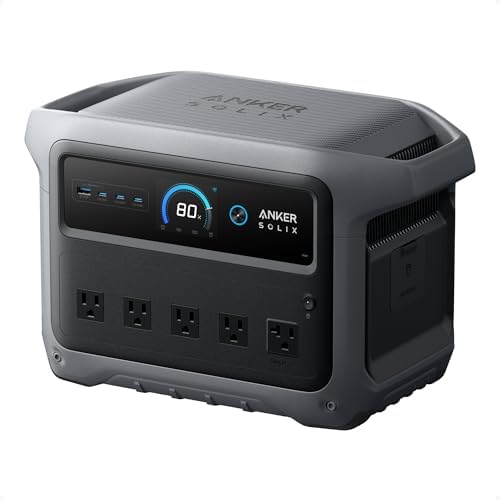
Our Best for Home Backup pick. The C1000 Gen 2 holds a Guinness World Record certification for the fastest wall-to-full charge ever measured on a 1kWh-class power station: 49 minutes at 1600W input, verified by independent reviewers at The Solar Lab and BackupPowerHub. Beyond charging speed, it delivers 2000W continuous output (3000W peak) through 10 total ports, including dual 140W USB-C, and a 10ms UPS switchover that keeps sensitive electronics running through the moment the grid cuts out - a feature built specifically for outage scenarios. Anker backs it with a 5-year warranty covering the battery, inverter and all components, longer than most competitors in this category. The 1024Wh capacity is more modest than the largest stations this category can reach, and its 600W-capped solar input limits off-grid recharge speed, but the combination of fast wall recharging, real UPS-style switchover and a long warranty is what earns it our Best for Home Backup pick among the stations currently in this lineup.
Battery capacity1024Wh LiFePO4
Continuous AC output2000W (3000W peak)
Recharge time (AC)Guinness World Record-certified 49 minutes wall-to-full
Cycle life4,000 cycles to 80% capacity
Output ports5 AC outlets, 3 USB-C (incl. dual 140W PD), 1 USB-A, 1 car socket
Weight24.9 lbs
Warranty5 years
Pros
Guinness World Record-certified 49-minute full charge is the fastest in this comparison
Five-year warranty is longer than most competitors in this category
10ms UPS switchover keeps sensitive electronics running through brief outages
10 total ports, including dual 140W USB-C, cover most charging needs at once
14% smaller and lighter than comparable-capacity competitors, per independent testing
Cons
1024Wh capacity is modest next to the EcoFlow Delta 3 Max and Jackery Explorer 2000 v2 in this lineup
Solar input is limited to 600W, capping off-grid recharge speed
Among the priciest options in this comparison on a per-watt-hour basis
Who is it for?
Buyers who want our Best for Home Backup pick: fast wall recharging, a real UPS-style switchover and a long warranty for keeping essentials running through an outage.
Who is it not for?
Anyone who needs more battery capacity for longer runtimes between charges - other stations in this lineup hold more energy.
StorageReview, OutdoorGearLab and longtime independent reviewer Ken Rockwell have all tested the AC180, and the consensus is that its TurboBoost AC charging, reaching 80% in about 45 minutes, and 5-year warranty punch above its price bracket. The 1152Wh LiFePO4 pack delivers 1800W continuous output, with a Power Lifting mode pushing surge capacity to 2700W for brief higher-draw loads, and four AC outlets accommodate more simultaneous plug-ins than most units in this comparison. LiFePO4 cells are rated for 3,500+ cycles to 80% capacity, roughly a decade of daily use. At about $449 it costs only slightly more than the 1070Wh Jackery Explorer 1000 v2 while offering more capacity, higher continuous output and faster AC charging. At 35.3 lbs it is a substantial unit to carry regularly, and it sits in the middle of this lineup's capacity range: enough for camping and short outages, short of true whole-home backup. Unlike the Jackery Solar Generator 1000 v2, it ships without a solar panel, so factor in a panel if you plan to recharge off-grid.
Battery capacity1152Wh LiFePO4
Continuous AC output1800W (2700W surge via Power Lifting mode)
Recharge time (AC)0-80% in about 45 minutes (TurboBoost)
Cycle life3,500+ cycles to 80% capacity (~10 years)
Output ports4 AC, 2 USB-C (100W), 2 USB-A, 1 car port
Weight35.3 lbs (16 kg)
Warranty5 years
Pros
TurboBoost AC charging reaches 80% in about 45 minutes
More capacity and higher continuous output than the 1070Wh Jackery stations for a similar price
Power Lifting mode pushes surge capacity to 2700W for brief higher-draw loads
Four AC outlets accommodate more simultaneous plug-in devices than most units here
Five-year warranty backed by independent testers, including longtime reviewer Ken Rockwell, who confirm real-world output matches spec
Cons
At 35.3 lbs it's a substantial unit to carry regularly
Sold without a solar panel, unlike the bundled Jackery Solar Generator 1000 v2
1152Wh capacity sits in the middle of this lineup, short of true whole-home backup
Who is it for?
Buyers who want 1000Wh-plus capacity with fast wall charging and a long warranty, without going to 2000Wh-class size and weight.
Who is it not for?
Anyone who wants the lightest possible unit, a bundled solar panel or multi-day whole-home backup capacity.
The stars you see are the Graded Picks cumulative score, not a single retailer's average. It blends verified buyer reviews aggregated across major retailers, assessments from professional reviewers and expert testers, and how prominently the product features in leading category lineups.
Advertising Disclosure
Our rankings are compiled by aggregating several independent signals, including verified buyer feedback, how popular a product currently is with shoppers, and evaluations published by professional reviewers. Editorial opinions are our own.
Please note that we participate in affiliate marketing programs. When you purchase through links on our site, we may earn a commission. As an Amazon Associate we earn from qualifying purchases. This comes at no additional cost to you and helps support the resources required to provide valuable content.