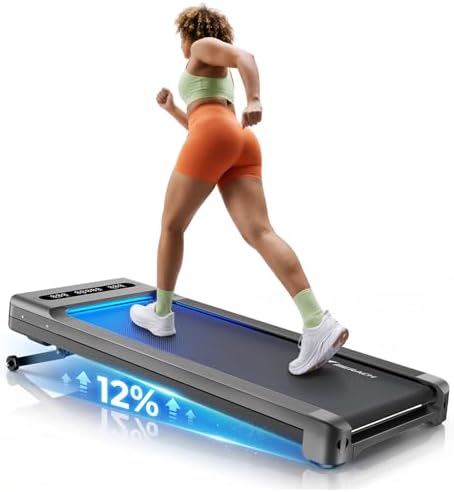
A flat treadmill gives you walking or running. Add incline and you get a machine that can push your heart rate hard while going easy on your knees, which is exactly why so many people want one. But incline is also where corners get cut: some machines make you stop and move a pin by hand, and a few advertise a steep grade the spec sheet does not actually back up. We analyzed thousands of verified buyer reviews, recent sales data, and expert evaluations to find six treadmills with incline that earn the feature instead of just printing it on the box.
Every product we compared, in ranked order. Tap through to Amazon to check today's price, or jump to the full review below.
1
MERACH UltraWalk W60
Best Overall26% OFF
MERACH UltraWalk W60 Walking Pad with 12% Auto Incline
5.0
400 lb capacity · 3.5HP peak motor · 12% auto incline
Our Best Overall pick: a 400 lb capacity, a 3.5HP peak brushless motor and a reinforced 67.7 lb steel frame sit under a genuine 12% auto incline and a wider-than-average 16.5 x 41.3 inch deck, measured by testers at roughly 53.6 dB in typical use.
0-18% auto incline · 3.5HP motor · 350 lb capacity
MERACH's full-size T31B1 pairs an 18% auto-incline range, just behind the 20% THERUN for the widest here, with a 3.5HP motor and a wide 47.2 x 18.1 inch belt built for jogging as well as walking. Three built-in climb-training modes and heart-rate tracking round out a very complete package.
A compact, well-reviewed walking pad with a 10% manual incline, app control and one of the lowest prices of any machine in this lineup, packed into a slim 5.12-inch-tall frame.
0-16% auto incline · 4.0HP motor · 400 lb capacity
Our Best for Heavy-Duty Use pick: a 4.0HP motor, the largest of any treadmill in this comparison, drives a genuine 0-16% auto incline with heart-rate tracking, and the frame is rated for 400 lbs - the most powerful all-round machine in this lineup.
0-20% auto incline · 12 mph top speed · 55" x 20" belt
A 3.5HP motor, 12 mph top speed and true 0-20% auto incline give the THERUN the widest auto-adjustable incline range and highest running speed in this lineup, built around a 55 x 20 inch belt that testers found stable even during longer runs.
Our Best Affordable pick: the most affordable treadmill in this comparison at the time of our scan, the CURSOR FITNESS SF20 pairs a genuine 16% manual incline with a 3.0HP motor and ties for the highest weight capacity of any walking pad in this lineup at 400 lbs.
Short on time? These three cover most buyers: our Best Overall pick with the highest weight rating, deepest standard warranty and genuine auto incline, the single lowest-priced treadmill here, and the most powerful motor in this lineup for heavy-duty daily use.
Best Overall
MERACH UltraWalk W60
MERACH UltraWalk W60 Walking Pad with 12% Auto Incline
Treadmills with Incline 101: What Incline Does & How to Choose
Understand the category before you buy - what the science actually says, and which specs matter.
Every incline treadmill promises a tougher workout in the same footprint, but the grade it reaches, the way you change it, and the motor doing the work vary a lot from model to model. Here is how incline actually works, the one thing that decides whether you will use it, and the specs worth comparing before you buy.
What does an incline treadmill actually do?
An incline treadmill tilts the running surface upward so you walk or run uphill in place. That small change does a lot of work:
It raises your heart rate and calorie burn at a much lower speed than flat running.
It shifts effort onto your glutes, hamstrings, and calves, so a walk starts to feel like a workout.
It lets shorter people and taller runners alike train hard without pounding the joints, since you can climb at a walk instead of sprinting.
Grade is measured as a percentage, where 0 percent is flat and a higher number is steeper. The lineup here spans from a 12 percent walking pad up to the 20 percent auto incline from the THERUN.
Why incline is the feature to shop for first
Here is the thing most shoppers miss: incline is the single feature that changes the workout, so it deserves your attention before speed or screen size. Walking at a steep grade burns close to what running burns, without the joint impact of running, which is the whole reason to buy one of these instead of a flat treadmill.
That makes two questions decide almost everything. First, how steep does it go? A 20 percent grade like the THERUN is genuinely demanding, while a 12 percent walking pad like the MERACH UltraWalk W60 is plenty for brisk incline walking but not a climbing workout. Second, and just as important, how do you change it? Auto or motorized incline adjusts at the push of a button, even mid-stride, so you will actually use it and can run intervals. Manual incline, like the 10 percent walking pad in this group, means stepping off to move a pin or leg by hand, and a grade you have to stop for is a grade you will mostly leave flat.
One more caution that ties directly to incline: trust the spec table over the listing title. Some listings advertise an aggressive incline percentage in the product name that the seller's own spec table does not actually back up, so always confirm the real grade in the spec table, not just the title, before you buy. A big number in a product title is a claim, not a measurement.
Which specs actually matter?
Max incline percent: This is the headline spec. Decide whether you want steep climbing (the 20 percent THERUN) or lighter incline walking (the 12 percent MERACH UltraWalk W60), and read the spec table, not the title.
Auto vs manual incline: Auto or motorized incline changes at the touch of a button and makes intervals possible. Manual incline is cheaper but far less likely to get used. The THERUN reaches 20 percent on auto incline alone; the Acezoe walking pad's 10 percent grade is manual only.
Motor power: More power means smoother, quieter, longer-lasting performance. Continuous-duty horsepower is the honest figure because it is what the motor sustains, not a brief peak. The THERUN TR04, for example, lists a 4.0 HP motor, the largest in this comparison, and the walking pads here run smaller motors around 2.5 to 3.5 HP.
Speed range: Match this to how you will use it. Walking pads like the MERACH UltraWalk W60 top out around 4 mph, while the running models reach 8.7 to 10 mph for real jogging and sprints.
Deck and running area: Longer, wider belts suit taller runners and a natural stride. Full-size running decks like the THERUN's 55 x 20 inch belt give real stride room, while compact walking pads trade belt length for a footprint that slides under a desk or bed.
Weight capacity and folding: Capacity in this group runs from 300 lbs up to the 400 lbs MERACH UltraWalk W60. Foldable frames like the THERUN and MERACH incline models save floor space in a home.
Display and app: Options range from a simple LED readout up to multi-metric LED consoles, with Bluetooth apps, heart-rate monitoring, and remotes on several models.
How we grade products
Graded Picks rankings are aggregated from several independent signals: verified buyer ratings and the size of the review base for credibility, recent monthly purchase volume for relevance, assessments from trusted fitness publications, and how each product places in leading category lineups. For treadmills with incline we weigh:
Maximum incline grade and how honest the rating is
Auto vs manual incline and ease of adjustment
Motor power, with continuous-duty rating favored over peak
Deck length, belt width, and cushioning for comfort
Speed range and weight capacity
Folding, footprint, and build quality
Display, app, and connected features
Safety note: Incline raises intensity quickly, so start at a low grade and speed and build up as you get comfortable, and use the safety clip or key if your model includes one. Give yourself clear space behind the belt, since a fall from an inclined, moving surface carries more momentum than a flat one. If you have heart, joint, or balance concerns, check with a healthcare provider before starting steep incline training.
In-Depth Reviews
Everything we learned from buyer reviews and expert testing, product by product.
MERACH UltraWalk W60
Best Overall26% OFF
1. MERACH UltraWalk W60 Walking Pad with 12% Auto Incline
5.0
Our Best Overall pick. The UltraWalk W60 earns the top spot in this comparison on the strength of a 400 lb weight rating, tying the highest among the full-size treadmills here, paired with a 3.5HP peak brushless motor rated for roughly 15,000 hours of use and a reinforced 67.7 lb steel frame. Twelve incline levels ramp up to a true 12% grade, and the deck is noticeably roomier than typical walking pads, which matters most during incline sessions when foot placement and stability become part of the workout. Testing measured average operating noise around 53.6 dB, about the level of normal household background noise, and the pad still rolls under a sofa, bed or desk for storage. Built-in Bluetooth speakers and RGB lighting sync to workouts, and the pad connects to Apple Health, Google Fit and Kinomap. At $329.99 with an 18% discount at the time of our scan, it combines real incline depth, a high weight rating and the only 2-year warranty in this comparison into the strongest all-around package here.
Genuine 12% auto-incline across 12 distinct levels, independently confirmed
Wider 16.5" x 41.3" deck than most walking pads in this comparison
Measured around 53.6 dB in testing - quiet enough for calls and video meetings
2-year warranty, double the standard 1-year coverage on every other model here
Bluetooth speakers, RGB lighting and app syncing (Apple Health, Google Fit, Kinomap)
Cons
4 mph top speed limits it to walking, not jogging or running workouts
Manual-incline walking pads elsewhere in this lineup cost less, but without auto incline or the 2-year warranty
Heavier 67.7 lb frame makes it less portable than the compact Acezoe walking pad in this lineup
Who is it for?
Most buyers: heavier users and daily walkers who want the strongest all-around combination of weight rating, real incline variety and warranty coverage in this comparison, at the lowest price of any auto-incline model here.
Who is it not for?
Runners who need higher top speeds - every model here caps out well under typical treadmill running speeds, but this one's ceiling is the lowest.
This MERACH T31B1 stands out for a genuinely wide 18% auto-incline range, a full-size running deck, and one of the most complete feature sets in this comparison. Independent testers at RunRank rated it 4.0 out of 5, calling it a genuinely impressive treadmill for the price and noting that its incline range exceeds what most commercial gym treadmills offer, typically 10-15%. The 3.5HP brushless motor drives speeds from 0.6 to 8.7 mph across the wide belt, and three preset climb modes - Steady Climb, Power Hike and Hill Sprint - automate hill-interval training without touching the console. A 7-layer belt over 12 silicone shock absorbers is aimed at reducing joint impact during the steeper grades, and a hydraulic hinge folds the deck in about 30 seconds for storage. It trails only the THERUN elsewhere in this lineup for outright incline depth and top speed, but its broader combination of incline range, running capability and preset programs makes it one of the strongest full-size options in this comparison. Reviewers note MERACH is a newer entrant to the treadmill category, so long-term durability data is thinner than for more established brands.
Incline range0-18% auto
Max speed8.7 mph
Motor power3.5HP
Weight capacity350 lbs (159 kg)
Deck / footprint (D x W x H)57.1" x 35" x 51.2"
Display & connectivityLED, heart-rate monitor, Bluetooth app
Warranty1 year
Pros
18% auto-incline range, just behind the 20% THERUN for the widest in this lineup
3.5HP motor and a wide belt support jogging, not just walking
Three preset climb modes (Steady Climb, Power Hike, Hill Sprint) automate hill intervals
7-layer belt and 12 silicone shock absorbers cushion steep-grade impact
Hydraulic folding hinge collapses the deck in about 30 seconds
Cons
MERACH is a newer treadmill brand, so long-term durability data is thinner than for established competitors
57.1 x 35 inch footprint needs a dedicated room, not an under-desk spot
8.7 mph top speed trails the THERUN's 12 mph for buyers who want to run at pace
Who is it for?
Buyers who want a full-size running deck with near-top-tier incline range and preset hill-interval programs built in.
Who is it not for?
Anyone who wants MERACH's under-desk footprint instead - the UltraWalk W60 above trades incline depth for a far smaller frame.
The Acezoe Walking Pad PRO combines consistently positive buyer feedback and solid expert coverage with a feature set and price point that punch well above its compact size. Built for under-desk and small-office use, it measures a slim 5.12 inches tall and folds down to 50 x 25 x 5.1 inches for storage under a bed or sofa - the smallest footprint of any product in this lineup. Reviewers note the 10% manual incline adds real training variety missing from most compact pads, and operating noise measured under 45 dB in testing, quiet enough for background video calls. The 40 x 16 inch running surface uses a 7-layer anti-slip belt over six silicone shock absorbers, and the unit supports speeds from 0.6 to 10 mph controlled via remote or companion app that tracks distance, speed and calories. At $221.99 at the time of our scan, it undercuts every full-size treadmill in this comparison, pairing that value with a quieter, more feature-rich package than the newest, more bare-bones budget walking pad in this lineup. The main trade-off against the auto-incline and full-size running machines elsewhere in this comparison is a manual incline lever and a motor sized for walking rather than running, but the breadth of buyer and expert approval behind it, combined with its compact footprint and low price, makes it one of the strongest value picks here.
Incline range10% (manual)
Max speed10 mph
Motor power2.5HP
Weight capacity300 lbs
Deck / footprint (D x W x H)53.94" x 28.27" x 5.12"
Display & connectivityLED, Bluetooth app, remote
Warranty1 year
Pros
Consistently positive buyer feedback and solid expert coverage
One of the most affordable treadmills in this comparison, in one of the most compact, lowest-profile frames here at 5.12 inches tall
10% manual incline adds real training variety in a small footprint
Measured under 45 dB in testing - quiet enough for calls in the next room
App and remote control with real-time distance, speed and calorie tracking
Cons
Manual (not auto) incline requires stopping to adjust the grade
10 mph top speed is more than the motor's compact size comfortably supports for running
Assembly is required out of the box, unlike some competitors
Who is it for?
Buyers who want a well-reviewed, compact and affordable walking pad with real incline variety.
Who is it not for?
Anyone who wants auto incline or true running speeds - the MERACH models and the THERUN TR04 elsewhere in this lineup handle that instead.
Our Best for Heavy-Duty Use pick. This THERUN TR04 pairs the largest motor of any treadmill in this comparison - a 4.0HP unit - with a genuine 0-16% auto-incline range, trailing only the 20% THERUN and the 18% MERACH T31B1 for grade depth here while still leading every other model on auto-adjustable incline. A 47.2-inch by 17-inch running belt matches the deck dimensions of THERUN's other models in this comparison, and it adds heart-rate tracking alongside distance, calories and time through a Bluetooth-connected app. The 400 lb weight capacity ties the MERACH UltraWalk W60 for the highest rating in this lineup, in a frame that folds down for storage. Independent testers have generally praised THERUN's other incline treadmills for quiet operation and easy assembly, but we found no dedicated review of this specific TR04 listing at the time of our scan, so its motor-power and incline claims remain unverified by outside testing for now. At $529.99 with no active discount, it costs more than most of this lineup, which reflects its larger motor and high weight rating.
Incline range0-16% auto
Max speed10 mph
Motor power4.0HP
Weight capacity400 lbs
Deck / footprint (D x W x H)47.2" deck length x 17" belt width; folds to 31.1" x 29.5" x 54.7"
Display & connectivityHeart rate monitor, Bluetooth app
Warranty1 year
Pros
Largest motor of any treadmill in this comparison at 4.0HP
Genuine 0-16% auto incline, wider than most auto-incline models in this lineup
400 lb weight capacity ties the highest rating in this comparison
Heart-rate tracking alongside distance, calories and time via Bluetooth app
Wide 47.2" x 17" running belt suited to jogging as well as walking
Cons
No independent review of this specific TR04 listing found at the time of our scan
Highest price of any THERUN model in this comparison at $529.99
No independently reported noise-level measurements available for this exact listing
Who is it for?
Buyers who want the most powerful motor and a 400 lb capacity in a full-size treadmill with real auto incline, and don't mind an unreviewed specific listing.
Who is it not for?
Anyone who wants confirmed independent test data or the absolute lowest price: the Acezoe walking pad elsewhere in this comparison costs less.
The THERUN offers the widest auto-incline range in this comparison paired with genuine running capability. Reviewers consistently point to its steel frame and shock absorption as standing out at its price, with testers reporting no knee discomfort after multi-mile sessions and praising its stability during incline work specifically - a common weak point on cheaper folding treadmills. The auto-incline system ranges from 0-20%, the widest range in this comparison, and pairs with a 12 mph top speed that supports actual running, not just walking, unlike the compact walking pads elsewhere in this lineup. An 18-inch LCD console with Bluetooth connectivity tracks workouts, and the frame folds vertically with transport wheels for storage in apartments or home offices. At $799.99 with no discount active at the time of our scan, it's priced as a full-size treadmill rather than a compact walking pad, which is reflected in its larger 69.3 x 32.1 inch footprint - the tradeoff for the combination of incline depth and true running speed that keeps it among the strongest choices in this comparison, though its 300 lb capacity and higher price keep it a step behind the THERUN TR04 for most buyers.
Incline range0-20% auto
Max speed12 mph
Motor power3.5HP
Weight capacity300 lbs
Deck / footprint (D x W x H)69.3" x 32.1" x 52.4"
Display & connectivity18" LCD, Bluetooth
Warranty1 year
Pros
Full 0-20% auto incline is the widest range in this lineup
12 mph top speed supports running, not just walking
Steel frame and shock absorption rated highly for stability during incline work
Folds vertically with transport wheels for easier storage
Cons
No discount active at the time of our scan, unlike most of this lineup
69.3 x 32.1 inch footprint is the largest here and needs a dedicated room
300 lb weight capacity is lower than the LONTEK and MERACH models
Who is it for?
Runners and serious incline trainers who want the single widest incline range and true running speeds in a full-size treadmill.
Who is it not for?
Small-space or under-desk users - the MERACH UltraWalk W60 or Acezoe walking pad elsewhere in this lineup offer a fraction of the footprint.
Our Best Affordable pick. At $149.98 after a steep discount, the CURSOR FITNESS SF20 is the most affordable treadmill in this comparison, but it doesn't skimp on the headline feature: a genuine 16% manual incline, driven by a 3.0HP brushless motor that also ties the MERACH UltraWalk W60 for the highest weight capacity of any walking pad in this lineup at 400 lbs. Three separate LED displays split out time, speed and distance rather than cycling them on a single screen, and the iron frame folds down to a compact 44.3 x 23.8 x 4.1 inch footprint for under-bed or under-desk storage. We didn't find independent testing of this exact 3-LED, 400 lb-capacity listing, though reviewers covering CURSOR FITNESS's other incline walking pads describe the brand's machines as straightforward and easy to set up, a reasonable proxy given the shared design language.
Incline range16% (manual)
Max speed7 mph
Motor power3.0HP
Weight capacity400 lbs
Deck / footprint (D x W x H)44.3" x 23.8" x 4.1"
Display & connectivity3 LED displays; no app or Bluetooth
Warranty1 year
Pros
Lowest price of any treadmill in this comparison at the time of our scan
Highest weight capacity of any walking pad in this comparison at 400 lbs
3.0HP brushless motor and genuine 16% manual incline
Three separate LED displays for time, speed and distance
Compact folded footprint for under-bed or under-desk storage
Cons
No independent testing found for this exact 3-LED, 400 lb-capacity listing
Manual incline requires stopping the belt to adjust grade
No app or Bluetooth connectivity, unlike the smart walking pads elsewhere in this comparison
Who is it for?
Budget-focused buyers or heavier users who want a full 16% incline walking pad with the highest weight capacity in this lineup.
Who is it not for?
Anyone who wants app connectivity or auto incline - the MERACH models elsewhere in this comparison offer those instead.
The stars you see are the Graded Picks cumulative score, not a single retailer's average. It blends verified buyer reviews aggregated across major retailers, assessments from professional reviewers and expert testers, and how prominently the product features in leading category lineups.
Advertising Disclosure
Our rankings are compiled by aggregating several independent signals, including verified buyer feedback, how popular a product currently is with shoppers, and evaluations published by professional reviewers. Editorial opinions are our own.
Please note that we participate in affiliate marketing programs. When you purchase through links on our site, we may earn a commission. As an Amazon Associate we earn from qualifying purchases. This comes at no additional cost to you and helps support the resources required to provide valuable content.