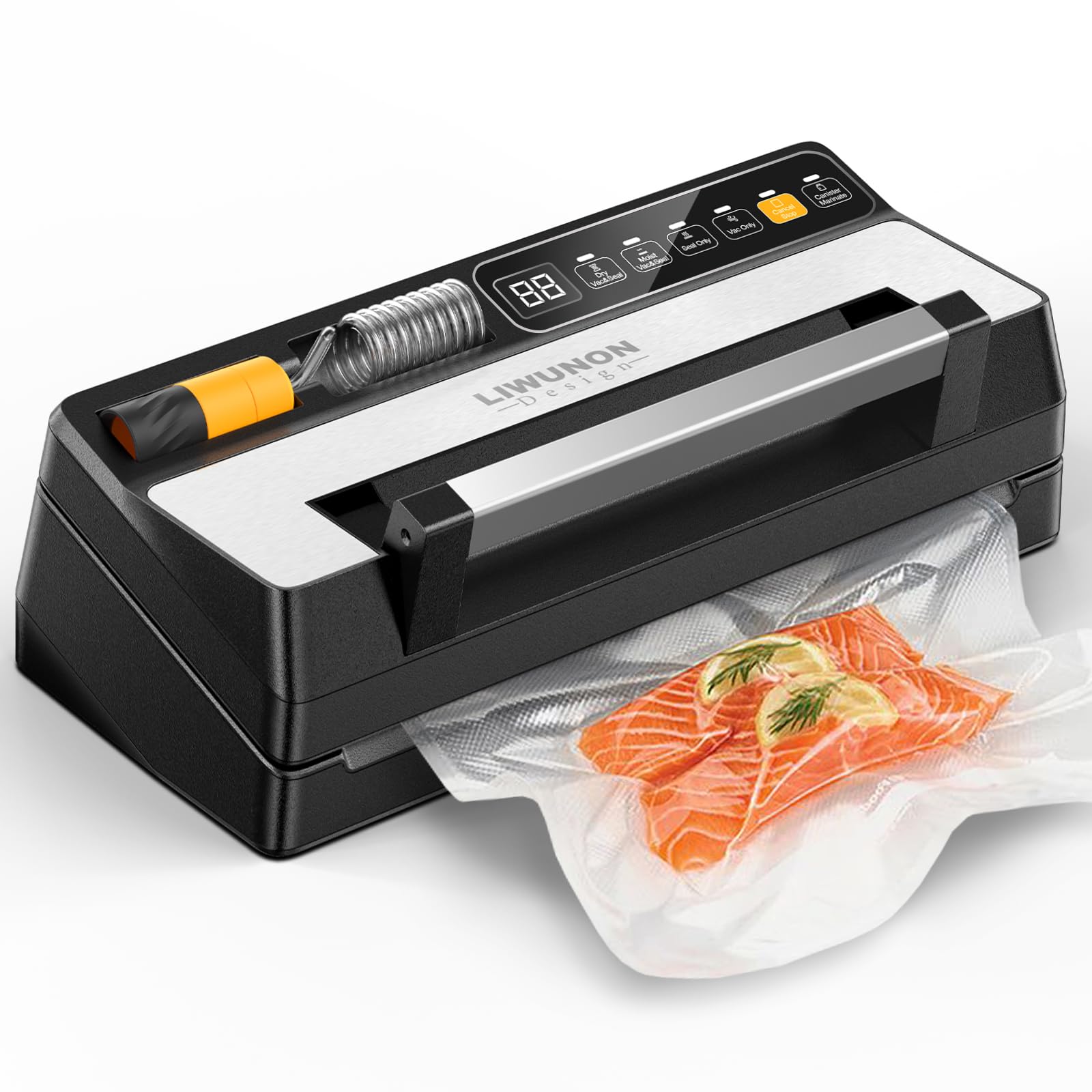
A vacuum sealer buys your food more time. Pull the air out, seal the bag, and meat, cheese, and leftovers last far longer in the freezer without freezer burn, while dry goods stay fresh in the pantry. But the cheap ones fight you the moment something is wet, letting juices creep into the seal so the bag pops open days later. We analyzed thousands of verified buyer reviews, recent sales data, and expert evaluations to find six vacuum sealers that pull a strong vacuum and hold a clean seal.
Our Best Overall pick: a dual-system sealer that switches between valve bags, textured bags, vacuum canisters and marinate containers from one machine, with a dual-heat seal for both dry and moist food and a 5-year limited support commitment - the most versatile sealer in this lineup.
Our Best for Meal Prep pick: a commercial-style dual-pump vacuum sealer with 95 kPa suction, double heat seal and six dedicated modes built for repeat, varied sealing sessions, sold under the LIWUNON name with a 5-year support commitment.
An 85 kPa vacuum sealer with up to 20 feet of built-in bag storage, automatic and manual modes for dry and moist foods, and the smallest countertop footprint in this lineup, backed by a 5-year warranty.
An 85 kPa, 8-in-1 preset vacuum sealer with dry, moist, soft and delicate food modes, a brushless motor and a 5-year warranty - built for varied, high-frequency meal-prep sealing at a discounted price.
A dual-pump 95 kPa vacuum sealer with double heat seal for both dry and moist foods, pulse mode for delicate items, and a built-in cutter and bag-roll storage, backed by a 5-year manufacturer warranty.
60 kPa handheld · Visible water tank · 30 reusable bags included
Our Best Value pick: a compact, battery-powered handheld sealer with a visible water tank, 60 kPa suction and 30 reusable bags included - the lowest price and easiest entry point in this lineup.
Short on time? These three cover most buyers: our Best Overall pick, a dual-system sealer that handles valve bags, textured bags, canisters and marinate containers from one machine, the Best Value pick, a compact handheld sealer built for quick, low-cost everyday use, and the Best for Meal Prep pick with 95 kPa suction and six dedicated modes for repeat batch cooking.
Understand the category before you buy - what the science actually says, and which specs matter.
Every sealer promises a tight vacuum and a lasting seal, but the way a machine handles liquids, delicate foods, and the bags it demands can vary a lot. Here is how they work, the one divide that decides which type you actually need, and the features worth comparing before you buy.
What does a vacuum sealer actually do?
A vacuum sealer removes the air around your food and then melts the open end of the bag shut, so nothing gets in and no air stays behind. Less oxygen means slower spoilage and no freezer burn, which is what lets sealed food keep for months longer than food in a zip bag. In plain terms, it does two jobs in one motion:
Sucks the air out of the bag through a pump.
Presses a heated wire across the opening to fuse it closed.
Most machines in this lineup add modes and extras on top of that, such as a dry setting, a moist setting, a pulse or manual button, a built-in cutter, and a roll storage compartment so you can make a bag in any length you need.
External suction sealers, and the two features that matter most
Every machine in this comparison is an external suction sealer: you feed the open end of a textured bag into the machine, it draws the air out, and a heated wire fuses the opening shut. You may also come across chamber sealers, the kind traditionally used in delis and butcher shops, which seal the whole bag inside a sealed compartment and can handle straight liquids, soups, and marinades without a drip tray. None of the six machines here use that design, so if you regularly seal liquid-heavy batches in bulk, look for a dedicated chamber model separately.
For an external sealer, two features carry real weight. The first is a moist mode. Juices from raw meat or a wet marinade can cool the seal wire and stop the bag from fusing, so a moist setting runs the heat longer to seal through the damp. The Gasbye 95kPa, both LIWUNON models, both Potane models, and the POWOT VS8002 all offer dry and moist sealing for exactly this reason. The second is a pulse or manual control, which lets you stop the vacuum the instant you want. That is how you seal bread, chips, or berries without the pump crushing them flat. The Gasbye's pulse mode and the Potane VS2690's soft and delicate presets both give you that kind of hands-on control.
One more thing to watch: many of these machines only work with textured or embossed bags, so the air has a channel to escape. That is an ongoing cost the sticker price hides, so factor in the rolls you will keep buying.
Which specs actually matter?
Once you know the type, a handful of features decide which one fits your kitchen:
Suction power (kPa): This is the pull strength. The lineup ranges from 85 kPa on the two Potane models up to 95 kPa on the Gasbye 95kPa and the LIWUNON VS8002S. Stronger suction pulls a tighter vacuum, which matters most for dense foods and long-term freezing.
Moist and dry modes: A dry mode seals fast for jerky, nuts, and cheese, while a moist mode seals slower and hotter to hold through juices. Most machines here offer both as dedicated settings you select before sealing.
Pulse or manual mode: This is your control over crushing. Look for a pulse button or a manual seal option if you plan to bag anything fragile, such as the pulse mode on the Gasbye 95kPa or the soft and delicate presets on the Potane VS2690.
Bag compatibility and included rolls: Check whether the machine needs textured bags, then see what it ships with. The Gasbye 95kPa includes 2 bag rolls and 5 quart bags, and the Potane VS5736 ships with two roll widths for larger batches.
Built-in cutter and bag storage: A cutter bar and an internal roll compartment let you make a custom-length bag on the spot. The Gasbye, both LIWUNON models, and both Potane models all build these in.
Footprint and weight: These range from the compact Potane VS5736 at 11 by 6.5 by 5 inches and 4.6 pounds up to the Gasbye 95kPa at 15.7 by 7.8 by 4.7 inches and 6.5 pounds.
Build and warranty: The LIWUNON Next-Gen and the Gasbye both use stainless-steel bodies, and every machine in this lineup carries a 5-year warranty.
How we grade products
Graded Picks rankings are aggregated from several independent signals: verified buyer ratings and the size of the review base for credibility, recent monthly purchase volume for relevance, assessments from trusted kitchen and home publications, and how each product places in leading category lineups. For vacuum sealers we weigh:
Suction strength and vacuum consistency
Seal reliability, especially on moist foods
Range of modes and control over delicate items
Bag compatibility and cost of ongoing supplies
Built-in cutter and roll storage convenience
Build quality, footprint, and warranty
Overall value for the price
Sealing and food-safety note: A vacuum seal slows spoilage, but it does not replace refrigeration or freezing, and it will not make unsafe food safe. Some bacteria grow in low-oxygen conditions, so keep sealed perishables cold and use them within safe windows. Let the seal wire cool for a few seconds between bags to avoid overheating, and always leave enough bag length above the food so juices stay clear of the seal.
In-Depth Reviews
Everything we learned from buyer reviews and expert testing, product by product.
LIWUNON VS8003S
Best Overall
1. LIWUNON VS8003S Next-Gen Vacuum Sealer
5.0
Our Best Overall pick. The LIWUNON VS8003S is the most versatile machine in this lineup: its dual-system pump switches between valve bags, textured bags, vacuum canisters and marinate containers without swapping parts, a combination one 2026 vacuum-sealer roundup singled out as the broadest bag-and-container compatibility it tested. A dual-heat seal handles dry and moist foods in the same cycle, and the stainless-steel body is built for the kind of repeat, varied sealing sessions regular meal prep demands. One-touch controls and a one-hand locking handle keep operation simple, and a built-in cutter with bag-roll storage means the whole cut-seal-store workflow stays on one countertop machine. LIWUNON backs it with the same 5-year limited support coverage as its VS8002S sibling elsewhere in this lineup, and while it is the newest model in the brand's range, its broad canister-and-marinate compatibility combined with its strong all-around suction and dual-heat sealing make it our Best Overall pick in this lineup, edging out the Gasbye 95kPa's dedicated pulse-mode control with broader bag-and-container versatility.
Included componentsAir suction hose, built-in cutter & bag storage, starter bags
Build materialStainless steel
Dimensions (L x W x H)15.25" x 7.06" x 4.4"
Item weight4.48 lbs
Warranty5 years (limited support)
Pros
Dual-system design handles valve bags, textured bags, canisters and marinate mode - the most versatile setup in this lineup
Dual-heat seal handles both dry and moist foods in the same machine
Built-in cutter and bag storage keep the whole workflow on one countertop unit
Stainless-steel body built for repeated, varied sealing sessions
5-year limited support coverage matches the brand's established sibling
Cons
Newest LIWUNON model here, so it has less of a public track record than established rivals
No dedicated pulse mode for hands-on control of delicate items, unlike some rivals in this lineup
Canister and marinate modes need separately sold containers to use
Who is it for?
Most buyers: our Best Overall pick for the broadest bag-and-container versatility in this lineup - valve bags, textured bags, canisters and marinate containers all from one machine with dual-heat sealing.
Who is it not for?
Buyers who specifically want a pulse mode for delicate foods (the Gasbye 95kPa elsewhere in this lineup offers that) or who want dedicated meal-prep presets (see our Best for Meal Prep LIWUNON VS8002S pick instead).
Our Best for Meal Prep pick. The LIWUNON VS8002S brings the same 95 kPa dual-pump suction tier as the Gasbye 95kPa elsewhere in this lineup, wrapped in an all-metal, black stainless-steel body built for the kind of repeated, commercial-style use that regular meal prep demands. Six dedicated functions - dry vac & seal, moist vac & seal, seal-only, vac-only, canister/marinate and cancel/stop - cover most batch-cooking scenarios without a learning curve, and the double heat-sealing wire is rated for high-cycle durability. A removable drip tray and one-touch operation keep day-to-day sealing simple across repeat sessions, and LIWUNON backs the machine with a 5-year limited support commitment. It ships with two bag rolls and an air suction hose so it is ready to use out of the box, and its six-mode menu makes it the pick for buyers who want dedicated presets for each food type rather than a single pulse dial.
Included components2 bag rolls, air suction hose, power cord, spare gasket
Dimensions (L x W x H)15.63" x 7.1" x 4.7"
Item weight5.2 lbs
Power source120V AC, 125W
Warranty5 years (limited support)
Pros
95 kPa dual-pump suction matches the category's top tier
Six dedicated modes cover dry, moist, canister and marinate sealing
All-metal body built for repeated, high-cycle use
5-year limited support commitment
Bag rolls and accessory hose included in the box
Cons
Newer to the market than most rivals here, so long-term durability data is still limited
125W draw runs on the higher end for this category
Canister/marinate mode requires separately-sold canisters to use
Who is it for?
Frequent meal-preppers who want commercial-tier 95 kPa suction and a dedicated preset for every food type, in an all-metal build.
Who is it not for?
Shoppers who prefer a brand with a longer public track record before committing to a 5-year support plan, or who want pulse mode for delicate foods (the Gasbye 95kPa elsewhere in this lineup offers that).
The Potane VS5736 pairs dependable 85 kPa suction with a feature that sets it apart from the rest of this lineup: a bag-storage compartment long enough to hold rolls up to 20 feet, so it's ready for however many bags a session calls for without stopping to reload. Automatic and manual modes plus dry and moist settings cover the essentials without a crowded preset dial, keeping day-to-day operation simple even as the machine handles a wide range of sealing jobs. It ships with two bag rolls in two widths (11-inch and 8-inch) so it is ready to seal different container and produce sizes out of the box, and a built-in cutter bar plus slide cutter let you size a bag on demand. At just 11 by 6.5 by 5 inches, it also holds the smallest footprint of any countertop machine in this comparison, trading raw dual-pump power for flexibility and convenience that suit a wide range of buyers. Potane backs it with the same 5-year manufacturer warranty carried by the pricier flagships in this lineup.
Suction power85 kPa
Sealing modesAutomatic, manual, dry, moist
Included components2 bag rolls (11" x16', 8" x16'), hose, cutter bar, spare gasket
Dimensions (L x W x H)11" x 6.5" x 5"
Item weight4.6 lbs
Power source110V AC, 120W
Warranty5 years (manufacturer)
Pros
85 kPa suction and automatic/manual dry-and-moist modes cover most sealing jobs without a crowded dial
20-foot bag storage compartment is the longest in this comparison, so it rarely needs reloading mid-session
Smallest countertop footprint in this lineup at 11 x 6.5 x 5 inches
Two bag-roll widths (11-inch and 8-inch) included, ready to use out of the box
5-year manufacturer warranty matches the pricier dual-pump machines here
Cons
85 kPa suction trails the 95 kPa dual-pump machines elsewhere in this lineup on the densest or most liquid-heavy loads
No dedicated soft or delicate presets, so fragile items rely on manual mode
110V-only rating rather than the 120V spec on some rivals in this lineup
Who is it for?
Buyers who want dependable all-around suction, the longest bag storage in this comparison, and the smallest footprint on the countertop.
Who is it not for?
Anyone sealing dense or liquid-heavy loads who wants the highest suction tier available (the Gasbye 95kPa above or LIWUNON VS8002S offer that), or who wants Potane's full 8-in-1 preset menu (get the VS2690 instead).
The Potane VS2690 is a versatile, feature-rich meal-prep sealer built on the breadth of its preset system: eight easy presets spanning automatic, manual, dry, moist, soft and delicate modes handle everything from raw meat to crackers without manual tuning. An 8mm sealing element paired with a brushless motor gives testers a tighter, more consistent seal than typical entry-level machines, and 85 kPa suction sits comfortably above the category's 60-75 kPa baseline. At a discounted price well below the dual-pump flagships in this comparison, it undercuts nearly every other option here while still matching their 5-year warranty coverage. A built-in cutter, bag-roll storage and two starter bag sizes streamline repeat sealing sessions. Reviewers note that very moist foods can still challenge the seal without using moist mode, foam gaskets and the drip tray together, and delicate produce like fresh mushrooms or garlic should never be vacuum sealed raw due to anaerobic bacteria risk.
Included components2 bag rolls, hose, canister adapter, spare gasket, cutter
Dimensions (L x W x H)15.94" x 9.09" x 5.16"
Item weight3 lbs
Power source120V AC, 120W
Warranty5 years (manufacturer)
Pros
Discounted price undercuts nearly every dual-pump flagship in this comparison
8-in-1 presets cover dry, moist, soft and delicate foods without manual tuning
Brushless motor and 8mm sealing element deliver a tighter, more consistent seal
85 kPa suction comfortably clears the category's entry-level baseline
5-year manufacturer warranty matches the pricier flagships
Cons
Moist or liquid-heavy foods can still leak air without using moist mode and the drip tray together
Foam gaskets wear over time and need occasional replacement to keep a full seal
8-in-1 preset dial has a learning curve compared with simpler one-button machines
Who is it for?
Frequent meal-preppers who seal a wide mix of dry, moist and delicate foods and want dedicated presets for each at a discounted price.
Who is it not for?
Occasional users who only seal one or two food types and don't need eight separate presets, or anyone who wants the absolute highest suction tier (get the Gasbye or LIWUNON VS8002S instead).
The Gasbye 95kPa combines near-commercial suction with the moist-food controls that matter most across a wide range of sealing jobs, from delicate berries to dense, marinated cuts of meat. Its dual-pump system generates 95 kPa of vacuum, among the strongest in this comparison and well above the 60 to 75 kPa entry-level norm, which independent testers credit for tighter, longer-lasting seals on dense and moist foods alike. A dedicated moist-food setting and removable drip tray keep juices from soaking the seal strip, while pulse mode gives hands-on control for delicate items like berries or baked goods, a feature the similarly-suctioned LIWUNON VS8002S elsewhere in this lineup does not offer. The progress display takes the guesswork out of cycle timing, and the easy-lock handle plus built-in bag storage and cutter mean the whole workflow of measure, cut and seal happens on one countertop footprint. Gasbye backs the machine with a 5-year quality warranty, roughly triple the category's 1 to 2 year norm, and that combination of near-commercial suction, dedicated moist-food handling and hands-on pulse control makes it one of the strongest all-around picks in this lineup, just behind our Best Overall LIWUNON VS8003S for outright bag-and-container versatility.
Suction power95 kPa (dual pump)
Sealing modesAutomatic, dry/moist, pulse mode
Included componentsAir suction hose, 2 spare gaskets, 2 bag rolls, 5 quart bags
Dimensions (L x W x H)15.7" x 7.8" x 4.7"
Item weight6.5 lbs
Power source120V AC, 130W
Warranty5 years (manufacturer)
Pros
95 kPa dual-pump suction handles dense and moist foods with a genuinely tight seal
Dedicated moist mode plus removable drip tray keeps liquids out of the sealing strip
Pulse mode gives manual control for delicate or easily-crushed items
Built-in cutter and bag-roll storage keep the whole workflow on one machine
5-year manufacturer warranty, well beyond typical category coverage
Cons
At this suction level, the unit runs louder than lighter-duty single-pump sealers
Replacement gaskets need periodic swapping to maintain the full 95 kPa seal
130W draw is among the highest in this lineup, so extended back-to-back sealing sessions use more power
Who is it for?
Buyers who want near-commercial 95 kPa suction, dedicated moist-food handling and pulse-mode control in one machine, backed by an unusually long warranty.
Who is it not for?
Anyone who only occasionally seals dry snacks and would be fine with a simpler, lower-suction machine, or who wants the canister-and-marinate versatility of our Best Overall LIWUNON VS8003S pick or the dedicated meal-prep presets of our Best for Meal Prep LIWUNON VS8002S pick instead of pulse control.
Our Best Value pick. The FEPPO trades the countertop form factor for a rechargeable handheld unit that fits in a drawer, making it a compact, budget-friendly option. Its 1200mAh battery delivers roughly 80 minutes of continuous use at 60 kPa suction, and a detachable, visible water tank stops the machine automatically before liquid reaches the motor, then pops off for a quick rinse. One-touch operation seals dry-food bags in about five seconds, and the 30 included reusable bags in two sizes mean it's ready for sandwiches, snacks and small produce right away. It is the most portable and least expensive way into vacuum sealing here, and that combination of low price, included bags and drawer-friendly size earns it our Best Value pick in this lineup, though the tradeoff is lower raw suction and a smaller sealing footprint than the countertop machines.
Suction power60 kPa (handheld pump)
Sealing modesOne-touch dry-food seal, auto pressure release at -40 kPa
Warranty1 year (extendable to 2 with registration)
Pros
Compact, battery-powered design fits in a drawer or travel bag
Visible, detachable water tank prevents liquid from reaching the motor and rinses clean
One-touch sealing finishes a dry-food bag in about five seconds
30 reusable bags in two sizes included in the box
Cons
60 kPa suction and battery-only power trail the countertop machines on volume and dense foods
Multiple passes are typically needed to fully seal moist or liquid-heavy items
1-year base warranty is the shortest in this lineup (extendable by registering)
Who is it for?
Budget-focused buyers, small kitchens, dorms or RVs who want our Best Value pick: a grab-and-go sealer for everyday snacks and leftovers at the lowest price in this comparison.
Who is it not for?
Anyone regularly sealing large cuts of meat, bulk produce or moist foods who needs full countertop suction.
The stars you see are the Graded Picks cumulative score, not a single retailer's average. It blends verified buyer reviews aggregated across major retailers, assessments from professional reviewers and expert testers, and how prominently the product features in leading category lineups.
Advertising Disclosure
Our rankings are compiled by aggregating several independent signals, including verified buyer feedback, how popular a product currently is with shoppers, and evaluations published by professional reviewers. Editorial opinions are our own.
Please note that we participate in affiliate marketing programs. When you purchase through links on our site, we may earn a commission. As an Amazon Associate we earn from qualifying purchases. This comes at no additional cost to you and helps support the resources required to provide valuable content.