Pairing vitamin D3 with K2 has quietly become one of the most popular moves in the supplement aisle, and for a good reason that most labels never bother to explain. The trouble is that the two nutrients are not interchangeable, and some products lean hard on one while quietly shorting the other. We analyzed thousands of verified buyer reviews, recent sales data, and expert evaluations to find eight vitamin D3 K2 supplements that get the pairing right and absorb the way they should.
Every product we compared, in ranked order. Tap through to Amazon to check today's price, or jump to the full review below.
1
Sports Research D3+K2 10K
Best Overall
Sports Research Vegan Vitamin D3 10,000 IU + K2 (60 Softgels)
5.0
10,000 IU D3 · 100 mcg K2 (MK-7) · 60 vegan softgels
Our Best Overall pick: a high-potency, fully plant-based D3+K2 softgel pairing 10,000 IU of lichen-sourced vitamin D3 with 100 mcg of chickpea-derived MK-7 K2 in an organic coconut-MCT-oil base, backed by Sports Research's Vegan Certified formula and strong buyer sentiment throughout this comparison.
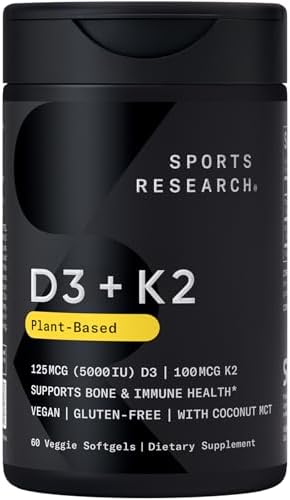
Sports Research Vegan Vitamin D3 5,000 IU + K2 w/Coconut Oil (60 Softgels)
4.9
5,000 IU D3 · 100 mcg K2 (MK-7) · 60 vegan softgels
The same fully plant-based D3+K2 formula as Sports Research's larger bottle, in a compact 60-count size: 5,000 IU of lichen-sourced vitamin D3 paired with 100 mcg of chickpea-derived MK-7 K2 in an organic coconut oil base. It carries the brand's Vegan Certified and Non-GMO Verified marks and the same strong buyer and professional sentiment as its siblings in this comparison.
Micro Ingredients Vitamin D3 10,000 IU + K2 (300 Softgels)
4.8
10,000 IU D3 · 200 mcg K2 (MK-7) · 300 softgels
A high-potency option for buyers who need to correct a diagnosed vitamin D deficiency: 10,000 IU of D3 with 200 mcg of MK-7 K2 in a near-year's supply of coconut-oil softgels.
Nutricost delivers the same 5,000 IU D3 / 100 mcg MK-7 K2 combination as premium brands in a bare-bones, budget-friendly softgel. It is the clear value pick for buyers who don't need extras.
Micro Ingredients Vitamin D3 5,000 IU + K2 (300 Softgels)
4.7
5,000 IU D3 · 100 mcg K2 (MK-7) · 300 softgels
Micro Ingredients' standard-strength D3+K2 softgel: the everyday-maintenance 5,000 IU / 100 mcg dose in a near-year's supply, at one of the lowest per-dose costs in the lineup.
A small-batch D3+K2 capsule that adds magnesium, B6, zinc and quercetin to the standard 5,000 IU / 120 mcg MK-7 combination, made in an NSF-GMP certified California facility.
A combination formula that adds calcium citrate to the standard D3+K2 pairing, aimed at buyers who want bone-health nutrients covered in a single capsule.
Vegan Vitality Multivitamin with D3, K2 & B12 (180 Tablets)
4.6
800 IU D3 · 75 mcg K2 (MK-7) · 180-tablet multivitamin
Our Best for Vegans pick: a full vegan multivitamin that folds D3 and K2 into a complete daily formula alongside B12 and roughly 20 other nutrients, for buyers who'd rather cover bone-health nutrients as part of one tablet.
Short on time? These three cover most buyers: our top-graded choice, the best budget pick, and the vegan-friendly multivitamin that folds D3 and K2 into one daily tablet.
Best Overall
Sports Research 10,000 IU D3+K2
Sports Research Vegan Vitamin D3 10,000 IU + K2 (60 Softgels)
Understand the category before you buy - what the science actually says, and which specs matter.
Every bottle promises stronger bones and better immune support, but the dose of each vitamin, the exact form of the K2, and whether the capsule is built to absorb can vary a lot from one product to the next. Here is how the two vitamins work together, why the MK-7 form of K2 matters so much, and the specs actually worth comparing.
What does a vitamin D3 K2 supplement actually do?
A D3 K2 supplement combines two fat-soluble vitamins that support how your body handles calcium. In plain terms:
Vitamin D3 helps your body absorb calcium from the food you eat.
Vitamin K2 helps steer that calcium toward your bones and teeth.
Both are fat-soluble, so they absorb best when taken with a meal or dissolved in an oil.
That is why so many of the products here, including the Sports Research and Micro Ingredients softgels, suspend the vitamins in coconut or MCT oil rather than a dry powder.
Why D3 and K2 belong in the same capsule
This is the insight most shoppers miss, and it is the whole reason the pairing exists. Vitamin D3 raises how much calcium your body absorbs. On its own, that extra calcium has to go somewhere, and you want it in your skeleton, not your arteries. That is K2's job. Vitamin K2, specifically the MK-7 form, activates the proteins that direct calcium into your bones and teeth and away from soft tissue like your blood vessels. So the two work as a team: D3 brings the calcium in, K2 tells it where to go.
That has a practical consequence when you shop. A high D3 dose with little or no K2 is only doing half the job. You can see the spread in this lineup. Most products pair 5,000 IU (125 mcg) of D3 with 100 mcg of K2 as MK-7, like the Sports Research and Nutricost D3 K2 softgels. Higher-dose options such as the Micro Ingredients 10,000 IU softgel step the K2 up to 200 mcg to match. And a D3-only formula with no K2 at all is a fine choice if you already get K2 elsewhere, but not what you want if you are counting on one bottle to do both.
Which specs actually matter?
Once you understand the teamwork, a few details decide which bottle fits you:
Vitamin D3 dose: Products here run from 5,000 IU (125 mcg) up to 10,000 IU (250 mcg). The 5,000 IU strength suits most everyday maintenance; the 10,000 IU options like Micro Ingredients and the Sports Research 60-count are higher-dose picks better suited to short-term or provider-guided use.
K2 form and amount: Confirm the K2 is MK-7, the longer-lasting form your body uses most efficiently. Amounts here range from 100 mcg to 120 mcg (Sandhu's) up to 200 mcg. If a label lists no K2 form at all, like the calcium-based 4-in-1 formula, you are guessing at what you get.
Oil or softgel base: Because both vitamins are fat-soluble, an oil-suspended softgel absorbs more reliably than a dry capsule. Look for coconut, MCT, or virgin coconut oil, as in the Sports Research and Micro Ingredients softgels.
Vegan or gelatin: Most softgels use gelatin, so if that matters, the Sports Research PlantGel softgels use plant-based D3 from lichen and K2 from chickpeas, and are Vegan Certified.
Added ingredients: Some formulas bundle more in. Sandhu's adds magnesium, B6, zinc, and quercetin, and the 4-in-1 formula pairs D3 K2 with 600 mg of calcium citrate. Handy if you want them, redundant if you already supplement them.
Serving size and supply: Most are one softgel a day, though the 4-in-1 calcium formula takes two capsules. Counts run from 60 up to 300 softgels, so a 300-count like Micro Ingredients is close to a 10-month supply.
Third-party testing: Look for independent testing and a certified facility. Micro Ingredients and Sandhu's list third-party testing, and Sandhu's is made in an NSF-GMP certified facility.
How we grade products
Graded Picks rankings are aggregated from several independent signals: verified buyer ratings and the size of the review base for credibility, recent monthly purchase volume for relevance, assessments from trusted health and nutrition publications, and how each product places in leading category lineups. For vitamin D3 K2 supplements we weigh:
D3 dose and whether it matches the K2 amount
K2 form (MK-7) and quality
Oil-based absorption and capsule type
Vegan and dietary certifications
Third-party testing and facility standards
Added ingredients and overall value
Serving convenience and supply length
Safety note: Vitamin D3 and K2 are both fat-soluble, which means your body stores what it does not use, so more is not automatically better and mega-dosing can cause harm over time. Vitamin K2 can also interact with blood-thinning medications such as warfarin, because K2 affects the same clotting pathway those drugs are managing. Talk to a healthcare provider before starting, especially if you take a blood thinner, are pregnant, or are considering a 10,000 IU dose, and treat these supplements as support rather than a substitute for medical care.
In-Depth Reviews
Everything we learned from buyer reviews and expert testing, product by product.
Sports Research D3+K2 10K
Best Overall
1. Sports Research Vegan Vitamin D3 10,000 IU + K2 (60 Softgels)
5.0
Our Best Overall pick. Sports Research's 10,000 IU vegan D3+K2 softgel is a fully plant-based formula with consistently strong buyer and professional sentiment in this comparison: vitamin D3 sourced from lichen instead of the lanolin most competitors use, paired with vitamin K2 as MK-7 derived from fermented chickpeas, both carried in an organic coconut MCT oil base that reviewers credit with meaningfully better absorption than dry-fill tablets. The softgels are small and easy to swallow, and the formula carries Non-GMO Verified and Vegan Certified marks alongside manufacturing at a GMP-audited US facility. At 10,000 IU of D3 per softgel, it's dosed for correcting a diagnosed deficiency rather than gentle maintenance, and the compact 60-count bottle is built for a defined corrective period rather than year-round use; buyers who want the same vegan formula for everyday maintenance should look to the Sports Research 5,000 IU PlantGel elsewhere in this comparison instead.
Vitamin D3 dose10,000 IU (250 mcg), plant-based (lichen)
Vitamin K2 dose & form100 mcg as MK-7 (from chickpeas)
Capsule/tablet count60 softgels
Serving size1 softgel daily
Capsule typeVegan PlantGel softgel with organic coconut MCT oil
Our Best Overall pick: fully plant-based formula - D3 from lichen and K2 as MK-7 from chickpeas, with no gelatin
Organic coconut MCT oil base measurably improves absorption of both fat-soluble vitamins
Vegan Certified and Non-GMO Verified, manufactured in a GMP-audited US facility
Consistently strong buyer and professional sentiment in this comparison
Compact 60-count bottle is easy to travel with
Cons
10,000 IU is a corrective dose best used under medical guidance, not everyday maintenance
Costs more per softgel than the brand's 5,000 IU version
60-count bottle needs restocking twice as often as the larger sibling
Who is it for?
Vegans, vegetarians and anyone who wants a high-potency, clean plant-based D3+K2 combination with no gelatin or animal-derived vitamin D.
Who is it not for?
Anyone wanting everyday maintenance dosing rather than a short-term corrective dose - the Sports Research 5,000 IU PlantGel elsewhere in this comparison is the better fit.
2. Sports Research Vegan Vitamin D3 5,000 IU + K2 w/Coconut Oil (60 Softgels)
4.9
This is Sports Research's standard-potency D3+K2 PlantGel in a smaller 60-count bottle: 5,000 IU of vitamin D3 sourced from lichen rather than the lanolin most competitors use, paired with 100 mcg of vitamin K2 as MK-7 derived from fermented chickpeas, both carried in an organic coconut oil base that reviewers at outlets including TheBodyBlueprint and Meo Nutrition credit with meaningfully better absorption than dry-fill tablets, since both vitamins are fat-soluble. The softgels are small, described by reviewers as easy to swallow with no lingering aftertaste, and the formula carries Non-GMO Verified and Vegan Certified marks alongside manufacturing at a GMP-audited US facility. Reviewers who track lab bloodwork report their vitamin D levels returning to a normal range with consistent daily use. At 5,000 IU, the dose suits everyday maintenance better than the brand's 10,000 IU bottle elsewhere in this comparison, which is built for correcting a diagnosed deficiency rather than year-round use. The 60-count size covers about two months at one softgel daily, a shorter runway than the brand's 120-count bottle but a lower upfront cost for buyers who want to try the formula first.
Vitamin D3 dose5,000 IU (125 mcg), plant-based (lichen)
Vitamin K2 dose & form100 mcg as MK-7 (from chickpeas)
Capsule/tablet count60 softgels
Serving size1 softgel daily
Capsule typeVegan PlantGel softgel with organic coconut oil
Fully plant-based formula: D3 from lichen and K2 as MK-7 from chickpeas, with no gelatin
Organic coconut oil base credited by reviewers with meaningfully better absorption than dry-fill tablets
Non-GMO Verified and Vegan Certified, made in a GMP-audited US facility
5,000 IU dose suits everyday maintenance better than the brand's higher-potency 10,000 IU bottle
Lower upfront cost than the brand's 120-count bottle for buyers trying the formula first
Cons
60-count bottle lasts about two months, half as long as the brand's 120-count size
No independent NSF or USP third-party certification, only in-house testing
Costs more per softgel than Nutricost's budget-priced equivalent dose elsewhere in this comparison
Who is it for?
Vegans, vegetarians and anyone who wants a clean, plant-sourced D3+K2 combination without gelatin or animal-derived vitamin D, in a smaller bottle to start with.
Who is it not for?
Buyers who want the lowest cost per softgel (see the Best Affordable pick) or who need the brand's higher-potency 10,000 IU version for a diagnosed deficiency.
Micro Ingredients' high-potency softgel pairs 10,000 IU of vitamin D3 with 200 mcg of MK-7 vitamin K2 in a virgin coconut oil base, aimed squarely at buyers whose bloodwork shows a real deficiency rather than people looking for everyday maintenance. Reviewers who track their vitamin D levels report meaningful lab-confirmed increases after consistent use, and the 300-count bottle stretches close to a year at one softgel daily, keeping the cost per dose low. The formula is Non-GMO, gluten-free and soy-free and third-party tested for purity. Because 10,000 IU sits above the standard 4,000 IU daily upper limit for unsupervised use, it is best taken with a doctor's guidance rather than as a default long-term dose, and a handful of buyers have reported bottles arriving with fewer than the labeled 300 softgels.
4. Nutricost Vitamin D3 5,000 IU + K2 (120 Softgels)
4.7
Nutricost's D3+K2 softgel strips the category down to the essentials: 5,000 IU of vitamin D3 and 100 mcg of MK-7 vitamin K2 in a small gelatin softgel, made in a GMP-compliant, FDA-registered facility. Independent buying-guide coverage has repeatedly singled it out as the budget pick in the category because it matches the dose profile of far pricier vegan formulas without the plant-based sourcing or MCT-oil carrier. Reviewers note the softgels are easy to swallow with no lingering taste, and the 120-count bottle keeps the per-dose cost low. The tradeoff for that price is a gelatin capsule (not vegan) and no independent third-party testing certification beyond Nutricost's own quality claims.
This is Micro Ingredients' standard-potency companion to its 10,000 IU bottle: 5,000 IU of vitamin D3 with 100 mcg of MK-7 vitamin K2 in the same virgin coconut oil softgel base. It's built for everyday maintenance rather than correcting a diagnosed deficiency, and the 300-count bottle keeps the cost per dose among the lowest in this comparison. The formula is Non-GMO, gluten-free and soy-free and carries the brand's own third-party purity testing, though it lacks an outside certification seal like NSF or USP. As with the brand's higher-potency version, a portion of buyer feedback flags bottles arriving with somewhat fewer than the labeled 300 softgels.
Vitamin D3 dose5,000 IU (125 mcg)
Vitamin K2 dose & form100 mcg as MK-7
Capsule/tablet count300 softgels
Serving size1 softgel daily
Capsule typeSoftgel with virgin coconut oil
Key certificationsNon-GMO, Gluten-Free, Soy-Free
Supply length300-day (10-month) supply
Pros
Standard clinically-referenced 5,000 IU D3 / 100 mcg MK-7 K2 dose, suited to everyday maintenance rather than deficiency correction
300-count bottle is close to a year's supply at one softgel a day
Virgin coconut oil base for improved absorption
Non-GMO, gluten-free and soy-free
Cons
Gelatin softgel, not vegan
No independent third-party certification beyond the brand's own testing claims
Some buyers have reported bottle counts short of the advertised 300 softgels
Who is it for?
Buyers who want a standard 5,000 IU maintenance dose at a low per-softgel cost and don't need the brand's higher-potency version.
Who is it not for?
Vegans (gelatin softgel) and anyone who has a diagnosed deficiency and needs the brand's higher-potency 10,000 IU bottle instead.
Sandhu's builds its D3+K2 capsule around the same clinically-referenced 5,000 IU vitamin D3 and 120 mcg MK-7 vitamin K2 pairing found in the category's larger brands, then layers in 25 mg of magnesium, vitamin B6, zinc and quercetin to round out a broader energy-and-immune formula in one capsule. It's manufactured in an NSF-GMP certified California facility with third-party testing for purity and potency on every batch, and the 120-count bottle covers a full four-month supply at one capsule daily. As a newer, single-listing brand it doesn't carry the roundup and buying-guide coverage the established names in this comparison have, but early buyer feedback is positive, with several reviewers noting steadier energy and less joint stiffness within the first week.
Vitamin D3 dose5,000 IU (125 mcg)
Vitamin K2 dose & form120 mcg as MK-7
Capsule/tablet count120 capsules
Serving size1 capsule daily
Capsule typeUncoated capsule with magnesium, B6, zinc & quercetin
This capsule folds calcium citrate into the standard D3+K2 combination, delivering 600 mg of calcium alongside 5,000 IU of vitamin D3 and vitamin K2 across a two-capsule daily serving. Calcium citrate is the more bioavailable of the two common calcium forms because it doesn't depend on stomach acid for absorption the way calcium carbonate does, and the D3 in the formula supports the calcium uptake that K2 then helps direct into bone rather than soft tissue. The capsule is gluten-free and vegan-friendly, and the 120-count bottle covers two months at the labeled two-capsule serving. The label doesn't specify which form of K2 is used (unlike the MK-7-specified formulas from Sports Research, Nutricost and Micro Ingredients above), and the brand has a smaller footprint with less independent testing documentation than the established supplement makers in this comparison.
Vitamin D3 dose5,000 IU (125 mcg) per 2-capsule serving
Vitamin K2 dose & formIncluded alongside calcium (form not disclosed on label)
Capsule/tablet count120 capsules (60 servings)
Serving size2 capsules daily
Capsule typeVegetarian capsule with calcium citrate base
Key certificationsGluten-Free, Vegan-Friendly
Supply length60-day supply
Pros
Combines calcium citrate with D3 and K2 in one capsule, covering three bone-health nutrients at once
Calcium citrate form doesn't require stomach acid for absorption, unlike calcium carbonate
Gluten-free and vegan-friendly capsule
120-count bottle is a two-month supply at the labeled 2-capsule serving
Cons
The vitamin K2 form and source aren't disclosed on the label, unlike the MK-7-specified formulas elsewhere in this lineup
Comes from a smaller, less-established supplement brand with limited independent testing information
Two-capsule serving means the bottle runs out twice as fast as a one-a-day formula
Who is it for?
Buyers who specifically want calcium bundled in with their D3 and K2 rather than buying a separate calcium supplement.
Who is it not for?
Anyone who wants a specified, verifiable K2 form (MK-7) or already gets enough dietary calcium and just needs the D3+K2 pairing.
Vegan Vitality's tablet earns our Best for Vegans pick as a full multivitamin rather than a focused D3+K2 combination: alongside 800 IU of lichen-derived vitamin D3 and 75 mcg of MK-7 vitamin K2, it packs in methylcobalamin B12, iron, zinc, magnesium and roughly 18 other vitamins and minerals in a single vegan tablet. That makes it the pick for vegan buyers who want broad nutritional coverage in one product rather than stacking several separate supplements, but the D3 and K2 doses are meaningfully lower than every dedicated combination formula in this comparison, since they share space with the rest of the multivitamin. The formula is free of gluten, sugar, wheat, nuts, soy and eggs, and the 180-tablet bottle covers six months at one tablet a day. Buyers specifically shopping for a high-dose, vegan D3+K2 pairing should look to our Best Overall pick above; this is the pick for vegans who want D3 and K2 folded into their daily multivitamin instead.
Vitamin D3 dose800 IU (20 mcg), plant-based (lichen)
Vitamin K2 dose & form75 mcg as MK-7
Capsule/tablet count180 tablets
Serving size1 tablet daily
Capsule typeVegan tablet (full multivitamin, not a standalone D3/K2 formula)
The stars you see are the Graded Picks cumulative score, not a single retailer's average. It blends verified buyer reviews aggregated across major retailers, assessments from professional reviewers and expert testers, and how prominently the product features in leading category lineups.
Advertising Disclosure
Our rankings are compiled by aggregating several independent signals, including verified buyer feedback, how popular a product currently is with shoppers, and evaluations published by professional reviewers. Editorial opinions are our own.
Please note that we participate in affiliate marketing programs. When you purchase through links on our site, we may earn a commission. As an Amazon Associate we earn from qualifying purchases. This comes at no additional cost to you and helps support the resources required to provide valuable content.