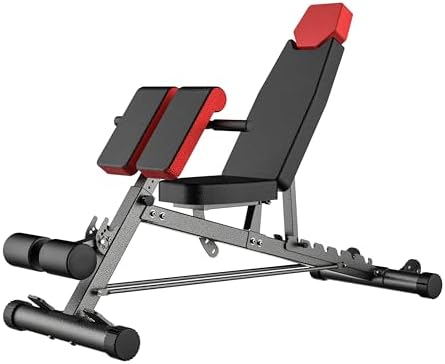
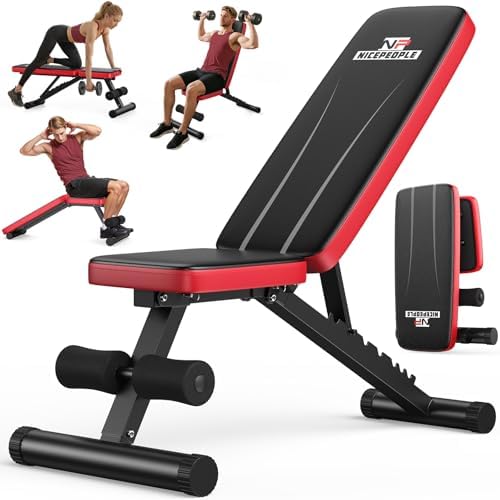
A good weight bench is the quiet backbone of a home gym. It turns a pair of dumbbells and a barbell into a full pressing, rowing, and core station, and a sturdy one lasts for years. But the cheap ones lean on a big headline number to hide a wobbly frame and a thin, narrow pad you will feel through your shoulder blades. We analyzed thousands of verified buyer reviews, recent sales data, and expert evaluations to find eight weight benches that stay solid under load and give you room to actually work.
The most widely covered budget adjustable bench in independent fitness testing: an ASTM-certified 800-pound frame, a 90-degree-to-negative-30 FID range and a 30-inch extended backrest.
YOLEO Adjustable Weight Bench with Bench Press Stand (Fits Users up to 7 ft)
4.8
Integrated press stand · Fits users up to 7 ft · Foldable frame
YOLEO's tallest-rated bench in this lineup: a foldable adjustable frame with an integrated bench press stand and an extended head/elbow pad built for lifters up to 7 feet tall.
Finer Form Multi-Functional FID Weight Bench (1,000 lb Capacity)
4.8
1,000 lb capacity · 8 backrest angles · 6-in-1 station
A 6-in-1 station combining flat, incline and decline bench press with a hyper back extension, Roman chair and adjustable ab sit-up bench in one heavy-gauge steel frame.
YOLEO's folding adjustable bench: an ASTM-certified 827-pound frame with 84 adjustment positions and a wider XL seat, built to collapse flat for home-gym storage.
Short on time? These three cover most buyers - our top-graded choice, the best value for money, and the proven pick for full-body training in one bench.
Understand the category before you buy - what the science actually says, and which specs matter.
Every bench advertises a big capacity number and a list of angles, but those two figures are easy to misread and they decide almost everything about how the bench feels in use. Here is how a bench works, why the capacity rating is not what most people think, and the specs actually worth comparing.
What does a weight bench actually do?
A weight bench gives you a stable, padded platform to press, row, and brace from, so you can load your muscles through positions the floor cannot offer. Most benches in this lineup adjust, which lets one piece of equipment cover a range of exercises:
Flat for bench press, rows, and hip thrusts
Incline for upper-chest and shoulder work
Decline for lower-chest presses and weighted core work
A folding frame on many models so it tucks away in a closet or corner
A bench that only lies flat, like the Finer Form flat bench, is rock-solid and simple. An adjustable FID bench, meaning flat, incline, and decline, trades a little simplicity for far more range.
The capacity number is not the number you think it is
This is the part worth understanding before you trust any spec sheet. When a bench is rated for 800 pounds, that figure almost always means the total load the frame is certified to hold: the bench itself, plus your body weight, plus the weights you are lifting, all combined. Your real working load is the headline minus your own weight, so a 660-pound bench like the FLYBIRD WB2 or the NICEPEOPLE is not 660 pounds of dumbbells, it is 660 minus you. All-in-one rack sets add another wrinkle: YOLEO's starter set advertises a 1,980-pound total, but that figure is actually three separate limits added together - 880 pounds on the bench, 660 on the rack and 440 on the leg-extension station - not one number you can load onto a single station at once.
Read it carefully, because the ratings in this lineup swing widely, and the honest ones tell you how they earned the number. The FLYBIRD WB5 and YOLEO's all-in-one set both cite ASTM certification, the FLYBIRD WB3 lists 8,000-plus load cycles of testing at its 750-pound rating, and that kind of detail matters more than a bare number printed large on the box.
Once you have a capacity that clears your body weight plus your heaviest planned lift with margin to spare, the more useful spec is the range of angles. A bench that offers flat, several incline steps, and a decline covers more exercises with one purchase. Just as important, closely spaced settings beat a big count with gaps: the FLYBIRD WB3 lays out its 8 angles from 90 degrees down through 70, 52, 38, and 24 to flat and on to -9 and -30, so you can find the exact position your shoulders want. A bench with a huge advertised number of positions but wide jumps between them can still leave you stuck between two angles that neither feel right.
Which specs actually matter?
Once you understand capacity and angles, a few features decide which bench fits you:
True working capacity: Subtract your body weight from the rated capacity, then make sure what is left clears your heaviest planned lift with room to spare. Favor ratings backed by ASTM certification or cited load-cycle testing.
Angle range and spacing: An FID bench that spans roughly 90 degrees to -30 covers flat, incline, and decline. Look for closely spaced steps, like the FLYBIRD WB3's 8 angles, rather than a big number with wide gaps.
Pad thickness and width: A thicker, wider pad keeps your spine supported and stops the frame from digging in. The Finer Form flat bench uses a 3-inch cushion, well above the thin, single-layer pads on many budget benches.
Frame stability: A steady frame matters more than any folding trick. Heavier, well-braced builds like the 50-pound YOLEO all-in-one rack set or the 46-pound Finer Form multi-functional bench feel planted under a heavy press.
Backrest length: A longer backrest supports taller lifters. The FLYBIRD WB5 uses a 30-inch extended pad and the WB3 a 33 to 35-inch backrest that fits users up to 6 feet 5 inches.
Attachments: A multi-function bench like the Finer Form FID adds a hyper back extension, Roman chair, and ab sit-up station, turning one frame into several stations.
Footprint and folding: If space is tight, a foldable bench like the NICEPEOPLE or FLYBIRD models tucks away, but treat folding as a convenience, not a reason to accept a less stable frame.
How we grade products
Graded Picks rankings are aggregated from several independent signals: verified buyer ratings and the size of the review base for credibility, recent monthly purchase volume for relevance, assessments from trusted fitness and home-gym publications, and how each product places in leading category lineups. For weight benches we weigh:
True working capacity and certification
Range and spacing of adjustment angles
Pad thickness, width, and comfort
Frame stability under load
Build quality and materials
Versatility and attachments
Footprint, folding, and value for the price
Safety and setup note: A bench is only as safe as its assembly, so tighten every bolt to spec before your first session and recheck them periodically, since bolts loosen with repeated loading. Always lift within your true working capacity rather than the headline number, use a spotter or safety rack for heavy pressing, and confirm the bench sits level and locked at your chosen angle before you load it.
In-Depth Reviews
Everything we learned from buyer reviews and expert testing, product by product.
Multiple independent garage-gym testing sites single out the FLYBIRD WB5 as the standout budget adjustable bench, citing its unusually deep review history and features that outperform its price point. The frame carries an ASTM certification and an 800-pound rated capacity, with a full flat-incline-decline range from 90 degrees down to negative 30 degrees and a 30-inch extended backrest that comfortably supports taller lifters. Testers note the double-stitched pad edges hold up better than the single-stitched seams common on cheaper benches, and the bench folds flat for storage. The honest caveat from experienced reviewers: pad thickness and long-term durability trail benches costing two to three times as much, so lifters regularly pressing 275+ lbs should budget for a heavier-duty bench eventually - for the large majority of home-gym users, though, testers call it the clear value leader.
Weight capacity800 lbs (ASTM-certified frame)
Adjustment range90° to -30° (flat, incline, decline)
Frame materialAlloy steel
PadBreathable leather, 30-inch extended backrest
Bench weight28.5 lbs
Folded footprint46" D x 13" W x 48.5" H
Included featuresASTM-certified frame, tool-free folding
Pros
Most extensively covered budget adjustable bench in independent testing
ASTM-certified 800-pound frame rating
Full 90 degree to negative 30 degree flat/incline/decline range
30-inch extended backrest suits taller lifters
Double-stitched pad edges outlast single-stitched budget pads
Cons
Pad thickness and long-term durability trail heavier-duty benches costing far more
Best suited to loads under roughly 275 lbs on flat-bench pressing
Folding mechanism adds moving parts versus a fixed flat bench
Who is it for?
The large majority of home-gym lifters who want the most independently proven adjustable bench at a budget price.
Who is it not for?
Lifters regularly pressing 275+ lbs as a working weight, who should budget for a heavier-duty commercial-grade bench.
The WB2 is FLYBIRD's straightforward utility bench: multi-position incline adjustment for full-body dumbbell work without the flat-to-decline range of the brand's FID models. Independent reviewers place it in the same family of well-regarded, budget-friendly FLYBIRD benches, citing solid steel construction and reinforced triangle bracing for stability during pressing and rowing movements. At roughly the same price as the WB5, the trade-off for buyers is functionality: the WB2 skips the decline position and the extended 30-inch backrest of its sibling, making it a better fit for buyers who know they only need incline and flat work.
Weight capacity660 lbs
Adjustment rangeMulti-position incline (no decline)
Frame materialAlloy steel
PadSweat-proof leather
Bench weight23.3 lbs
Folded footprint42.3" D x 15" W x 17.4" H
Included featuresFoldable, full-body multi-purpose incline bench
Pros
Solid steel construction with reinforced triangle bracing
Multi-position incline adjustment covers most dumbbell exercises
Lighter and more compact than the brand's full FID model
Sweat-proof leather pad
Foldable for storage
Cons
No decline position, unlike the brand's WB5 and WB3 models
Backrest is shorter than the WB5's extended 30-inch pad
Less independent model-specific testing than the brand's flagship FID benches
Who is it for?
Buyers who only need flat-to-incline dumbbell training and want to save a little versus a full FID bench.
Who is it not for?
Anyone who wants decline bench press or the extended backrest of the WB5 and WB3 models.
3. YOLEO Adjustable Weight Bench with Bench Press Stand (Fits Users up to 7 ft)
4.8
This YOLEO model pairs the brand's familiar adjustable bench with a built-in bench press stand, so a solo lifter can rack and unrack a loaded bar without a spotter. Independent coverage of YOLEO's press-stand line describes a double-triangle frame with dual support bars that held flat-bench testing with no flex at 185 lbs, and the vertical, near-90-degree stand folds out of the way for incline and decline sets. What sets this specific listing apart is reach: an extended head and elbow pad is rated to fit lifters up to 7 feet tall, beyond the 6-foot-5 ceiling reviewers cite for the brand's other extended-pad benches in this comparison. The frame ships mostly pre-assembled and folds down in well under a minute for storage between sessions. As a newer, lower-volume listing, it carries a thinner independent review trail specific to this exact configuration than YOLEO's longer-running benches elsewhere in this lineup.
Weight capacity1,150 kg (about 2,535 lbs rated frame)
Adjustment rangeFlat, incline and decline with an integrated bench press stand
Included featuresIntegrated bench press stand, foldable frame, mostly pre-assembled
Pros
Integrated bench press stand lets solo lifters rack and unrack without a spotter
Extended head/elbow pad fits lifters up to 7 feet, the tallest rating in this lineup
Double-triangle, dual-support frame reviewers describe as flex-free under load
Ships mostly pre-assembled with a quick fold-down for storage
Full flat, incline and decline adjustment range
Cons
Newer, lower-volume listing with less independent model-specific testing than YOLEO's other benches here
Press stand sits near vertical and must be moved aside for incline and decline work
Heavier and pricier than the standalone folding benches in this comparison
Who is it for?
Taller lifters, up to 7 feet, who want an integrated bench press stand for solo pressing without a spotter.
Who is it not for?
Buyers who want the widest independent review track record or mainly need incline/decline work without repositioning a rack - the other YOLEO and FLYBIRD benches above fit better.
4. Finer Form Multi-Functional FID Weight Bench (1,000 lb Capacity)
4.8
Where most benches in this lineup do one job, the Finer Form Multi-Functional FID does six: flat, incline and decline bench press, a hyper back extension, a Roman chair and an adjustable ab sit-up station, all stress-tested to a 1,000-pound frame rating. Independent reviewers consistently call out the complete lack of wobble even under hard use, crediting the heavy-gauge steel frame, and note that consolidating six pieces of equipment into one bench saves real money and floor space versus buying separate machines. With 8 backrest angles, 3 seat tilts and adjustable support-pad heights, it accommodates a wide range of exercises and body sizes. The trade-offs: unlike the foldable benches in this lineup it doesn't collapse for under-bed storage, and very tall users over roughly 6'2" may find the back-extension range a bit limited.
Weight capacity1,000 lbs
Adjustment range8 backrest angles, 3 seat tilts
Frame materialAlloy steel
PadHigh-density foam
Bench weight46.3 lbs
Folded footprint62" D x 20" W x 30.25" H
Included featuresHyper back extension, Roman chair, ab sit-up station
Pros
Combines flat, incline and decline bench press with hyper extension, Roman chair and ab sit-up in one frame
1,000-pound frame rating with no wobble reported under hard use
8 backrest angles, 3 seat tilts and adjustable pad heights
Saves money and floor space versus buying separate machines
Straightforward assembly reported by independent testers
Cons
Does not fold for under-bed or closet storage like the dedicated flat benches here
Very tall users (roughly 6'2" and up) may find the back-extension range limited
Heavier and larger footprint than a single-purpose bench
Who is it for?
Home-gym builders who want one piece of equipment to cover bench press, core work and back extensions without buying separate machines.
Who is it not for?
Space-constrained buyers who need a bench that folds flat for storage between uses.
NICEPEOPLE undercuts every adjustable bench in this comparison on price while still delivering 8 backrest positions across flat, incline and decline settings. Independent reviewers describe the alloy-steel, reinforced-triangle frame as surprisingly robust for the price, tested through thousands of durability cycles, and its 17-pound weight makes it one of the easiest benches to fold and tuck away in an apartment. The groove-based angle-adjustment system lets you switch positions in seconds without tools. Reviewers are consistent that this is a beginner- and dumbbell-focused bench: some report noticeable flex or wobble under heavy barbell loads, so it's a poor match for serious powerlifting but a strong value pick for lighter, foundational strength training.
6. Finer Form Foldable Flat Weight Bench (1,000 lb Capacity)
4.6
For lifters who only need a flat bench, Finer Form's foldable model pairs a heavy-gauge, 4-way steel frame with a notably thick 3-inch cushion pad - more padding than most flat benches in this price range. Independent reviewers consistently praise the complete absence of wobble even under hard use and the tool-free pop-pin folding system: pull a pin, swing the leg down, and it locks into its folded position without any disassembly, collapsing to about 6 inches thick for storage. At around 27.7 lbs it remains light enough to move single-handedly. The obvious limitation versus the adjustable benches in this lineup is fixed: there's no incline or decline position, so it suits buyers who specifically want a dedicated flat bench rather than an all-in-one.
Weight capacity1,000 lbs
Adjustment rangeFlat only (fixed, no incline/decline)
Frame materialAlloy steel
Pad3-inch thick cushion
Bench weight27.7 lbs
Folded footprint45" D x 12" W x 18" H
Included featuresTool-free pop-pin folding, free workout chart
Pros
Heavy-gauge 4-way steel frame with no reported wobble
Thick 3-inch cushion pad, above average for a flat bench
Tool-free pop-pin folding collapses to about 6 inches thick
Light enough (27.7 lbs) to move and store single-handedly
Comes with a free workout chart
Cons
Flat position only - no incline or decline adjustment
Costs more than some adjustable benches in this comparison despite fewer positions
Not a fit for buyers who want multi-angle versatility
Who is it for?
Lifters who specifically want a dedicated, well-padded flat bench rather than a multi-position adjustable one.
Who is it not for?
Buyers who want incline or decline positions - the FLYBIRD or YOLEO adjustable benches in this lineup cover that.
This YOLEO bench collapses flat for storage while still carrying an ASTM-certified 827-pound rating that comfortably covers most home lifters' needs. A dual-triangle steel frame and a ladder-style backpad adjustment - reviewers note it changes angles faster than the pull-pin systems on many budget benches - combine for 84 total position combinations across 7 back angles, 4 seat positions and 3 leg settings. It arrives 98% pre-assembled, needing only two pins to lock into place, and independent testers consistently praise how quickly it folds down, typically in a couple of seconds, plus a wider XL seat pad that adds comfort during longer sessions. Reviewers rate it strong on stability and quietness even under heavy dumbbell pressing and loaded hip thrusts, putting it in the same well-regarded tier as YOLEO's other benches in this comparison.
Weight capacity827 lbs (ASTM certified)
Adjustment range84 positions: 7 back angles, 4 seat positions, 3 leg settings
Frame materialAlloy steel, dual-triangle bracing
PadWider XL seat pad
Bench weight19.9 lbs
Folded footprint43.3" D x 17.1" W x 47.6" H
Included features98% pre-assembled, ladder-style backpad adjustment
Pros
ASTM-certified 827-pound frame rating
84 total position combinations across 7 back angles, 4 seat positions and 3 leg settings
Ladder-style backpad adjustment changes angles faster than pull-pin systems
Folds down in a couple of seconds for home-gym storage
98% pre-assembled, needing only two pins to set up
Cons
Folding hinge adds a little flex versus a rigid, non-folding frame
Wider XL seat adds a bit more footprint than slimmer folding benches in this comparison
827-pound rating trails the heaviest-duty benches for buyers who want maximum headroom
Who is it for?
Home-gym lifters who want YOLEO's build quality and fine-grained adjustability in a bench that folds away between sessions.
Who is it not for?
Lifters who want the highest possible rated capacity or built-in transport wheels for a heavier-duty frame.
This is NICEPEOPLE's longer, more heavily reinforced sibling to the brand's original 8-backrest bench, adding a dual-support frame structure and two extra backrest positions - 10 total - along with an extended pad rated to fit users up to 6.5 feet tall. It keeps the same 660-pound capacity, alloy-steel reinforced-triangle construction and one-step folding as the original, in a package that's compact enough for apartment storage. As a newer addition to the lineup, it doesn't yet have the same breadth of independent, model-specific review coverage as the brand's original bench or the FLYBIRD line, so buyers are relying more on the brand's established reputation and the spec sheet than dedicated long-term testing of this exact version.
The stars you see are the Graded Picks cumulative score, not a single retailer's average. It blends verified buyer reviews aggregated across major retailers, assessments from professional reviewers and expert testers, and how prominently the product features in leading category lineups.
Advertising Disclosure
Our rankings are compiled by aggregating several independent signals, including verified buyer feedback, how popular a product currently is with shoppers, and evaluations published by professional reviewers. Editorial opinions are our own.
Please note that we participate in affiliate marketing programs. When you purchase through links on our site, we may earn a commission. As an Amazon Associate we earn from qualifying purchases. This comes at no additional cost to you and helps support the resources required to provide valuable content.